The centralized nature of the available data centers is no longer sufficient as businesses go more digital and data-driven. Data is being produced now everywhere at factory floors, in shops, at hospitals, at telecom locations, and at remote locations. In order to facilitate this transformation, organizations are resorting to micro data centers as a smarter, more flexible model of infrastructure.
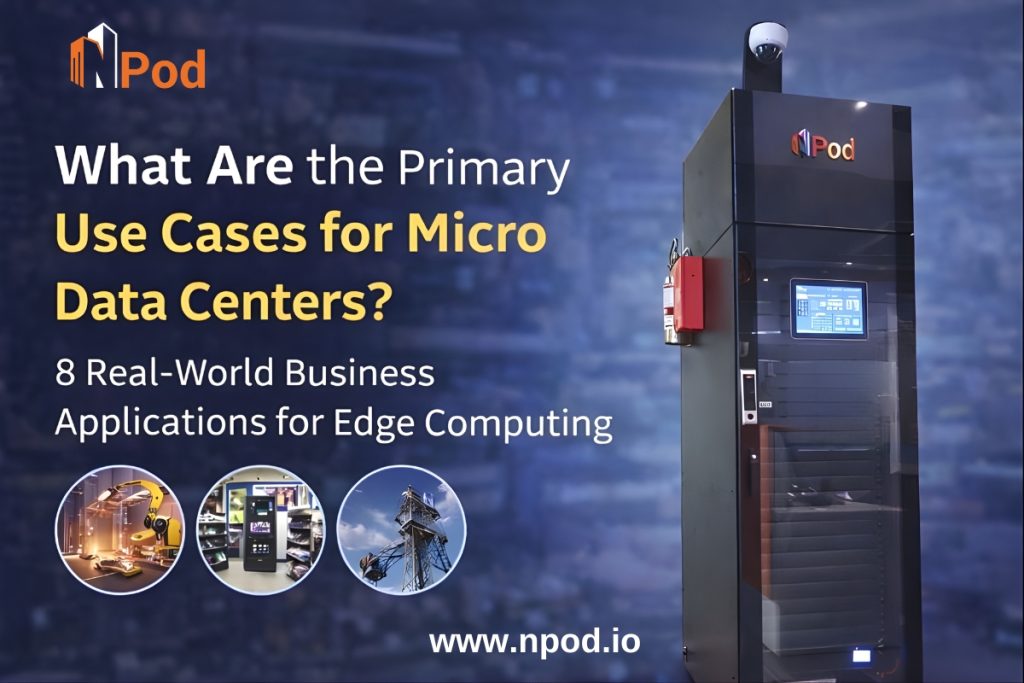
A micro data center is a small, self-contained piece of information technology equipment that incorporates computer, storage, networking, cooling, power backup, and security capabilities in a single container. Npod and other solutions such as Npod take away enterprise-level infrastructure to the point of data creation, enabling businesses to run faster, safer, and more efficiently.
The following are the most viable and impactful real-life applications of micro data centers, which are described in straightforward language.
1. Manufacturing Plants and Smart Factories
The challenge:
The manufacturing conditions are based on machine-driven environments with sensors and automation systems producing unceasing data. Any delay or failure of the network system may lead to stoppage of production and result in expensive downtime.
How a micro data center helps:
Micro data center such as Npod allow data computing on-site without relying on remote data centers, making sure that operations are low latency.
Real-world example:
An example of utilizing Npod in a manufacturing facility is the installation of an Npod close to the production line to calculate the PLC data, control the health of the machines, and launch a predictive maintenance program. This will result in quicker decision-making time, a reduction in failures, and an easy flow of production.
2. Retail Chains and Distributed Branches
The challenge:
Retailers have several stores that are dependent on POS systems, inventory software, and CCTV surveillance. The failure of the network or a system can also have a direct effect on sales and experience.
How a micro data center helps:
Npod gives a unified and safe IT environment to all stores, and operations cannot be interrupted even when certain connectivity problems are observed.
Real-world example:
Npod is installed in every outlet in a retail brand to handle billing, inventory, and video surveillance. Stores are running continuously with local processing even when the network is unavailable.
3. Smart Cities and Urban Infrastructure
The challenge:
Smart cities rely on real-time information of traffic systems, surveillance cameras, and social infrastructure. This transmits all the data to a central data center which introduces bandwidth and latency issues.
How a micro data center helps:
Through localized processing, Npond allows making decisions in real-time, near the point of data generation.
Real-world example:
Traffic departments use Npod to monitor traffic at major crossroads to process live videos, control traffic, and enhance road safety, but not based on centralized systems.
4. Banking, Financial Services & Insurance (BFSI)
The challenge:
Banks and other financial institutions demand high availability, high security, and regulatory compliance, particularly at the branch outlets.
How a micro data center helps:
Npod provides a self-contained, secure environment that has in-built power, cooling, and monitoring so that business continuity is guaranteed.
Real-world example:
An example implementation of Npod in a regional bank is in the branch offices to operate core banking applications, transact locally, and ensure that it stays online even when the network goes down.
5. Healthcare and Diagnostic Centers
The challenge:
Hospitals and diagnostic labs rely on the availability of patient information at all times, imaging, and connected medical devices. Downtime may have a direct effect on patient care.
How a micro data center helps:
Npod guarantees high availability of local data processing and storage, making the clinical processes run without a hitch.
Real-world example:
Npod is used in a diagnostic center to handle MRI and CT scan data and make reporting faster, allowing unlimited access to patient records.
6. Telecom and 5G Edge Deployments
The challenge:
The 5G networks need low latency and high processing capacity at the end user.
How a micro data center helps:
Npod is an edge computing device, which delivers compute and storage to the network edge.
Real-world example:
Npod is used by telecom operators at the edges to service 5G traffic and 5G IoT devices and to offload backhaul traffic on the core networks.
7. Remote and Harsh Environments
The challenge:
Several industries, such as mining, oil and gas, and renewable energy, tend to be in remote or hostile areas where the conventional IT solutions cannot be practical.
How a micro data center helps:
The rugged design of the Npod and the systems has seen to it that one is able to operate in a challenging environment with confidence.
Real-world example:
The Npod is used in a solar power plant to monitor real-time energy production, equipment operation, and the health of the system even at remote sites.
How to Choose the Right Micro Data Center
When selecting a micro data center, consider the following essentials:
- Power & UPS: Inbuilt backup and redundancy power.
- Cooling: The high-density workload requires precision cooling.
- Security: Non-IT security, firewall, and alarms.
- Monitoring: Visibility of the health of the systems centrally.
- Scalability: Simple growth with an increase in business requirements.
Why Npod Fits These Use Cases
Npod is designed for organizations that require scalable, reliable, and easy-to-deploy edge infrastructure capable of supporting modern workloads, including AI applications and GPU-driven computing environments.
Each Npod solution includes:
-
Integrated UPS and intelligent power management.
-
Precision cooling for consistent and efficient operation, ideal for high-density GPU workloads.
-
Built-in fire detection and suppression systems.
-
Centralized monitoring, alerts, and remote management capabilities.
-
Secure, compact modular enclosures designed for edge deployment.
Instead of building complex traditional server rooms, businesses can deploy Npod as a ready-to-use micro data center that integrates seamlessly with hybrid cloud and GPU cloud platforms, enabling day-one operations with faster deployment and simplified infrastructure management.
Conclusion
With the shift to distributed IT and edge computing, the micro data center has become a very important base. Through products such as Npod, organizations can not only modernize the infrastructure but also increase availability and bring computing into areas that need it most, without complexity or massive investment.
I would also be happy to assist you in making this into a landing page, sales brochure, or SEO-optimized web copy of npod. Would you like me to do that, too?
Frequently Asked Questions (FAQs)
- What is a micro data center?
A micro data center refers to a small self-enclosed IT facility with built-in computing, storage, a cooling system, power, and a security system. It is set to execute important applications at points of greater proximity to the generation of data. - Why are micro data centers becoming popular?
They decrease the latency, enhance reliability, and enable edge computing through local processing of data rather than centralized data centers alone. - Where are micro data centers commonly used?
Micro data centers are popular in factories, stores, hospitals, telephone networks, smart cities and remote areas. - Do micro data centers require on-site IT staff?
No. A majority of the modern micro data center systems, such as Npod are remotely monitored and managed, thereby eliminating the necessity of having technical personnel on-site. - How are micro data centers different from traditional data centers?
Conventional data centers are big and centralized, whereas micro data centers are small, modular and implemented near to the users or equipment to ensure that the data center performs quickly - Are micro data centers secure?
Yes. They consist of physical security, controlled access, monitoring, and fire protection—they are applicable to sensitive and regulated areas. - Can micro data centers support edge computing and IoT?
Absolutely. They are designed to operate well in edge computing, IoT, and real-time analytics, in which low latency and local processing need to be performed. - How fast can a micro data center be deployed?
The majority of micro data centers have been pre-configured and can be implemented in days rather than months and save setup time. - Are micro data centers scalable?
Yes. New units can be incorporated with ease into the organization when workloads increase without necessarily redesigning the entire infrastructure. - Why choose Npod for a micro data center?
Npod is a stand-alone, high-performance, and conveniently installed micro data center platform that includes in-house power, cooling, monitoring, and security application features, which are ideal in contemporary and distributed IT environments.