The digital infrastructure is no longer confined to big buildings located in the suburbs of cities. In India, data is being generated everywhere in factories, hospitals, retail shops, bank branches, telecom towers, and even distant industrial locations. It is costly, cumbersome, and sometimes risky to send all this data to distant facilities. It is at this point that a micro data center comes in handy.
A micro data center is a computer facility that is created to facilitate computing power to locations where data is created. Organizations no longer need to rely on centralized infrastructure, but they are able to process, store and manage data at the local level where it is safe and efficient. This blog describes what a micro data center is in effect, its application in India and the reason why it is becoming popular among many businesses compared to a small data center model.
The real purpose of a micro data center
This is because at its simplest level the objective of a micro data center is merely to offer on-site and dependable IT infrastructure in a small and manageable format. It is an all-in-one integration of servers, networking, storage, cooling, power backup, and even monitoring.
A micro data center is pre-engineered and not in need of special rooms, cabling, and other vendors, unlike the traditional setups, which need dedicated rooms, extensive cabling, and various vendors. It enables businesses to execute applications based on critical applications precisely where they are required without having to engage in complicated constructions or extended preparation periods.
Practically, there is a micro data center to address the latency, space, uptime, and complexity of operations issues.
Why micro data centers are becoming essential in India
Local data processing and low latency
Quite a number of Indian applications require real-time processing of data. There are no delays afforded to manufacturing lines, video surveillance, digital payments, and healthcare systems. A micro data center is one that works with the information at the local level before it takes a long time to transmit the information to the far-off data centers.
Limited space and infrastructure constraints
A full-sized installation cannot be installed at every location. There is a limitation of space and power in offices, factories, and branch locations. A micro data center is designed to work under these conditions but at the same time with data center-grade reliability.
Faster Deployment and Scalability
Traditional data center construction can take months or even years, delaying infrastructure readiness. In contrast, micro data centers enable rapid deployment and modular scalability, allowing organizations to quickly roll out GPU-ready environments for AI, machine learning, and high-performance workloads. This approach is especially valuable for Indian companies expanding into Tier-2 and Tier-3 cities, where businesses need localized infrastructure that supports edge computing and seamless integration with GPU cloud platforms for flexible scaling.
Micro data center vs traditional small data center (in simple terms)
A small data center typically implies a smaller number of racks and reduced capacity, although the design philosophy of a large facility applies to it: it has separate cooling, the UPS is external, and it is not integrated manually. This tends to aggravate the effort of operations and expenses in the long term.
A micro data center, in its turn, is developed as one isolated system. All cooperate with each other, thereby making it less complex and more predictable. In the case of distributed environments, this combined solution may prove to be more viable than constructing dozens of small data centers.
Key purposes served by a micro data center
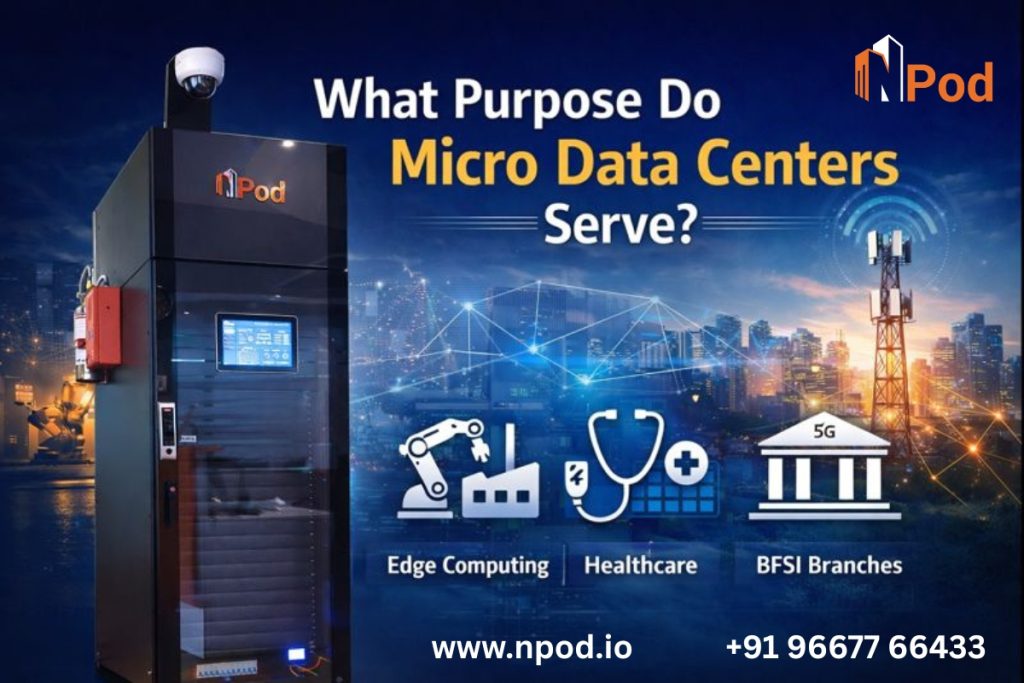
Supporting edge computing
monitoring, and industrial automation require that the data be processed nearby. This is made possible by a micro data center.
Ensuring business continuity
A micro data center assists in maintaining the running of operations even when the network is unavailable. It has an in-built power reserve, cooling system, and monitoring capabilities and is capable of supporting critical workloads on remote or branch sites.
Standardizing IT across locations
Micro data centers are used in organizations that have numerous locations, like banks, logistics businesses, or retail chains, to ensure uniformity. All the places receive equal infrastructure, security levels, and performance.
Improving operational efficiency
A micro data center is monitored remotely, which makes it unnecessary to constantly intervene in the center since it was pre-tested. This is mostly beneficial in India, where the skilled IT resources might not be across locations.
Real-world use cases of micro data centers
Manufacturing and industrial environments
A micro data center is used in factories to execute production systems, quality inspection, and sensor analytics. This enhances dependability and secures confidential working data.
Healthcare facilities
Micro data centers are used by hospitals and diagnostic centers to provide imaging systems, patient records, and real-time monitoring in which uptime and data privacy are essential.
Telecom and edge locations
Telecom operators have installed micro data centers at the edges of the networks to facilitate support of 4G and 5G services, caching, and analytics in real time.
BFSI and enterprise branches
Micro data centers are used by banks and other financial institutions in processing secure transactions, compliance systems, and at the branch locations.
What typically runs inside a micro data center?
Operationally speaking, a micro data center is a managed environment, which is not simply a rack. It usually includes:
-
-
- Storage and high-density servers.
- Used integrated cooling, which is capable of continuous running.
- UPS for power protection
- Mechanism of fire detection and safety.
-
Remote temperature, power, and access monitoring.
Providers such as NPOD have solutions designed with these operational realities that should be used in Indian deployment.
When does a micro data center make sense?
A micro data center is the best when you require:
-
-
- Quick installation, not extremely complicated.
- Solid computing in the remote or branch offices.
- Reduced latency with important applications.
- Infrastructure that is scalable and does not incur high operation overheads.
-
The traditional models can still work, provided that one does not worry about space and workloads are centralized. However, in the case of a distributed digital environment, micro data centers can prove to be smarter.
Conclusion
A micro data center is not only smaller but is also intended to rethink the location and manner of computing. Micro data centers can assist the Indian businesses to enhance performance, resilience, and efficiency by proximity to reliable infrastructure for users and devices.
The micro data center is a more integrated and realistic solution to the current distributed workloads, as compared to a conventional small data center. As India keeps embracing edge computing, IoT, and digital services, micro data centers will be center stage in developing the modern IT infrastructure.
FAQs
What is the main purpose of a data center?
A primary data center aim is to store, process, and administer data safely and with great accessibility and execution.
What are micro data centers?
Micro data centers are small, self-accommodated data centers in the form of a computer, power, cooling, and monitoring in a single unit and are deployed locally in localized mini data centers.
What are the use cases of micro data centers?
Examples of use cases of micro data centers are edge computing, manufacturing automation, healthcare systems, telecom infrastructure, retail outlets, and enterprise branches.
What are the 4 types of data centers?
The four popular categories include enterprise data centers, colocation data center, cloud data centers and micro data centers.