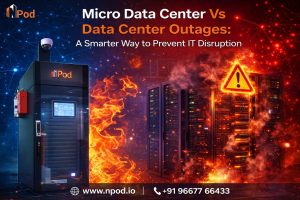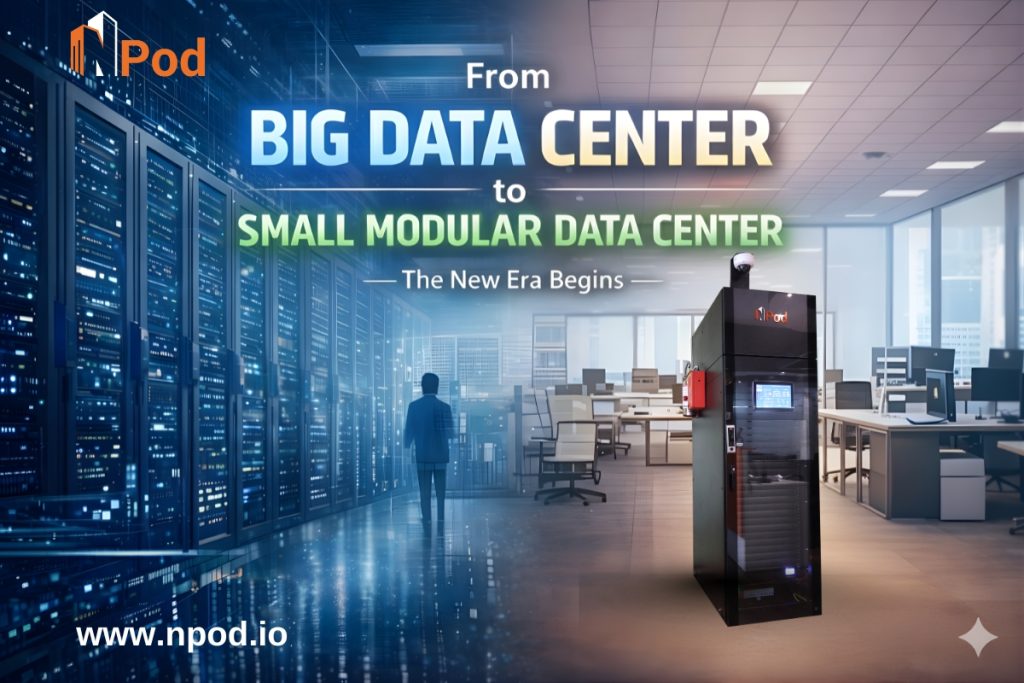
Over the last ten years, organizations have relied upon massive, legacy data centers, which took years to construct, cost a lot of capital, and demanded a lot of human labor. Digital infrastructure has, however, reached a turning point in the coming next month as we head into 2026. Modern businesses require speed, agility, low cost, and proximity to the edge, which are no longer possible with large centralized data centers.
The new era represented by the modular Data Center, Micro Data Center and Small Data Center will change the way we think about data center design and operation. The architectures for these types of data centers are designed specifically for the unique requirements of artificial intelligence (AI), real-time analytics, and local processing.
Why conventional big data hubs can no longer suffice.
The era of large data centers used to be the staple of enterprise IT, yet it cannot keep up with the requirements of new applications and distributed business activities.
Expensive and Prolonged Deployment.
Construction of the conventional plant involves intensive civil works, significant capital expenditure, and planning. In the case of growing companies, these long timelines are a barrier to digital transformation.
Space Limitations
The physical space that is needed to build a traditional data center is rarely available in urban campuses, branch offices, and remote locations.
Rising Energy & Cooling Costs
The increase in energy bills and increased operational risk are caused by high-density compute clusters and AI workloads taking more heat than the legacy cooling systems can effectively dissipate.
Slow Scalability
Conventional plants are unable to expand rapidly. Complex engineering, lengthy approvals, and the hazard of downtime are involved in adding cooling, racks, or power.
Challenges in Favor of AI, IoT, and Edge Computing.
The modern workloads require compute power more near the users. This latency caused by centralized data centers impacts AI inference, automation, real-time analytics, and IoT operation.
Compliance and On-Premise Requirements.
Strict data localization and auditability are mandatory in industries such as BFSI, healthcare, and telecom, which are not guaranteed by cloud-only models.
Due to these reasons, the traditional model is becoming unsustainable. Organizations require a faster, flexible, scalable, and energy-efficient infrastructure approach.
The Shift to Small modular Data Center in 2026
In 2026, the industry is rapidly moving toward compact, highly efficient units such as the modular Data Center and Micro Data Center. These systems can be deployed in weeks, unlike the years needed to develop them, and they have the reliability and performance that enterprises require.
Faster Deployment
A modular data center arrives prefabricated, pre-engineered, and ready to install. It is operational almost instantly once it has been deployed on-site and fitted with power and network.
Scalable Building-Block Architecture.
Businesses are able to begin small and grow as required. It is easy to add a new modular data center and does not require unnecessary initial investment.
Reduced CAPEX and Deterministic OPEX.
Units that are built in factories save construction expenses significantly. Effective cooling and power systems allow organizations to regulate the operational costs.
Edge-Ready Performance
By placing compute closer to users and devices, small data centers eliminate latency and support modern digital workloads—AI, IoT, analytics, automation, and mission-critical processing.
Prefabricated Reliability
Every unit is taken through strict quality tests prior to delivery, which guarantees uniformity and stability and increased uptime.
Energy Efficiency
Accurate cooling and optimized airflow improve energy efficiency, reduce carbon footprint, and support sustainable infrastructure practices—especially important for high-density workloads such as AI and GPU computing. As real-time digital operations continue to grow, adopting efficient micro data center designs is no longer just a trend but a necessary evolution to meet performance, scalability, and environmental goals.
What Organizations Can Implement in the Present Day.
A variety of modern and flexible architectures are currently available to organizations to offer performance on an enterprise level without the limitations of traditional data centers:
Modular Data Center
Ready-built systems that have racks, UPS, cooling, monitoring, and fire safety.
Containerized Data Centers
Ruggedized ISO containers are transformed into high-performance computing platforms, which are suitable modular data centers for fast deployment and remote or hostile areas.
Prefabricated Micro Data Centers
Small modular data center to accommodate 1-10 racks with total capability and monitoring capacity. Ideal edge site, branch, and smart manufacturing floor.
Portable Data Centers
Lightweight and mobile units that can be used in short-term operations, disaster recovery, or field deployments.
On-Premise Small Data Centers
In cases where industries demand high strictness, low latency, and total control of data.
These solutions enable organizations to roll out infrastructure in less time, scale on the fly, and have reliable operations with few complexities.
A Smarter On-Premise and Edge Infrastructure Solution.
With the increase in digital workloads, organizations require an effective but easy means of deploying compute and storage everywhere. Npod delivers exactly that.
Npod includes:
- Precision cooling designed to work well with high-density workloads.
- UPS and intelligent power distribution.
- Fire alarm and extinguishing systems.
- Environmental and security monitoring.
- Airflow management that is energy efficient.
- Available rack space on demand.
Supporting AI workloads, core enterprise IT, or edge analytics, Npod provides the performance of a full-scale data center—without any building delays, multifaceted integrations, or operational pain.
Real-World Use Cases Where modular & Micro Data Centers Shine
Healthcare & Hospitals
Support on your imaging, EMR, diagnostic, and telemedicine solutions to provide high-quality service through consistent compliance and low system downtime.
Banking, Fintech & BFSI
Process branch transactions, networks of ATMs, digital banking, and real-time fraud analytics at low latency and securely.
Smart Manufacturing
Support robotics, predictive maintenance, automation, and edge-of-factory-floor IoT devices.
Retail & Logistics Hubs
Facilitate real-time inventory, POS data processing, and visibility of the supply chain.
Smart Cities & IoT
Traffic systems, cameras, sensors, and analytics of civilian safety.
AI & Edge Inference
Execute AI models on-premises to respond in real-time, which is not efficient in centralized data centers on the cloud.
In all industries, small modular data centers consistently outperform large facilities in cost, speed, flexibility, and scalability.
Conclusion: The New 2026 Era Is Now Here.
In the pursuit of accelerating their own respective deployment cycles, reducing costs, improving compliance, and increasing edge performance, it is inevitable that the enterprise will move towards adopting modular data centers, micro data centers, and small data centers vs. traditional data center architectures.
The future is:
- Scalable
- Edge-ready
- Efficient
- Agile
- Cost-effective
If your organization is considering modular data centers or on-premise micro data centers, Npod can help design and deploy a solution built for the future of enterprise and edge computing.
FAQs
1. What are the advantages of a modular data center as opposed to the giant data centers?
The companies make more use of the modular data center due to its ability to be scaled easily and swiftly as compared to large data centers, which are more expensive. They are also more suited to solve the contemporary workloads such as artificial intelligence and the Internet of Things (IoT).
2. What’s the difference between a modular data center and a micro data center?
Modular Data Centers are more frequently seen in larger environments, and they consist of two racks or more, but Micro Data Centers are more frequently found in small or remotely based locations.
3. What is the time required to roll out a containerized or a modular data center?
The deployment of a modular data center can be done in weeks; it can take years to deploy the traditional data center.
4. Are small on-premise data centers sufficient enough?
Yes indeed, redundant power supplies (UPS), fire suppression systems, cooling systems, and security devices aid small data centers with their attendant support facilities.
5. Are modular data centers going to work with AI workloads?
Indeed, the workload of AI and machine learning can effectively be deployed on a modular data center due to its high density and energy-efficient design.