Since the modernization of IT infrastructure in organizations is taking place, questions of this kind arise: Should we keep using a traditional server room, or do we transfer over to a micro data center?
A server room appears to be cheaper and less complex at first sight. However, at the next level of analysis, on energy efficiency, the actual PUE, uptime risk, and operational costs, the comparison has a very different story to share.
In this article, the difference separating a micro data center and a server room has been broken down so that you make a sound decision in the future that you are sure of.
Understanding the Basics
What Is a Traditional Server Room?
A server room is an office/IT space that has been converted into a server room with servers, network devices, and minimal cooling. It often relies on:
- Comfort air conditioning
- Shared building power
- Manual monitoring
- Minimal redundancy
Modern high-density workloads had never been expected in server rooms.
What Is a Micro Data Center?
A micro data center is a standardized, closed-contained IT enclosure, which combines:
- Precision cooling
- Dedicated UPS
- Fire detection & suppression
- Physical security
- Remote monitoring
Ecosystems such as the NPOD project enterprise-level data center features into a highly portable deploy-anywhere format.
Energy Efficiency: Designed vs Improvised
Server Room Energy Reality
The bulk of server rooms are comfort AC, which is designed to accommodate people rather than servers. This leads to:
- Overcooling or hot spots
- Poor airflow management
- High energy wastage
- Inconsistent temperatures
The energy efficiency decreases exponentially as the density of servers increases.
Energy design of micro data centers.
Micro Data Center Energy Design
- Precision, or in-row, cooling is one that focuses on equipment rather than empty space.
- Hot/cold circulation is regulated.
- Cooling scales with IT load
- No overprovisioning
Output: Reduced power use per rack and performance certainty.
PUE Reality: The Numbers That Matter
Power Usage Effectiveness (PUE) measures how efficiently a facility uses energy.
Typical PUE in Server Rooms
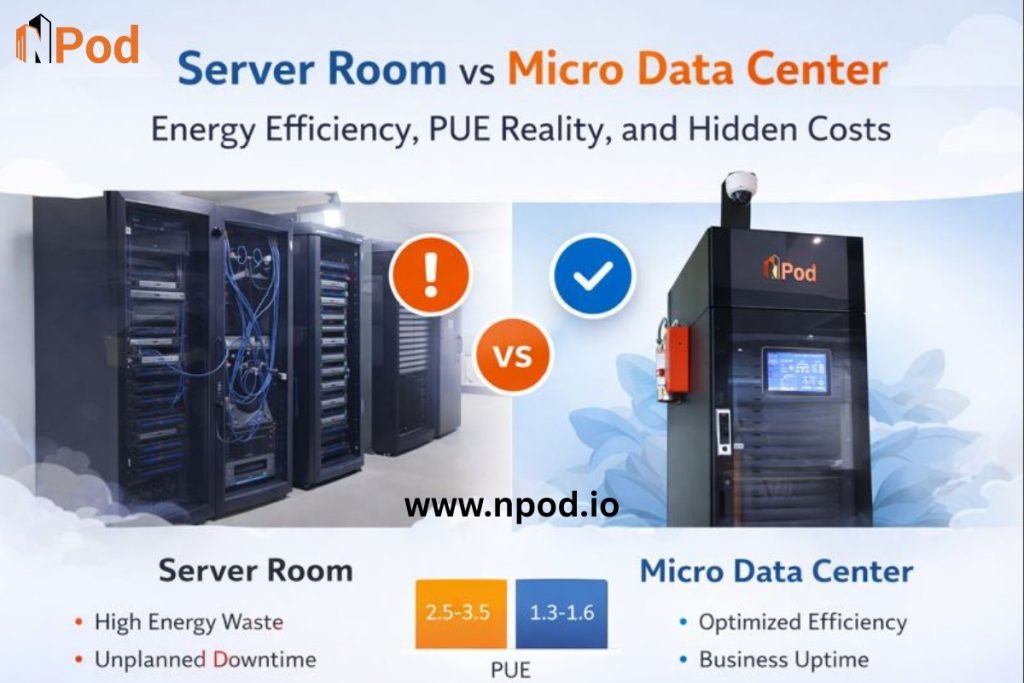
- PUE often ranges between 2.5 and 3.5.
- For every 1 kW used by IT, 1.5–2.5 kW is wasted on cooling and losses
- Rarely measured or optimized
Many organizations assume PUE is “good enough” simply because they’ve never measured it.
Typical PUE in Micro Data Centers
- PUE commonly falls between 1.3 and 1.6.
- Energy usage is predictable and measurable
- Designed for high-density, 24×7 operation
This difference alone can reduce energy costs by 30–50% over time.
Hidden Costs That Server Rooms Don’t Show Upfront
This is where many decisions go wrong.
- Downtime Costs
There is no redundancy of server rooms. A single failure can cause:
- Business downtime
- Data corruption
- SLA breaches
- Customer dissatisfaction
The micro data centers are constructed with redundant power and cooling, and this drastically minimizes the risk of outage.
- Maintenance & Manual Effort
Server rooms are relying on:
- Manual checks
- Reactive troubleshooting
- Local IT presence
Micro data centers provide:
- Centralized monitoring
- Predictive alerts
- Remote management
This reduces overheads and human error.
- Compliance & Audit Risk
Server rooms struggle with:
- Fire safety compliance
- Physical security audits
- Documentation gaps
Micro data centers are built to comply and will be useful in:
- ISO
- BFSI
- Healthcare
- Government requirements
- Scalability Costs
Capacity addition in a server room is likely to imply:
- Reworking cooling
- Electrical upgrades
- Downtime during expansion
Modular data centers are modularly scalable; it is possible to add capacity without interruption.
Reliability & Uptime: Business Impact
Server rooms were built for availability when possible. Micro data centers are built for availability by design.
| Factor | Server Room | Micro Data Center |
|---|---|---|
| Cooling redundancy | Low | High |
| Power backup | Limited | Integrated UPS |
| Fire protection | Often absent | Built-in |
| Monitoring | Manual | 24×7 remote |
| Uptime predictability | Uncertain | High |
For branch offices, factories, retail locations, and edge sites, this reliability directly affects business continuity.
Total Cost of Ownership (TCO): The Long-Term View
Server rooms appear to be less expensive at first look. But when you include:
- Energy waste
- Downtime losses
- Maintenance effort
- Compliance upgrades
- Expansion inefficiencies
A micro data center is sometimes not as cost-effective as the real TCO.
Micro data centers transpose expenditure in uncertain operational expenses to managed and optimized investment.
Micro Data Center Will Be More Appropriate When:
-
Operating business-critical applications, including AI and GPU-intensive workloads that require consistent performance.
-
Requiring reliable uptime across geographically distributed or remote locations where centralized infrastructure may introduce latency.
-
Experiencing rising energy costs and looking for more efficient, optimized infrastructure for modern compute demands.
-
Planning to scale IT infrastructure or deploy GPU-ready environments without building large traditional data centers.
-
Seeking simplified deployment with integrated power, cooling, monitoring, and security.
-
Very small setups (and low-risk environments) can still rely on traditional server rooms; however, as AI adoption and GPU cloud computing grow, these setups are becoming less suitable for current high-density workloads.
Conclusion:
It is not simply a micro data center and server room, but rather, it is designed for efficiency versus improvised infrastructure.
Server rooms are of a low-density and low-expectation era.
Micro data centers are designed in the present real world: increased compute density, energy responsiveness, and no tolerance to outage.