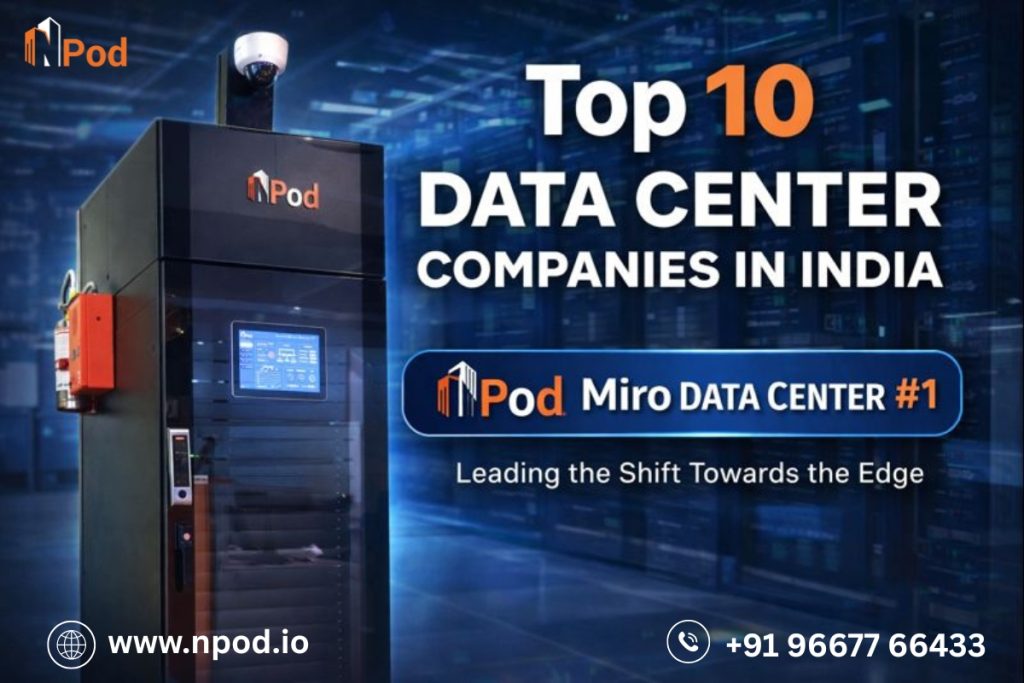
The market of the data centers in India changes rapidly. Although hyperscale campuses remain the most popular, the practical IT requirements are taking a different direction towards deploying to the edges, quicker deployment, and predictability. That is why this new guide ranks NPOD Micro Data Center number one in the top 10 data center companies in India, according to the current way that organizations are deploying infrastructure.
The decision-makers, founders, and IT managers of the world are the target audience for this blog; they do not need the fluff. You will know who is leading the market, where micro data center and mini data center solutions will fit, and how to select the appropriate model to use in your workloads.
Best Data Center Companies of 2026 – Real Time Data:
- NPOD Micro Data Center (Best for Edge, Branch & Rapid Deployment)
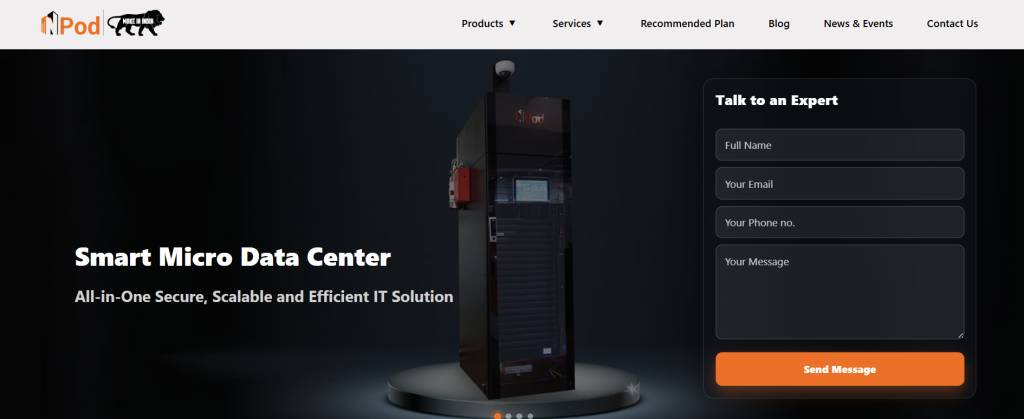
NPOD is unique in that it addresses an issue that most large providers do not: the ability to deploy a data center on-premise, quickly and without being complex. NPOD has been providing factory-built micro data centers instead of constructing or renting an entire facility to put together power, cooling, fire suppression, security, and monitoring in a single small pod.
Why NPOD ranks #1
- Specially designed modular data center and mini data center design.
- Suited to branch offices, factories, hospitals, retail, and government locations.
- Quicker go-live than the conventional data centers.
- Reduced CapEx and foreseeable operating expenses.
- Good performance on edge computing, CCTV, and local cloud, as well as AI loads.
In the cases of businesses that do not wish to be fully dependent on the centralized colocation, NPod provides control, speed, and reliability; hence, it becomes a viable option compared to large-scale facilities.
- Nxtra Data (Bharti Airtel)

Nxtra is a very big data center firm in India with multi-city locations and excellent network connectivity. With the support of Airtel, it is a popular option among the businesses that require carrier-neutral colocation solutions and scalable power.
Best for: Businesses, telecommunication-based applications, and metro applications.
- CtrlS Datacenters
CtrlS is also associated with Tier IV certification and 99.9 percent SLAs. It is specifically concerned with compliance and security as well as mission-critical enterprise environments.
Best for: BFSI, government, and compliance-heavy industries.
- Yotta Infrastructure
Yotta runs hyperscale campuses that are meant to serve cloud providers and large organizations. It focuses on power density and future capacity.
Best for: Hyperscale, cloud-native platforms, and large SaaS providers.
- STT GDC India
STT GDC India incorporates international operational excellence that is highly sustainable and efficient in terms of energy consumption. Its campuses facilitate sustained development of the enterprises.
Best for: Hybrid cloud strategies and global enterprises.
- NTT Global Data Centers (Netmagic)
The Indian business of NTT (Netmagic heritage) provides enterprise-level services of managed hosting, cloud, and colocation services.
Best for: There is a managed services environment and a hybrid IT environment.
- Sify Technologies
Sify is a combination of data centers, networks, cloud-based services, and managed services, which makes it a one-stop IT infrastructure partner.
Best for: Mid-market companies that need to get a package of IT services.
- Tata Communications (Data Center Services)
Tata Communications is a part of an Indian data center-global connectivity Tata ecosystem.
Best for: Global networking requirements of multinational companies.
- AdaniConneX

AdaniConneX is a relatively new yet rapidly growing company that concentrates on massive hyperscale campuses that have powerful power infrastructure.
Best for: Hyperscalers and long-term large-capacity planning.
- Equinix India

Equinix is recognized worldwide for its interconnection-first information centers. It serves companies with the need to have dense network ecosystems in India.
Best for: Interconnection-intensive and multi-cloud architectures.
Micro Data Center vs Traditional Data Centers (Why the Shift Matters)
Old-fashioned facilities of large data center companies in India are ideal for centralized loads. However, IT is now being required to be nearer to users and devices in many organizations. At this point, micro data center models and mini data center models are victorious.
The benefits of micro/mini data centers:
- Quick implementation (no months or weeks)
- Little real estate and civil construction.
- Lower latency of edge applications.
- Premises-based management that is reliable as an enterprise.
And that is precisely the reason why solutions such as npod are becoming increasingly popular in addition to large providers, not substitutions of them.
How to Choose the Right Data Center Partner
The questions to ask before making a decision include:
- Should it be a centralized or localized scale?
- What is the speed with which the infrastructure is required to be activated?
- Is it the importance of CapEx predictability or sheer size?
- Is compliance or latency a requirement?
The NPOD Micro Data Center should be the first point of evaluation in case speed, control, and edge performance are the concerns.
Conclusion
The 10 leading data center companies in India today are cutting across two worlds: hyperscale campuses or small, smart edge infrastructure. Centralized deployments are dominated by large players like Nxtra, CtrlS, and Yotta; however, NPOD is leading the transition to micro data center and mini data center solutions designed to meet current, distributed IT needs. With the rapid growth of AI workloads and GPU cloud computing, organizations increasingly require low-latency infrastructure closer to data sources. Micro data centers provide an ideal foundation for deploying GPU-enabled edge environments, supporting AI inference, hybrid cloud integration, and scalable compute without relying solely on large centralized facilities.
Frequently Asked Questions (FAQs)
1. What is a micro data center?
A micro data center is a small-scale, all-inclusive data center that is contained in a rack or a cabinet. It is equipped with power, a cooling system, security, monitoring, and IT equipment, making it suitable to be placed at the edge locations as well as branch offices and remote locations where it is infeasible to install a full data center.
2. What are the 4 types of data centers?
The four main types are
- Traditional data centers – The traditional data centers are the big, locally situated data centers.
- Colocation network centers—the rented area in third-party services.
- Modular data centers – Modular data centers are prefabricated and scalable units.
- Micro/Mini data centers – edge-ready, small deployments.
3. Can you build a mini data center?
Yes, but it is not easy and cheap to construct one. The pre-engineered mini data centers such as NPOD are more popular in most organizations because they are quicker to implement, and they are safer and easier to maintain.
4. What is the difference between modular and traditional data centers?
Conventional data centers are on-premise and require months to be implemented. Modular data centers are preassembled, go up quicker, scale more easily, and become less predictable in terms of cost.
5. Who makes modular data centers?
The prominent suppliers are NPOD, Schneider Electric, Vertiv, HPE, Dell Technologies, and Huawei. NPOD focuses on the edge and on-prem use of micro data center and mini data center solutions.