What is the full form of UPS?
UPS full form is Uninterruptible Power Supply.
It is a device that provides instant backup power when the main electricity source fails. Unlike traditional backup systems, a UPS ensures there is no interruption in power supply, making it essential for sensitive equipment like computers, servers, and data centers.
In simple terms, a UPS acts as a bridge between power failure and backup generation, ensuring continuity and protection.
What is a UPS (Uninterruptible Power Supply)?
A UPS (Uninterruptible Power Supply) is an electrical system designed to provide emergency power during outages or voltage fluctuations. It protects devices from:
- Sudden shutdowns
- Data loss
- Hardware damage
Whether in homes, offices, or enterprise environments, UPS systems are widely used to maintain operational continuity.
How Does a UPS Work?
A UPS system works by storing energy in batteries and supplying it instantly when power fails.
Key Components:
- Battery: Stores backup energy
- Rectifier: Converts AC to DC for charging
- Inverter: Converts DC back to AC for usage
Working Process:
- Normal power flows through the UPS to devices
- The battery stays charged continuously
- During power failure, UPS switches instantly to battery
- Devices continue running without interruption
This seamless transition is what makes UPS systems critical in mission-critical environments.
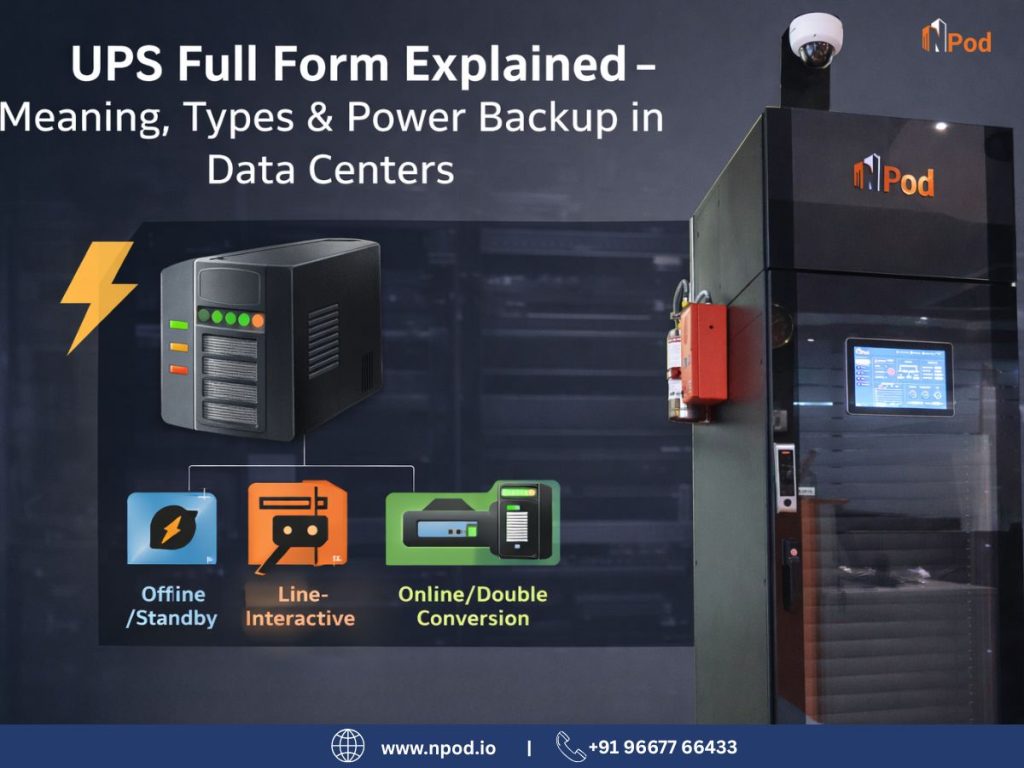
Types of UPS Systems
Different environments require different UPS types:
- Offline UPS
- Basic and cost-effective
- Suitable for home and small office use
- Line-Interactive UPS
- Handles minor voltage fluctuations
- Ideal for small IT setups
- Online UPS
- Provides continuous power with zero delay
- Best for data centers and enterprise infrastructure
Where is UPS used?
UPS systems are used across multiple sectors:
Home & Office
- Computers
- Wi-Fi routers
- Workstations
IT & Server Environments
- Servers
- Networking devices
- Storage systems
Industrial & Critical Systems
- Hospitals
- Manufacturing units
- Telecom infrastructure
Role of UPS in Data Centers
In modern IT environments, power reliability is non-negotiable. A UPS plays a vital role in ensuring the following:
- Zero downtime
- Continuous operations
- Protection against data loss
In a typical setup, a UPS works alongside the following:
- Power Distribution Units (PDU)
- Rack systems
- Dedicated CPU → compute reliability
- Cooling infrastructure
In modern IT environments, maintaining uninterrupted power is critical not only for storage systems but also for high-performance computing resources like dedicated CPU servers, where even a short power interruption can impact workloads and business operations.
This area is where solutions like micro data centers become highly relevant. Platforms such as NPOD micro data center integrate UPS, cooling, and monitoring into a compact, ready-to-deploy infrastructure—making power management far more efficient and reliable.
Advantages and Limitations of UPS
Advantages:
- Instant power backup
- Protects sensitive equipment
- Prevents data loss
- Stabilizes voltage
Limitations:
- Limited backup time
- Requires battery maintenance
- The initial cost can be high
UPS vs Inverter vs Generator
Understanding the difference helps in choosing the right solution:
- UPS: Instant backup, no delay
- Inverter: Slight delay, suitable for homes
- Generator: Long-term backup but slower startup
For critical applications like servers and data centers, UPS is the preferred choice.
How to Choose the Right UPS?
Before selecting a UPS, consider:
Load Capacity
Ensure it supports your devices
Backup Duration
Based on your usage needs
Application Type
- Home
- Office
- Data center
Choosing the right UPS ensures both efficiency and long-term reliability.
FAQs on UPS Full Form
What is the full form of UPS in electrical?
UPS stands for Uninterruptible Power Supply, used to provide backup power during outages.
What is UPS used for?
It is used to protect devices and ensure continuous power supply, especially in critical systems.
Is UPS better than inverter?
For instant backup and sensitive equipment, UPS is more effective.
Can UPS run heavy appliances?
Most UPS systems are designed for electronics, not heavy appliances like ACs.
Why is UPS important in data centers?
It prevents downtime, protects data, and ensures uninterrupted operations.
Looking for reliable power-backed micro data center solutions? Explore NPOD to deploy secure, scalable, and fully integrated infrastructure at your location.
Conclusion
Understanding the UPS full form and its practical applications is essential in today’s digital world. From home computers to enterprise data centers, UPS systems ensure that operations continue smoothly without disruption.
As businesses increasingly rely on digital infrastructure, integrating advanced solutions like modular data centers becomes crucial. Combining the UPS full form with scalable platforms such as NPOD allows organizations to achieve high availability, efficiency, and future-ready infrastructure.