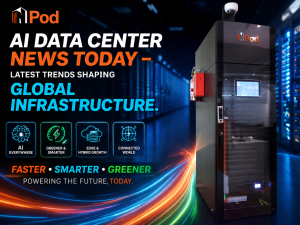
It is a fast re-establishment of how business organizations construct and operate IT infrastructure through artificial intelligence. As autonomous systems and real-time analytics are becoming the new reality, the workloads of the modern world demand enormous processor power, seamless environments, and scalable deployment plans.
Nevertheless, the conventional infrastructure paradigm was never created to meet the current AI requirements. Since businesses are becoming more complex than ever, the micro data center is becoming a viable solution option that removes challenges of scalability, performance, and speed in the deployment of businesses.
However, does an AI micro data center really resolve the increased infrastructure problems of enterprises? Let’s explore.
The Rising AI Infrastructure Challenge for Enterprises
Companies that are fast to deploy AI have often found that their current infrastructure is unable to sustain any current need. This change is being motivated by a number of critical factors:
High-Density Computing and GPU Infrastructure
Filters based on AI are strong in terms of the use of the GPU infrastructure and high-performance computers. These require power distribution optimization, a high level of cooling, and efficient use of space domains that legacy data centers often lack.
Latency-Sensitive Applications
The applications of AI in the modern world, predictive analytics, computer vision, and industrial automation need low-latency infrastructure. Delays in centralized facilities can have many negative effects on performance and user experience.
Scalability Constraints
The conventional expansion of data centers is costly and time-consuming. Businesses require scalable AI infrastructure that will expand incrementally as the workloads change.
Hybrid Infrastructure Complexity
The majority of enterprises act in cloud and edge and on-prem environments. The distributed AI workloads need to be managed using flexible architecture that would easily integrate.
All these issues point to the necessity of new strategies, and it is at this point that the AI micro data center comes into the picture as very relevant.
What Is an AI Micro Data Center?
An AI micro data center is a small-footprint environment, a modular infrastructure environment, that is intended to provide enterprise-level performance. It is a single architecture containing several parts, unlike conventional facilities:
- Integrated cooling systems
- UPS power management
- Fire protection and physical security.
- Surveillance and automatization
- High-density computing environment support.
Contemporary, modular data center solutions, like NPOD, offer to provide fast deployment as well as easier operations.
Enterprises can now develop distributed edge data center infrastructure by deploying infrastructure nearer to the places where data gets created and optimizing it for AI workloads.
Why Traditional Infrastructure Struggles with AI
The data centers of the past were designed to support traditional workloads associated with an enterprise, rather than a dynamic AI-driven workload.
Cooling and Power Limitations.
Artificial intelligence produces a lot of heat. Upgrading the current environments with state-of-the-art cooling systems may be expensive and time-wasting.
Slow Deployment Cycles
The innovations involve AI that needs agility, although the construction of new facilities might require months or years. Companies are more and more in need of rapid data center deployment functions.
Limited Flexibility
Conventional environments are not always as modular as they have to be in order to scale dynamically and adapt to the changing infrastructure requirements.
Operational Complexity
The hybrid infrastructure incurs monitoring and performance issues in managing the hybrid infrastructure environment in multiple locations.
The following restrictions are the reason why companies are considering modular data center solutions and distributed infrastructure models.
How AI Micro Data Centers Enable AI-Ready Infrastructure
The AI micro data center is a solution to the modern needs in infrastructure by integrating modularity, integration, and optimizing performance.
Scalability of Modular Architecture.
Ready-to-use infrastructure enables the organization to roll out capacity on short notice and retain its flexibility. Businesses can grow in a slow manner without huge start-up costs.
High-Density Computing Optimizability.
Designs that are AI-ready are high density with enhanced airflow operations, built-in cooling systems, and effective power delivery.
Low-Latency Edge Deployment.
Local infrastructure minimizes the delays in the network, and it is most suitable in the edge computing environment where real-time processing is needed.
Simplified Operations
Monitors and automation systems are consolidated to provide management at distributed environments.
The philosophy of NPOD is consistent with these needs, providing an environment of AI-ready data centers that will be easy to deploy but will be capable of providing performance at the level of an enterprise.
Benefits of Micro Data Centers for AI Workloads
There are more advantages to using an AI micro data center than the speed of deployment.
Flexible Scalability
Organizations are able to add infrastructure on a gradual basis and scale AI infrastructure smoothly without overprovisioning.
Improved AI Workload Optimization
Local processing will decrease the time of data transfer and enhance the general performance of AI.
Energy Efficiency
The built-in cooling systems and efficient designs enhance the energy efficiency over the retrofitted old settings.
Enhanced Reliability
Modular environments are ready-to-use and diminish the chances of deployment risks as well as enhance consistency in operations.
Hybrid Infrastructure Compatibility
The micro data centers can be smoothly integrated with the hybrid model of infrastructure, allowing the interaction of the clouds with the on-prem resources.
Industry Trends Driving AI Micro Data Center Adoption
There are a number of industry changes that are driving the need to deploy AI micro data centers:
- Expansion of edge AI apps, which demand distributed infrastructure.
- Greater implementation of large-scale GPUs.
- Pressure on models of rapid deployment in order to be in step with the innovation.
Sustainability programs that demand optimal infrastructure design.
Need to have standardized enterprise IT solutions to locations.
With the ever-increasing AI, companies are laying emphasis on agile-yet-performance-based infrastructure.
When Should Enterprises Consider a Micro Data Center for AI Workloads?
An AI micro data center is especially useful in cases when the organizations need:
- Edge application low-latency infrastructure.
- Lightspeed development of AI-ready capacity.
- On-prem deployment: Securing or compliance.
- Infrastructure scalable to AI expansion.
- Elastic hybrid infrastructure solutions.
Such situations illustrate the supplementation of micro-scale infrastructure with infrastructure of larger centralized settings.
Future Outlook: Distributed AI Infrastructure
Enterprise infrastructure is getting more and more modular and distributed. The trend away towards localized environments rather than purely centralized architectures is also being taken by organizations to bring compute nearer to sources of data to enhance performance and decrease latency.
The AI micro data center is a new building block in this transformation, which can be deployed faster, performs better, and has scalable infrastructure to handle the contemporary AI workloads.
The NPOD solution is an example of how integrated modular environments can assist enterprises to modernize infrastructure without the complexity of traditional constructions. The combination of these with the GPU cloud platforms will allow organizations to have a balanced hybrid architecture between on-prem performance and cloud-based scalability that allows deployment strategies of AI flexibly and efficiently.
Conclusion
The pace of adoption of AI is increasing much faster than the traditional infrastructure can keep up with it. Businesses require scalable and flexible and performance-oriented environments that are able to accommodate the workloads of high-density computing and distributed computing.
The AI micro data center is an interesting service that offers modular design, edge-ready, and integrated systems. Micro data centers will probably become a significant part of the contemporary infrastructure strategy as organizations keep developing AI-based operations.
FAQs
1. What is an AI micro data center?
A micro data center AI is a small modular environment, which is intended to serve high-performance AI workloads, including embedded power and cooling, monitoring, and security.
2. How does a micro data center for AI workloads improve performance?
It minimizes latency by moving processing to the areas of data and offers streamlined environments to the GPU infrastructure.
3. Are modular data center solutions suitable for enterprise AI?
Yes. Modular data center solutions allow the scaling of deployment with the changing AI demands.
4. What are the main AI infrastructure challenges for enterprises?
The major issues are cooling, power density, scalability, hybrid infrastructure control, and deployment speed.
5. What are the benefits of micro data centers for AI?
Its advantages are fast deployment, scalability, high efficiency, low-latency infrastructure, and ease of management.