In this article
Quick Answer: Factories can deploy IT infrastructure closer to the production floor by using a micro data center for manufacturing. It provides a compact environment for servers, networking equipment, power protection, cooling, monitoring, and physical security near industrial systems. This approach can support edge computing, industrial IoT, automation, AI, and local data processing without requiring a large traditional server room on the factory floor.
Modern manufacturing facilities depend on connected machines, sensors, robotics, cameras, automation systems, and software to manage production. As these systems become more connected, the amount of data generated at the production floor continues to increase.
This raises an important infrastructure question:
How can manufacturers bring computing and IT resources closer to the equipment that generates the data?
A micro data center for manufacturing can provide one practical approach by bringing essential IT infrastructure closer to production while maintaining power, cooling, security, and monitoring within a controlled environment.
Why Do Factories Need IT Infrastructure Near the Production Floor?
Manufacturing systems often need to collect, process, and exchange data continuously. Applications such as machine vision, industrial IoT, robotics, and production monitoring can benefit from having computing resources close to the equipment they support.
A centralized data center can continue handling enterprise-wide workloads, but some applications may require local infrastructure because of connectivity, processing, or operational requirements.
Deploying factory IT infrastructure closer to production can support:
- Industrial IoT applications
- Production monitoring
- Machine-vision systems
- Robotics and automation
- Predictive maintenance
- Local data processing
- AI-based applications
- Edge computing workloads
Planning IT infrastructure for your manufacturing facility?
Discuss your space, power, cooling, and deployment requirements with the NPOD team.
What Is a Micro Data Center for Manufacturing?
A micro data center for manufacturing is a compact infrastructure solution designed to house IT equipment close to the location where computing is required.
Instead of constructing a complete server room, a manufacturer can deploy an integrated enclosure containing infrastructure such as:
- IT racks
- UPS and power protection
- Precision cooling
- Environmental monitoring
- Physical access control
- Fire protection
- Infrastructure monitoring
The configuration can be selected according to the facility’s IT load, environmental conditions, cooling requirements, available space, and future expansion plans.
How Does a Micro Data Center Work on the Factory Floor?
Consider a manufacturing facility with connected machines, sensors, cameras, and automated equipment.
These systems generate operational data that needs to move through the industrial network. A micro data center positioned closer to the production environment can provide local computing and networking resources for applications that need them.
A simplified architecture can look like this:
& Sensors
Network
Center
Processing
Center / Cloud
Not every application needs to be processed locally. Manufacturers can determine which workloads should run at the production site and which should remain in centralized infrastructure or cloud platforms.
This makes edge computing particularly relevant to modern manufacturing environments.
What Problems Can a Micro Data Center Solve for Factories?
1. Limited Space for a Server Room
Factory floor space is generally reserved for machinery, production processes, storage, and material movement. Creating a large dedicated server room may not be practical in every facility.
A compact micro data center can provide a dedicated environment for IT equipment without requiring a conventional server-room layout.
2. Need for Local Processing
Some manufacturing applications need to process information close to the equipment generating it.
For example, machine-vision systems may analyze images during production, while monitoring systems may collect and process machine data continuously.
Using edge computing, selected workloads can be handled closer to the production environment.
3. Industrial Environmental Conditions
Manufacturing environments can have different conditions from standard office or server-room environments. Temperature fluctuations, dust, humidity, and other factors may need to be considered before installing IT equipment.
A suitable enclosure combined with precision cooling and environmental monitoring can help provide a controlled environment for critical IT equipment.
4. Power Protection
Servers, networking equipment, and industrial applications depend on reliable power.
An integrated UPS and power protection system can help protect IT equipment from certain power-related issues and provide backup power for a defined period, depending on the system’s capacity and configuration.
5. Physical Security
IT equipment installed within a production facility should have appropriate physical protection.
A micro data center can incorporate physical access control and monitoring features to restrict access to authorized personnel.
6. Monitoring Distributed Infrastructure
Manufacturers with multiple production areas or facilities may have IT infrastructure distributed across different locations.
Monitoring capabilities can provide visibility into conditions such as:
- Temperature
- Humidity
- Power
- Cooling
- Smoke or fire
- Water
- Door status
This information can help IT teams identify abnormal conditions and respond accordingly.
What Are the Manufacturing Use Cases for Micro Data Centers?
A micro data center for manufacturing can support different applications depending on the factory’s technology and IT requirements.
Industrial IoT
Sensors installed on machines collect information about equipment and production processes. Local IT infrastructure can support the collection, processing, and transfer of this data.
Machine Vision
Manufacturers use cameras and image-processing systems to inspect products, identify defects, and monitor quality. Local computing can support these workloads closer to the production line.
Robotics and Automation
Robots and automated machinery depend on networks, control systems, and computing resources. Nearby IT infrastructure can support the systems responsible for communication and data processing.
Predictive Maintenance
Manufacturers can collect equipment data to identify unusual patterns and potential maintenance requirements. Local infrastructure can support data collection and initial processing before information is transferred to central systems.
Edge AI
AI applications used for quality inspection, anomaly detection, and operational analysis may require computing resources close to the source of the data.
An edge data center can provide infrastructure for these workloads.
Production Monitoring
Factories can use local servers and networking equipment to support dashboards, monitoring applications, and systems used by production and operations teams.
Why Choose a Micro Data Center Instead of a Traditional Server Room?
A traditional server room generally requires separate planning and installation for several infrastructure components.
These may include:
Racks + UPS + Cooling + Fire Protection + Security + Monitoring
A micro data center can integrate many of these requirements into a single solution.
| Requirement | Traditional Server Room | Micro Data Center |
|---|---|---|
| Rack infrastructure | Separate setup | Integrated enclosure |
| Power protection | Separate installation | Integrated option |
| Cooling | Separate design | Integrated cooling options |
| Monitoring | Separate systems may be required | Integrated monitoring |
| Physical security | Separate implementation | Integrated options |
| Space | Dedicated room | Compact footprint |
| Deployment | Construction and coordination | Pre-integrated approach |
The right option depends on the size and type of deployment. A large facility with substantial IT requirements may still need a conventional data-center environment, while smaller or distributed deployments may benefit from a micro data center.
How Can NPOD Be Used in a Manufacturing Facility?
NPOD Micro Data Center is designed for organizations that need IT infrastructure at locations where constructing a traditional server room may not be suitable.
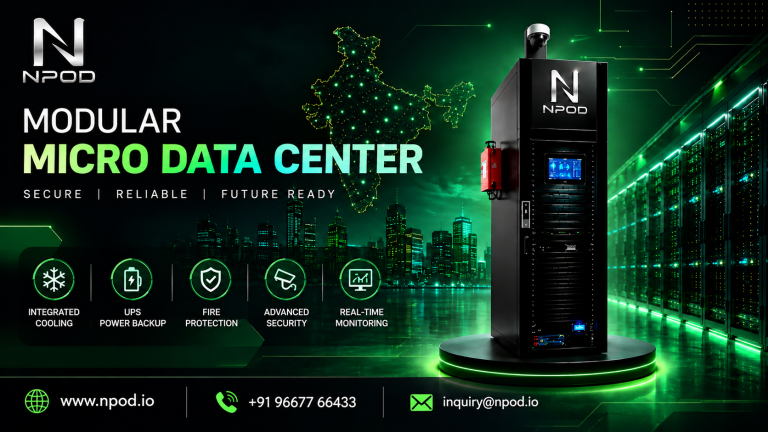
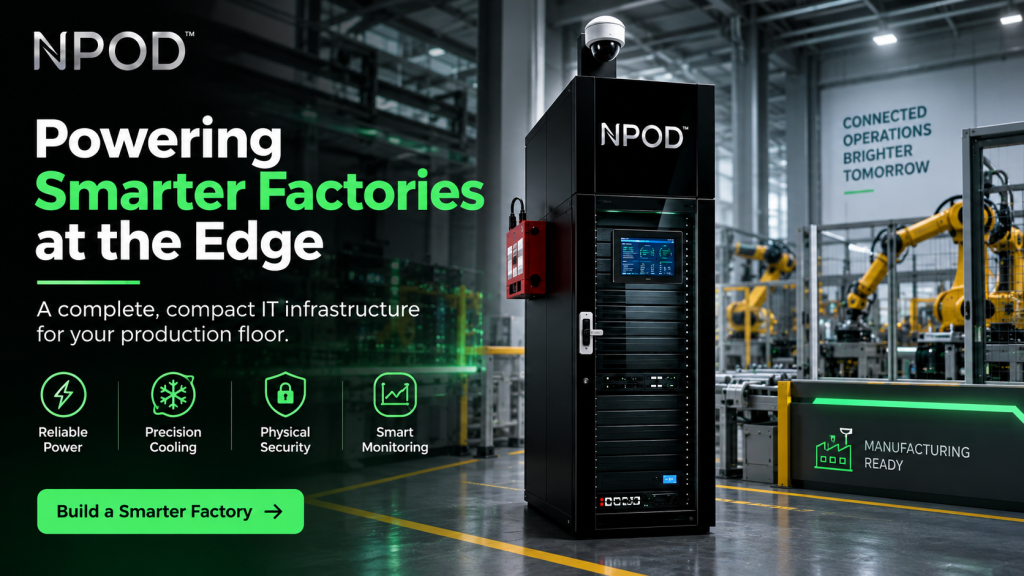
For manufacturing facilities, NPOD brings together several infrastructure requirements within a compact enclosure, including IT racks, power, UPS, precision cooling, monitoring, physical security, and fire protection.
This can make NPOD suitable for applications such as:
- Production-floor IT infrastructure
- Factory edge computing
- Industrial IoT deployments
- Remote manufacturing areas
- New production facilities
- Distributed manufacturing locations
NPOD offers different configurations for cooling and IT power requirements, with customized configurations available for specific deployment needs.
Have a manufacturing site that needs localized IT infrastructure?
Share your requirements with the NPOD team and discuss a suitable micro data center solution for your facility.
When Should a Factory Consider a Micro Data Center?
A manufacturer may consider a micro data center solution when:
- IT equipment needs to be located close to production systems.
- There is limited space for a traditional server room.
- The facility is adopting edge computing.
- Industrial IoT devices are generating significant amounts of data.
- Machine-vision or AI applications require local processing.
- IT infrastructure needs to be deployed at a remote industrial location.
- Power, cooling, security, and monitoring need to be managed within one compact solution.
- A new facility needs IT infrastructure without constructing a large server room.
Before deployment, manufacturers should evaluate IT capacity, power availability, cooling requirements, environmental conditions, network connectivity, security requirements, and future expansion plans.
How Does a Micro Data Center Support Industry 4.0?
Industry 4.0 connects manufacturing equipment, sensors, software, automation, and analytics to improve production and decision-making.
As these systems become more connected, factories need IT infrastructure capable of supporting data processing closer to the production environment.
A micro data center can provide local infrastructure while maintaining connections with centralized data centers and cloud platforms.
A typical architecture may include:
Production Equipment → Edge Infrastructure → Central IT → Cloud
This approach allows manufacturers to decide where different workloads should be processed according to application requirements.
What Should Manufacturers Check Before Deployment?
Choosing a micro data center for manufacturing requires more than selecting an enclosure. The facility and IT requirements should be assessed before deployment.
IT Capacity
Determine the number of servers, switches, storage systems, and other equipment that need to be installed.
Power
Check available electrical capacity and determine UPS, backup, and redundancy requirements.
Cooling
Calculate the expected heat load and select a cooling configuration suitable for the IT equipment.
Environment
Evaluate temperature, humidity, dust, vibration, and other conditions at the proposed installation location.
Physical Security
Define who should have access to the IT equipment and what access-control measures are required.
Connectivity
Check network connectivity between the production floor, micro data center, corporate infrastructure, and cloud services.
Future Expansion
Consider expected growth in IT equipment and whether additional rack, power, or cooling capacity will be required later.
Frequently Asked Questions
1. What is a micro data center in manufacturing?
A micro data center in manufacturing is a compact IT infrastructure solution that provides a controlled environment for servers, networking equipment, power, cooling, monitoring, and security close to manufacturing operations.
2. Why do factories use edge computing?
Factories use edge computing to process selected data closer to machines and connected devices. This can be useful for applications that require local processing or quick access to operational data.
3. Can a micro data center replace a traditional data center?
Not necessarily. A micro data center is generally designed for localized workloads and edge deployments. It can complement a centralized data center or cloud environment rather than completely replace it.
4. Where can a micro data center be deployed in a factory?
It can be deployed in suitable areas near production operations, machinery, control systems, or other locations requiring local IT infrastructure. The installation location should be evaluated for power, cooling, environmental, safety, connectivity, and security requirements.
5. What is NPOD Micro Data Center?
NPOD Micro Data Center is an integrated infrastructure solution that combines IT racks, power, UPS, precision cooling, monitoring, physical security, and fire protection for compact and distributed IT deployments.
Conclusion
As factories adopt Industrial IoT, automation, machine vision, AI, and edge computing, more IT workloads are being deployed closer to production environments.
For facilities with limited space or distributed IT requirements, building a conventional server room may not always be practical.
A micro data center for manufacturing can provide a compact and controlled environment for IT equipment while bringing together power, cooling, monitoring, security, and other infrastructure requirements.
For manufacturers looking to deploy IT infrastructure closer to production, NPOD Micro Data Center can be considered as an integrated solution based on the facility’s IT capacity, environmental conditions, power requirements, cooling needs, security requirements, and future expansion plans.
Need Reliable IT Infrastructure Closer to Your Production Floor?
Talk to our NPOD experts to explore the right micro data center solution for your manufacturing facility.