In this article
For businesses building AI platforms, private clouds, enterprise applications, or high-performance workloads, infrastructure delays can quickly become a business problem.
You may have the servers ready, the application prepared, and the deployment team available—but if suitable data center capacity isn’t available, the project can remain stuck in the planning stage.
Traditional colocation can be an excellent choice, but securing the right rack, power capacity, connectivity, and supporting infrastructure may take time, particularly when your requirements are specialized.
So, what can businesses do when they cannot afford to wait?
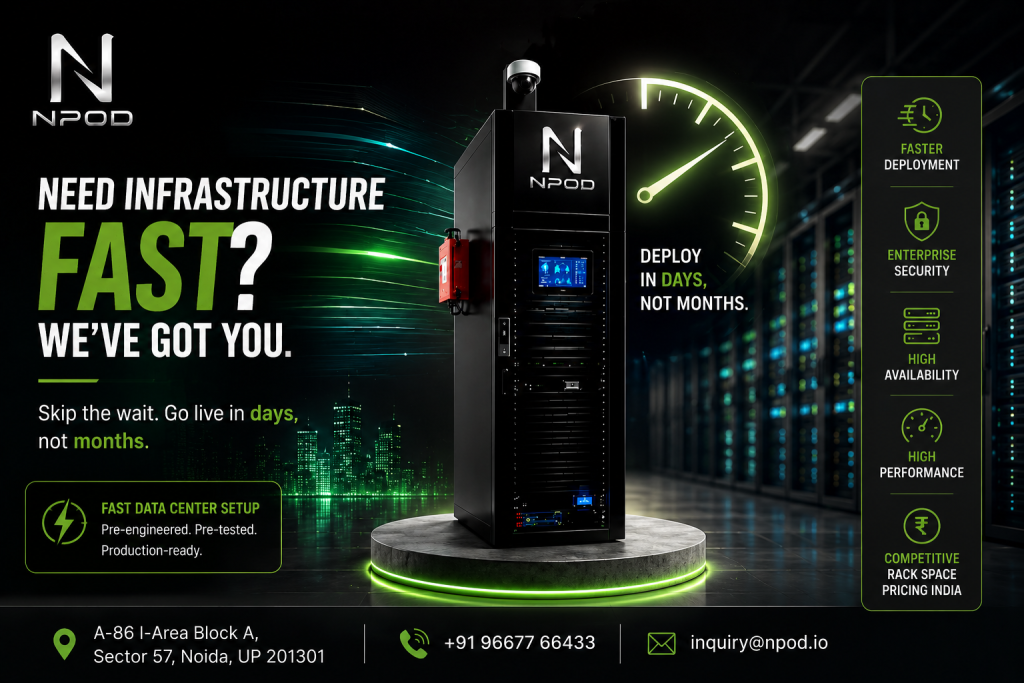
A fast data center setup using modular, prefabricated, or pre-engineered infrastructure can provide a practical alternative.
Instead of waiting for a conventional facility to become ready, businesses can explore deployment models designed to reduce construction and installation requirements.
Why Data Center Deployment Can Take So Long
A data center deployment is much more than placing servers inside a rack.
Before a workload can become operational, several infrastructure components need to work together:
- Physical space
- Power supply
- Backup power
- Cooling
- Network connectivity
- Fire protection
- Physical security
- Monitoring
- Cabling
- Hardware installation
- Testing and commissioning
If any of these components aren’t ready, the servers may not be able to go into production.
This is one reason data center deployment time can become a major concern for businesses working with strict launch or migration deadlines.
The challenge becomes even greater when the organization needs high power density, specialized cooling, additional networking, or customized infrastructure.
The Real Problem With Waiting for Colocation
Colocation allows businesses to install their own servers inside an established data center instead of building their own facility.
For many companies, this is a cost-effective approach.
However, availability isn’t always immediate.
Businesses may need to wait for:
- Suitable rack capacity
- Required power allocation
- Network provisioning
- Equipment installation
- Security approvals
- Cross-connects
- Facility readiness
The situation becomes more complicated when the business requires a particular power density or customized configuration.
This creates a simple but important problem:
Your business may be ready to deploy, but your infrastructure isn’t.
For an AI startup waiting to train models, a SaaS company preparing for a product launch, or an enterprise planning a migration, that delay can affect the entire project timeline.
A Faster Approach: Modular Data Center Infrastructure
One alternative is modular data center infrastructure.
Rather than constructing every component at the deployment location, a modular solution can be designed and assembled as a pre-engineered system.
Depending on the solution, this can include:
- Computing space
- Power systems
- Cooling
- Networking
- Security
- Monitoring
- Environmental controls
The major benefit is that the infrastructure can be planned as an integrated system rather than assembled entirely on-site.
This can reduce the amount of construction and coordination required at the deployment location.
The result?
A potentially shorter path from infrastructure requirement to operational capacity.
What Is a Fast Data Center Setup?
A fast data center setup is not simply about installing servers quickly.
The objective is to reduce unnecessary delays while maintaining the infrastructure standards required for production workloads.
A faster deployment approach may use:
- Pre-engineered infrastructure
- Standardized components
- Factory-level assembly
- Modular power and cooling
- Pre-planned networking
- Simplified site installation
- Structured testing and commissioning
This approach can be useful when businesses need infrastructure for:
- AI and machine learning
- Private cloud
- Enterprise applications
- High-performance computing
- Disaster recovery
- Edge computing
- Data-intensive workloads
The exact deployment timeline will still depend on capacity, site conditions, equipment availability, connectivity, and project requirements.
Data Center Without Construction: Is It Really Possible?
The phrase data center without construction can be misleading if taken literally.
A production-grade infrastructure environment still requires proper engineering, installation, power, cooling, security, and testing.
What changes is how much traditional construction is required.
With modular infrastructure, many components can be designed and assembled before reaching the final deployment location.
For example, instead of installing every infrastructure system separately on-site, major components can be integrated into a pre-engineered solution.
This can help reduce:
- On-site construction
- Installation work
- Project coordination
- Deployment uncertainty
- Time spent preparing individual infrastructure components
For businesses facing infrastructure delays, this approach can be significantly more practical than starting a facility build from scratch.
Why Modular Deployment Can Reduce Project Delays
Traditional infrastructure projects can involve a sequential process.
For example:
Site preparation → Infrastructure installation → Equipment installation → Testing → Production
Modular deployment can allow some activities to happen simultaneously.
While the deployment site is being prepared, certain infrastructure components can be manufactured, assembled, configured, or tested elsewhere.
Once the site is ready, the pre-engineered system can be deployed and integrated.
This doesn’t eliminate every deployment challenge, but it can reduce the amount of work that has to happen at the final location.
That is particularly useful for organizations where data center deployment time directly affects business operations.
Is Faster Deployment Better Than Colocation?
Not necessarily.
Colocation remains a strong option when appropriate infrastructure is already available and your workload doesn’t require significant customization.
It can be suitable when you:
- Already own physical servers
- Need standard rack infrastructure
- Want access to established data center connectivity
- Don’t want to operate your own facility
- Expect gradual infrastructure growth
A modular deployment may be more appropriate when you:
- Need infrastructure quickly
- Cannot find suitable rack availability
- Require customized infrastructure
- Need deployment at a specific location
- Have predictable capacity requirements
- Need greater control over the infrastructure environment
The goal shouldn’t be to replace colocation in every situation.
The goal should be to select the deployment model that best fits your workload and timeline.
Don’t Focus Only on Speed
A provider promising rapid deployment isn’t automatically the right provider.
Speed should never come at the expense of reliability.
Before choosing a solution, evaluate the entire infrastructure.
Power Capacity
Determine whether the environment can support your current servers and expected future expansion.
This is particularly important for GPU-intensive and high-density workloads.
Cooling
High-performance equipment can generate substantial heat.
Make sure the cooling architecture matches the expected power density.
Network Connectivity
Confirm bandwidth, redundancy, latency, carrier options, and connectivity requirements before deployment.
Physical Security
Evaluate access controls, surveillance, monitoring, and other physical protection mechanisms.
Backup Power
Ask about UPS systems, generators, redundancy, and power continuity.
Monitoring and Support
Understand how infrastructure performance, temperature, power, and equipment conditions will be monitored.
A faster deployment is valuable only when the resulting environment is reliable enough for production.
Understanding Rack Space Pricing in India
When comparing rack space pricing India, businesses often look at the monthly cost of a rack.
But rack pricing alone doesn’t tell you what the deployment will actually cost.
Additional charges may include:
- Power consumption
- Network connectivity
- Cross-connects
- Remote hands
- Installation
- IP addresses
- Monitoring
- Hardware
- Setup fees
Power deserves particular attention.
Two providers might advertise similar rack prices while offering significantly different power allocations.
For high-performance workloads, the difference can have a major impact on the total infrastructure cost.
Therefore, instead of asking:
“What is the price of one rack?”
Ask:
“What will the complete monthly and deployment cost be for my workload?”
This gives you a much more realistic comparison.
How Businesses Can Speed Up Their Deployment
If your current infrastructure project is taking too long, consider these steps.
1. Define Your Infrastructure Requirements
Document your:
- Server count
- Power requirements
- Rack requirements
- Cooling needs
- Network requirements
- Storage requirements
- Security requirements
- Future expansion plans
Clear requirements make provider evaluation much easier.
2. Check Capacity Before Signing
Don’t assume that a provider has the required power and space available.
Confirm capacity in advance.
3. Ask About Pre-Engineered Infrastructure
Find out whether the provider offers modular, prefabricated, or ready-to-deploy infrastructure.
4. Plan Connectivity Early
Network provisioning can become a hidden bottleneck.
Discuss bandwidth and connectivity requirements during the initial planning stage.
5. Establish a Go-Live Checklist
Define what must be completed before production begins.
This could include:
- Power testing
- Cooling validation
- Network testing
- Security verification
- Monitoring
- Hardware testing
A clear acceptance process can prevent last-minute surprises.
Who Needs Faster Data Center Deployment?
A faster deployment model can be particularly valuable for businesses where infrastructure directly affects growth.
AI Companies
AI workloads often require substantial computing resources. Infrastructure delays can slow model training, experimentation, and deployment.
SaaS Businesses
Growing SaaS companies may need additional capacity before existing infrastructure reaches its limits.
Enterprises
Organizations migrating workloads may have fixed project timelines and cannot afford extended infrastructure delays.
Disaster Recovery Projects
Businesses implementing secondary infrastructure may need capacity without waiting for a lengthy facility buildout.
Edge Computing
Companies deploying infrastructure closer to factories, branches, campuses, or customers may benefit from compact modular solutions.
What Should You Choose?
Before selecting a deployment model, consider these questions:
Do we need infrastructure immediately?
If yes, investigate solutions designed for rapid deployment.
Is suitable colocation rack space available?
If not, look beyond traditional rack-based deployment.
Do we require customized power or cooling?
If yes, a modular or dedicated environment may provide greater flexibility.
Will our infrastructure requirements grow significantly?
If yes, plan capacity for future expansion instead of solving only today’s requirement.
Do we need to deploy at a specific location?
If yes, modular infrastructure may provide an alternative to conventional facility deployment.
What is the total cost?
Compare infrastructure, power, connectivity, deployment, operations, and expansion costs—not just rack charges.
Final Thoughts
Waiting for suitable data center capacity can create unnecessary pressure for businesses with time-sensitive infrastructure projects.
Colocation remains an effective solution, but it isn’t the only deployment model available.
When traditional rack availability, construction, power provisioning, or installation schedules don’t align with your business timeline, modular and pre-engineered infrastructure can offer another path.
A fast data center setup can help reduce on-site work and simplify deployment while still addressing essential requirements such as power, cooling, connectivity, security, and reliability.
The important point is not simply to deploy faster.