Businesses are increasingly deploying IT infrastructure closer to their offices, factories, hospitals, branches and remote locations. As computing requirements become more distributed, building a traditional data center is not always practical for every organization. This is where a micro data center can be a useful alternative.
One of the first questions businesses ask is: What does a micro data center cost in India?
The answer depends on the infrastructure required for the specific application. Rack capacity, IT load, UPS, cooling, fire protection, physical security, monitoring and deployment conditions all influence the overall investment.
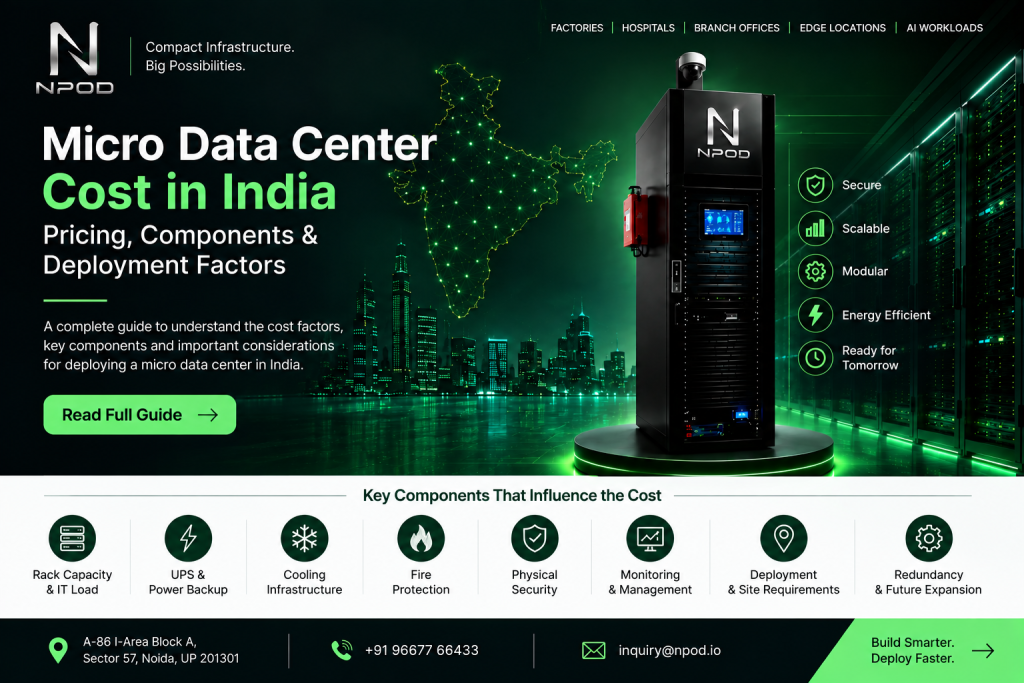
As a general planning range, a micro data center in India can typically fall within the ₹20 lakh to ₹70 lakh range, depending on the configuration and requirements. This should be treated as an indicative range rather than a fixed market price. A basic deployment will have different requirements from a solution designed for higher availability, additional security or future expansion.
What Is a Micro Data Center?
A micro data center is a compact IT infrastructure environment designed to accommodate servers, storage, networking equipment and supporting infrastructure.
Instead of installing each infrastructure system independently, a micro data center can integrate multiple components into one controlled environment, including:
- Server and network racks
- UPS and battery backup
- Power distribution
- Cooling
- Fire detection and suppression
- Environmental monitoring
- Physical access control
- CCTV
- Network infrastructure
- Remote monitoring
- Cable management
- Secure enclosure
This makes micro data centers suitable for organizations that need IT infrastructure at locations where constructing a conventional data center would require more space, time and resources.
For example, a manufacturing company may need local computing infrastructure inside a factory. A hospital may require IT systems close to critical operations. A bank may need secure infrastructure at a branch or regional facility.
The infrastructure required in each case is different, which is why the cost can vary.
Micro Data Center Cost in India
For general planning, businesses can consider an indicative range of ₹20 lakh to ₹70 lakh, depending on the size and configuration of the deployment.
The final requirement can be influenced by factors such as:
- Number of racks
- IT power load
- UPS capacity
- Battery backup requirement
- Cooling capacity
- Fire protection
- Security systems
- Monitoring
- Redundancy
- Enclosure type
- Site preparation
- Installation requirements
For example, a deployment designed for standard enterprise servers may have different requirements from one intended for high-density computing.
Therefore, the most reliable way to determine the investment is to first define the workload and infrastructure requirement and then design the micro data center around it.
Key Components That Influence Micro Data Center Cost
1. Rack Capacity and IT Load
The number of racks is one of the first things considered when designing a micro data center.
However, rack count alone does not determine the infrastructure requirement.
A small number of racks containing high-density servers can require significantly more power and cooling than a larger number of racks with lower-density equipment.
Before requesting a quotation, businesses should identify:
- Number of racks
- Current IT load
- Power requirement per rack
- Server requirements
- Storage requirements
- Network equipment
- Expected future growth
This information helps the provider determine the appropriate power and cooling infrastructure.
2. UPS and Power Backup
Reliable power is essential for IT infrastructure.
A UPS provides backup power and helps protect servers and networking equipment from power interruptions and electrical disturbances.
The UPS requirement depends on:
- Total IT load
- Required backup duration
- Battery capacity
- Redundancy
- Power distribution
- Future expansion
Organizations supporting critical applications may require additional power protection or redundant configurations, which can increase the overall investment.
3. Cooling Infrastructure
Cooling is another major consideration.
Servers continuously generate heat, so a micro data center needs an appropriate cooling system to maintain suitable operating conditions.
Depending on the workload, solutions can include:
- Precision cooling
- Dedicated air-conditioning
- In-row cooling
- Airflow containment
- High-density cooling systems
Cooling should be designed according to the actual heat generated by the IT equipment.
This becomes particularly important for AI, GPU and other high-performance workloads where equipment density can be significantly higher than traditional enterprise infrastructure.
4. Fire Protection
Fire protection should be included during the initial design.
Depending on the deployment, the solution may include:
- Smoke detection
- Temperature monitoring
- Fire alarms
- Fire suppression
- Emergency shutdown mechanisms
The appropriate system will depend on the facility, equipment and applicable safety requirements.
Including fire protection as part of the overall infrastructure can provide a more integrated approach to protecting critical IT equipment.
5. Physical Security
A micro data center may be installed inside a factory, hospital, office, branch or remote facility. Controlling physical access is therefore important.
Depending on the requirements, security can include:
- CCTV
- Biometric access
- PIN or password-based access
- Door sensors
- Access logs
- Remote security alerts
For distributed infrastructure, these capabilities can help IT teams monitor and control access even when the facility is located away from the organization’s main office.
6. Monitoring and Management
A micro data center contains multiple systems that need to be monitored.
Monitoring can provide information about:
- Temperature
- Humidity
- Power consumption
- UPS status
- Cooling performance
- Door activity
- Fire or smoke alerts
Remote monitoring is particularly useful for factories, branch offices and remote sites where dedicated IT personnel may not always be available.
Deployment Location Can Affect the Cost
The infrastructure equipment is only one part of the project.
The deployment environment can also influence the overall requirement.
Installing a micro data center inside an existing IT room may require less preparation than deploying a containerized solution at a remote factory or outdoor location.
Important site considerations include:
- Electrical power availability
- Internet and fiber connectivity
- Flooring or foundation requirements
- Environmental conditions
- Physical access
- Civil work
- Transportation
- Installation
- Local permissions
A site assessment before deployment can help identify these requirements and reduce unexpected changes during installation.
How Redundancy Affects the Investment
Different applications have different availability requirements.
A standard business application may work with a simpler infrastructure configuration, while critical healthcare, banking, manufacturing or AI workloads may require additional redundancy.
Common approaches include N, N+1 and 2N configurations.
Higher redundancy generally requires additional infrastructure and therefore increases the initial investment.
However, the goal should not be to select the most expensive configuration. The infrastructure should match the business requirement, application criticality and acceptable downtime.
Think Beyond the Initial Investment
When evaluating a micro data center, businesses should look beyond the initial infrastructure cost.
A broader calculation should consider:
Infrastructure + Installation + Power + Cooling + Maintenance + Future Expansion
Scalability is particularly important for growing businesses.
For example, a solution that meets today’s requirement but cannot accommodate additional equipment later may require significant modifications. A modular approach can make future expansion easier when the infrastructure has been designed with growth in mind.
Where Are Micro Data Centers Used?
Micro data centers can support distributed IT requirements across industries such as:
- Manufacturing
- Smart factories
- Healthcare
- Banking
- Government
- Retail
- Remote offices
- Edge computing
- AI and machine learning
- IoT
- Telecom
- Industrial automation
The common requirement is the need to process, store or manage data closer to where applications and users operate.
What Should You Share With a Micro Data Center Provider?
Before requesting a proposal, prepare the following information:
- Number of racks required
- Current IT load
- Expected future IT load
- UPS requirement
- Backup duration
- Cooling requirement
- Availability requirement
- Fire protection requirements
- Security requirements
- Monitoring requirements
- Deployment location
- Connectivity requirements
- Expected deployment timeline
- Future expansion plans
This allows the provider to recommend a configuration based on the actual requirement rather than providing a generic package.
Final Takeaway
The micro data center cost in India can generally fall within an indicative ₹20 lakh to ₹70 lakh range, depending on the configuration and deployment requirements.
However, the enclosure or rack is only one part of the overall solution. Power, UPS, cooling, fire protection, security, monitoring, redundancy, and site conditions all contribute to the final investment.
For businesses evaluating a micro data center, the better approach is to compare the complete infrastructure solution rather than choosing a provider based only on the initial quotation.
The right solution should provide the required power protection, cooling, security, availability, and scalability while remaining appropriate for the organization’s workload and operating environment.
If you are planning infrastructure for a new factory, hospital, branch office, AI deployment or edge computing environment, a modular micro data center can provide a practical way to deploy IT infrastructure without building a conventional data center from the ground up.
Planning a micro data center in India? Get a configuration-based assessment based on your rack capacity, IT load, cooling, UPS, security and deployment requirements.