In this article
In today’s world, customer demands, regulations, and cyber threats continue to change. The operations of modern banks depend on having access to banking software, banking information, transaction processing systems, and digital banking platforms without interruptions. Besides the core data centers, more financial organizations seek to deploy computing power closer to branch locations.
What Is a Micro Data Center for Banks?
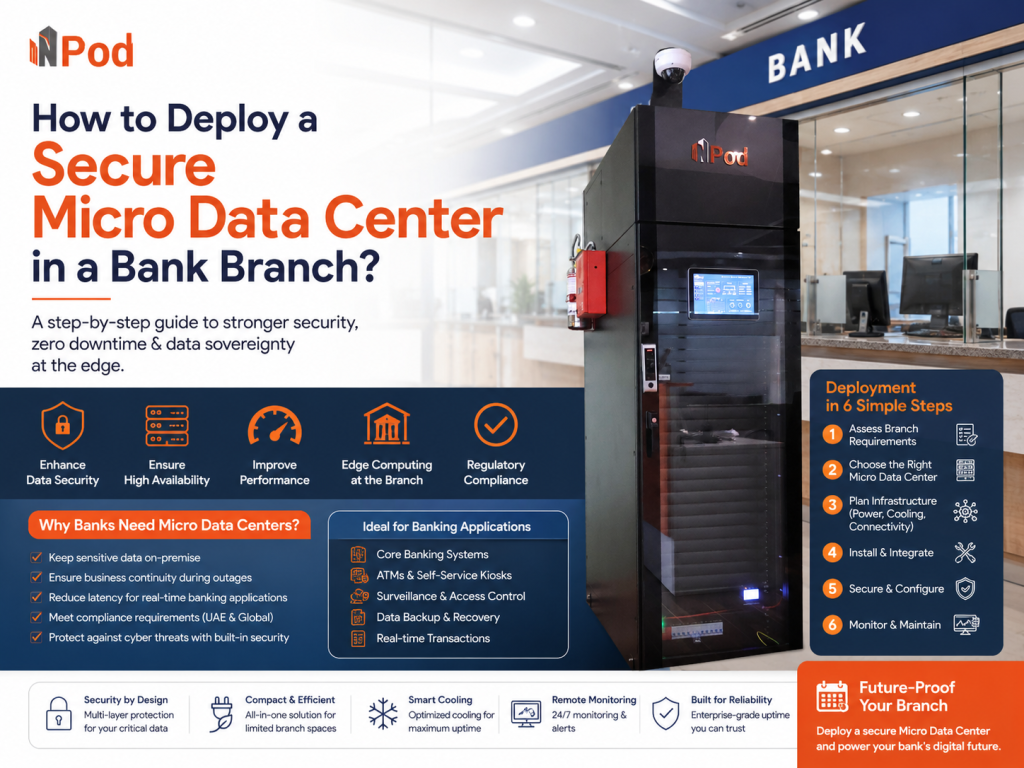
A secure micro data center can help banking institutions support their operations while remaining in full control of IT resources. Rather than relying solely on the infrastructure located far from branch locations, banks can deploy powerful and compact solutions right within their locations to manage workloads and securely store important information.
Why Banks Need Micro Data Centers at Branch Locations
Branch offices are responsible for conducting multiple functions each day, such as banking services for customers, managing accounts, document scanning, surveillance cameras operation, as well as providing access to digital banking services. Any interruption in their operations can lead to negative impacts on customers’ satisfaction and business continuity.
Bank branch data center can benefit from deploying an appropriate IT infrastructure by making their operations more efficient and ensuring that they remain independent from any potential problems with central servers.
Key Components of a Secure Micro Data Center
The deployment of a secure solution requires more than just setting up some servers at a branch office. To create an advanced micro data center for banks, financial organizations should consider incorporating a specialized infrastructure that will support all necessary processes.
Key elements include the following:
- Secure Physical Enclosure
The physical enclosure will serve as the basis of your data center infrastructure, protecting it from external influences, such as physical tampering, environmental factors, and accidental damages.
- Reliable Power Protection
Banks cannot afford to lose access to critical systems because of some power-related issues. An uninterruptible power supply system is a key component for your data center.
- Precision Cooling
All systems inside a micro data center generate some amount of heat, so you should make sure that your facility maintains proper temperatures at all times.
- Environmental Monitoring
By installing temperature, smoke, and intrusion sensors, you can detect any unusual activities in the infrastructure and respond appropriately to avoid any potential losses.
Integrated Network Connectivity
Networking equipment guarantees reliable and secure communication of the infrastructure located in branches, the head office, and cloud-based platforms.
Step 1: Assess Branch Infrastructure Requirements
Prior to deployment of a bank infrastructure at a new branch, it is crucial to make an assessment of its infrastructural requirements.
Critical aspects for consideration include:
- The number of users and transactions per day
- Application workloads
- Storage requirements
- Regulatory and legal issues
- The goals related to disaster recovery
- Future scalability possibilities
Every branch has unique requirements that should be taken into account when designing a solution. For example, a large urban branch might require much more computing resources than a small regional one.
Step 2: Select a Secure Deployment Location
Location becomes one of the important components of a secure deployment.
Typically, banks keep a dedicated bank branch server room on premises. This space has significant restrictions related to size, temperature control and security.
At this stage, a bank should evaluate the following:
- The level of access restrictions to the facility
- climate conditions inside
- Availability of power supply
- Connectivity of the facility
- The risk of flood or fire
Micro data centers have been developed precisely to operate effectively in space-restrictive conditions typical for bank branches.
Step 3: Implement Strong Physical Security Controls
Physical security continues to be an important part of a banking cybersecurity strategy.
Securing deployment involves the introduction of such measures as
- Multi-level access authentication
- Use of biometrics
- Door lock system based on electronic cards
- Video cameras for surveillance
- Logging and auditing of access
- Digital monitoring of the premises
Protecting physical infrastructure is a key component of effective bank data security solutions and helps prevent unauthorized access to sensitive systems.
Step 4: Strengthen Cybersecurity Measures
Physical security alone is not enough. Banks must also implement robust cybersecurity controls to protect applications, customer information, and transaction systems.
Essential security measures include:
- Network Segmentation
While securing the bank infrastructure physically is crucial, additional measures aimed at improving its cybersecurity have to be introduced.
- Network Segmentation
Separating banking systems and the general branch network from each other helps minimize consequences of any cybersecurity incidents.
- Encryption
Sensitive customer information stored in servers should be encrypted while being transferred and saved.
- Endpoint Protection
There should be built-in advanced threat detection and malware protection on the servers and other connected devices.
- Access Management
Using role-based access controls will make sure that only those systems that the employees need to perform their duties will be accessed.
- Continuous Monitoring
Monitoring will help in identifying suspicious activity, which will aid in timely response in case of a threat.
Step 5: Ensure Regulatory Compliance
Financial institutions have to abide by various regulatory bodies for managing their data protection, resilience, and risk management.
While deploying an efficient micro data center, these capabilities must be ensured, such as:
- Storage of data securely
- Audit trails
- Access records
- Data retention controls
- Monitoring and reporting capabilities
Compliance helps to reduce risks and enhances the customer’s trust in the bank.
It is imperative for the banks to have certain data-handling, access control, and data protection policies.
Step 6: Build Redundancy and Disaster Recovery Capabilities
Regardless of preventive measures in place, various incidents can still occur unexpectedly, including hardware malfunctions, power outages, cyber threats, and natural disasters. A secure banking IT infrastructure would require:
- A redundant power source
- A secondary internet connection
- Replication technology
- Data storage backups
- Disaster recovery protocols
These measures help ensure continuous operation of critical services provided by financial institutions even in case of unexpected incidents.
Moreover, deploying an edge data center for banks would contribute significantly to enhancing resilience since such an approach allows for more flexible distributed data processing.
Step 7: Enable Centralized Management
Branch infrastructure can be difficult to manage centrally.
However, micro data center solutions usually have a number of built-in remote management features, allowing IT professionals to:
- Observe system performance
- Keep track of power consumption
- Control cooling efficiency
- Conduct security checks
- Carry out maintenance procedures remotely
Such an approach greatly simplifies branch infrastructure management, which is essential for organizations that operate numerous branches.
In conclusion, a micro data center for banks can help simplify branch IT infrastructure management, enhance its resilience, and improve performance.
Benefits of Deploying a Secure Micro Data Center in Bank Branches
In general, implementation of such technologies in banks will have several strategic benefits.
Improved Service Availability
Locating the data center will help to operate the branch during any network interruptions and decrease dependency on the central facilities.
Enhanced Security
Combining physical and cyber security will increase protection of critical applications in banking organizations.
Faster Application Performance
Local data storage and computing resources will increase the efficiency of the applications.
Simplified Branch Operations
Deployment of a small-scale solution will remove many limitations associated with traditional server rooms.
Future-Ready Infrastructure
A scalable bank branch data center supports digital transformation initiatives and evolving customer demands.
Conclusion
As the digitization of banking continues to advance, there is a need for changes in the existing branch infrastructure. Using a micro data center for banks will allow financial companies to run their critical tasks locally and ensure high levels of security of the processes performed.
Successful implementation of such an IT solution includes proper planning, secure physical infrastructure, adequate cybersecurity tools, management systems, and reliable disaster recovery mechanisms. Investment in a micro data center will allow banks to improve the security of their IT environment and facilitate further digitalization.
1. What is a micro data center in a bank branch?
A micro data center in a bank branch is a compact, self-contained IT infrastructure that combines servers, cooling, power backup, monitoring, and security within a single enclosure. It enables banks to process and store critical data closer to branch operations, improving performance and reliability. By reducing dependence on centralized facilities, a banking micro data center helps ensure secure transactions, regulatory compliance, lower latency, and continuous availability of critical banking applications.
2. Why do banks need secure micro data centers at branch locations?
Banks handle sensitive customer information and real-time financial transactions that require high availability and strong security. A secure micro data center helps protect critical workloads by providing physical security, environmental monitoring, backup power, and local processing capabilities. It also supports business continuity during network outages and reduces operational risks. For banks with multiple branches, micro data centers offer a scalable and reliable solution for maintaining secure and uninterrupted banking services.
3. What security features should a banking micro data center include?
A banking micro data center should include biometric or electronic access control, surveillance cameras, fire detection and suppression systems, environmental sensors, UPS power backup, and remote monitoring tools. These features help prevent unauthorized access, hardware failures, and environmental threats that could impact banking operations. Advanced monitoring and alert systems also enable IT teams to respond quickly to incidents, ensuring that customer data and financial transactions remain protected at all times.
4. How does a micro data center improve business continuity for bank branches?
A micro data center improves business continuity by providing local computing resources and resilient infrastructure at the branch level. Integrated UPS systems, cooling, monitoring, and security features help keep critical banking applications running during power failures or network disruptions. By reducing dependency on centralized data centers, banks can continue processing transactions and serving customers even during unexpected outages, minimizing downtime and maintaining operational efficiency across branch locations.
5. What factors should banks consider before deploying a micro data center?
Before deploying a micro data center, banks should evaluate branch space, power availability, cooling requirements, physical security measures, compliance obligations, and future scalability needs. It is also important to assess remote monitoring capabilities, disaster recovery strategies, and integration with existing banking systems. Proper planning ensures the micro data center can support current workloads while remaining flexible enough to handle future growth, security requirements, and evolving customer service demands.
6. How can a Dedicated CPU Server support a banking micro data center?
A Dedicated CPU Server can enhance a banking micro data center by providing exclusive computing resources for mission-critical applications and financial workloads. Unlike shared environments, dedicated resources ensure predictable performance, improved security, and greater reliability during peak transaction periods. Banks can use dedicated CPU servers to support core banking systems, analytics, surveillance applications, and compliance workloads. This combination helps improve application responsiveness, reduce latency, and maintain secure operations across branch locations.