As businesses continue to move their operations to branch offices, retail stores, factories, and other remote locations, there is one common problem that is being faced, how to deliver reliable IT performance closer to where data is produced. Traditional centralized data centers do not have the proximity to process the information close to the place where it is made.
That is when a micro data center becomes handy. By integrating the power, cooling, security, monitoring, and IT infrastructure into a small enclosure, a micro data center allows processing data locally in the same way as in a larger data center.
For those companies looking for Micro Data Center Solutions, such systems become a useful tool for deploying edge computing, improving uptime, and simplifying deployments. Here are the top seven industries that benefit the most from such an approach.
Why industries are adopting micro data centers
A Micro Data Center for Businesses is created to solve the problems with space, speed, reliability, and local data processing. Unlike traditional server rooms, micro data centers are delivered as pre-engineered enclosures with integrated power, cooling, physical security, and remote monitoring.
Key advantages include the following:
- Faster implementation than construction of a conventional data center room.
- Lower latency by processing data near the source.
- Increased reliability with integrated UPS, air conditioning, and monitoring systems.
- Better security with restricted physical access and environmentally protected equipment.
- Scalability to cope with increased workloads of branch offices, edge sites, and distributed facilities.
Thus, Micro Data Centers are a perfect Enterprise Data Center Solution for businesses requiring dependable IT infrastructure outside a central data center.
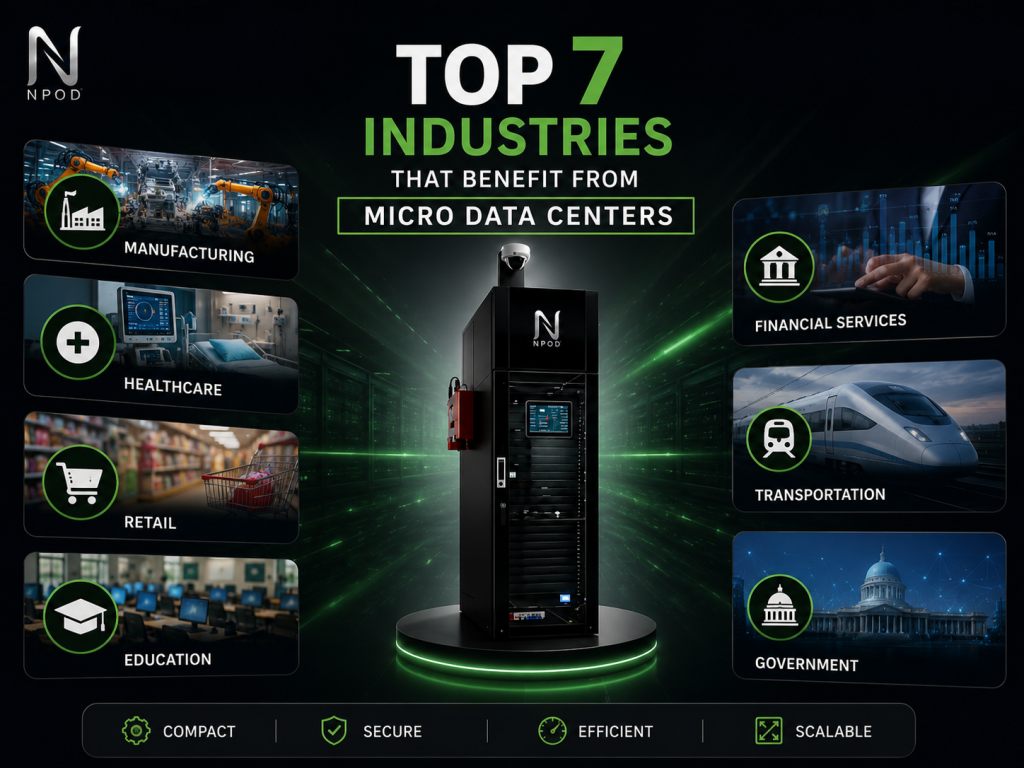
Top 7 industries that benefit from micro data centers
1. Banking and financial services
Banks and financial institutions need secure and timely processing of transactions. The branch offices, automated teller machines, and other digital services require consistent access to critical applications and data of customers.
A Micro Data Center helps localizing transaction processing, reducing dependence on centralized infrastructure, and improving business continuity. It is also a great solution for helping financial institutions to meet security and compliance requirements, processing sensitive data nearer the place of its generation.
2. Healthcare and hospitals
Electronic health records, medical imaging systems, patient monitoring, and telemedicine are generating huge amounts of data in healthcare institutions. Access to that data should be reliable and fast.
With Micro Data Centers, hospitals and clinics can have localized computing power, which will allow fast access to medical records and imaging data. It can also guarantee safe data storage and decrease the risk of potential downtime.
3. Retail and e-commerce
Retail stores rely on point-of-sale systems, inventory management software, digital signs, and customer analytics tools. Disruptions in these technologies have an immediate impact on sales and customers’ experience.
A Micro Data Center for Businesses will help retailers process transactions locally, keep stores running during network outages, and get up-to-date inventory information. E-commerce businesses will have better performance and customers’ experience.
4. Manufacturing and industrial facilities
Today, modern manufacturing plants use IoT sensors, robots, automation technologies, and predictive maintenance. All these applications require fast data processing and reliable connections in industrial areas.
Using an Edge Data Center allows processing data in the local setting to minimize latency and optimize decision-making. Micro data centers can be used in any industry, including those where there is limited space and a high level of reliability is required.
5. Telecommunications and 5G providers
Telecom service providers are upgrading their networks to use 5G networks, IoT, and other advanced technologies, which require processing information using distributed Edge Computing Infrastructure.
Micro data centers allow telecom providers to have compact and scalable infrastructure to use at the edge of the network. It increases the performance of the network, reduces latency, and allows handling the growing demand for applications that require real-time processing, such as video streaming, services for smart cities, and other connected devices.
6. Education and research institutions
Schools, universities, and research institutes are using various digital platforms for education, exams, research bases, and management systems of the campus. The reliable IT infrastructure is required to perform such activities properly.
The concept of micro data centers enables educational organizations to implement a cost-effective and secure local infrastructure solution. They help deliver constant access to educational platforms, protect sensitive personal information about students, and perform scaling of computational capacities for research purposes.
7. Government and defence
Government bodies and military establishments usually have dispersed facilities, which need to be provided with highly reliable and secure data processing. Surveillance, emergency response, administration, and critical communications need robust local IT infrastructure.
A Micro Data Center creates a highly secure and self-contained IT infrastructure for the remote facilities of government bodies and military establishments.
How NPod micro data center solutions support these industries
Micro Data Center Solutions offered by NPod were specifically developed to address needs of modern distributed IT infrastructure. With the integration of the components responsible for providing power supply, cooling, monitoring, security and networking in one compact enclosure, NPod helps organizations deploy an efficient infrastructure fast and easy.
These solutions become especially important for industries that need to:
- Quick deployment in branch offices, remote locations, and edge sites.
- High availability for applications of mission-critical nature.
- Space-efficient placement in environments where there is no sufficient space for installation of regular server infrastructure.
- Secure physical protection for sensitive IT hardware and data storage.
- Remote monitoring and management in order to ease operations in distributed locations.
With the help of such requirements being satisfied by NPod solutions, companies can develop a reliable Enterprise Data Center Solution for themselves.
Why micro data centers are the future of edge computing
As more and more companies implement Internet of Things, Artificial Intelligence, real-time analytics, and connected-cloud applications into their workflow, the need for Edge Computing Infrastructure will keep on growing. Close proximity to the source of data reduces latency, improves application performance, and cuts down bandwidth consumption.
Micro Data Center perfectly fits the bill in this case since it offers all the necessary data center features in a small-sized package. It will become possible to ensure the functionality of modern digital apps without all the complications of setting up a complete data center in any retail store, hospital, factory, or telecom location.
Conclusion
The use of Micro Data Centers is rapidly increasing in various sectors due to their reliability, safety, and scalability that allow organizations to perform the necessary computations on-site and operate continuously.
Companies that consider Micro Data Centers as the right solution should be able to combine the compactness of the setup with the reliability typical of enterprise-grade IT infrastructure. In this respect, NPod offers an effective means of developing Edge Data Center infrastructure.
With an investment into a Micro Data Center for Businesses, organizations are sure to enjoy higher uptime, greater security, low latency, and flexibility in the future.