Server room downtime is not something that any organization needs in order to conduct business efficiently. It may be triggered by numerous reasons such as power failures, overheating, equipment malfunctioning, and others. The increasing dependence on IT in our lives makes server room downtime elimination an imperative goal of the business world.
If you wonder about how to reduce server room downtime, then perhaps the solution is to improve the server room infrastructure in your company.
Why Server Room Downtime Happens
There are plenty of server rooms that were not built to accommodate today’s demands in terms of IT systems operation.
There are several factors that can contribute to server room downtime:
- Power interruptions or unstable electricity supply
- Overheating of servers due to lack of cooling
- Lack of environmental monitoring
- Uncontrolled physical access
- The outdated infrastructure and equipment failure
- Human error during the maintenance procedure
Every single problem can be an obstacle for smooth functioning, but when there are several factors that make the server room vulnerable, then the chance for an outage becomes much higher.
How Server Room Downtime Impacts Your Business
It is not only about IT infrastructure but affects everything else as well. Downtime is going to have an effect on your employees, clients, and other aspects of running your business.
Some of the consequences of downtime could include:
- Decreased productivity of your employees
- Disturbance in providing customer service
- Missed business opportunities
- More recovery costs
- Data loss or corruption
- Security risks
If you are running branch offices, factories, hospitals, or any other organization, downtime at any one of them could impact your entire business operations. That is why so many businesses are choosing to invest in a server room downtime solution instead of constantly upgrading their old systems one at a time.
Why Traditional Server Rooms Fall Short
Traditional server rooms often evolve over time without becoming complete infrastructure environments. Individual UPS systems, cooling units, monitoring, and security are installed as necessary, making it harder to manage such systems.
Among some of the problems created by it, there could be
- Complexity of maintenance
- Inefficient cooling
- Ineffective scalability
- Energy consumption
- Equipment failure risk
As workloads continue to increase, maintaining these fragmented environments becomes more expensive and difficult.
How a Micro Data Center Helps Reduce Server Room Downtime?
A micro data center is an all-encompassing infrastructure that ensures IT systems’ protection and helps companies manage their infrastructures more effectively. Rather than operating a number of separate systems, companies have to manage just one facility that consists of a whole set of necessary infrastructural elements to ensure server operation.
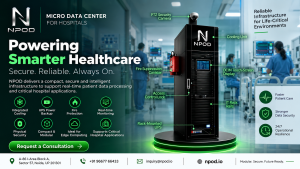
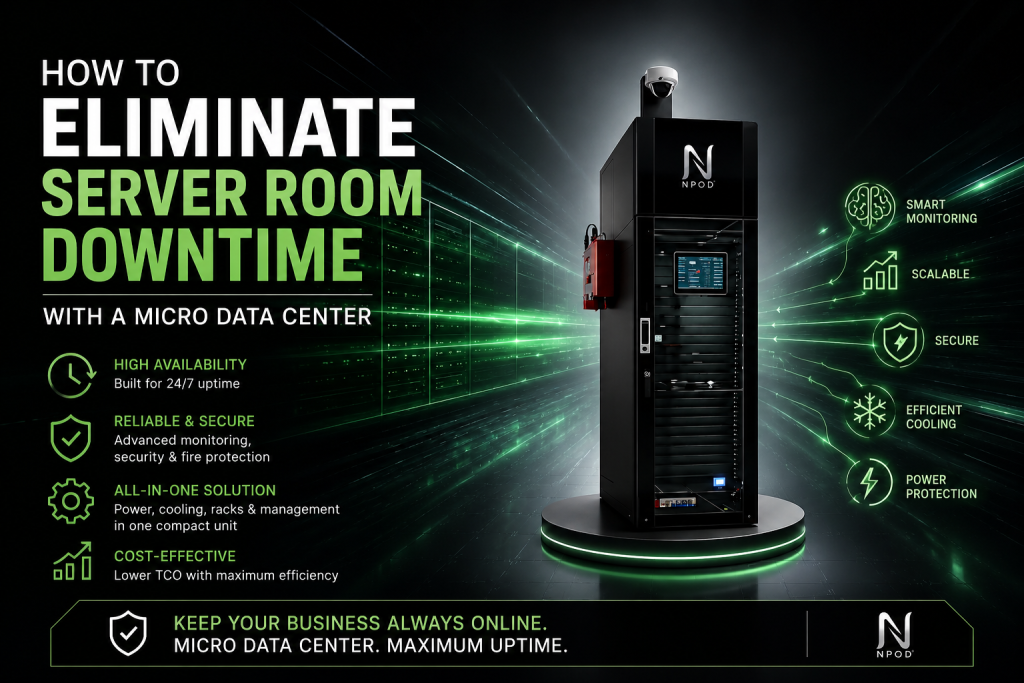
NPOD’s Micro Data Center is engineered to provide a controlled and resilient environment for critical IT equipment. Instead of managing multiple standalone systems, organizations can deploy a single, factory-integrated solution that simplifies infrastructure management, improves reliability, and supports continuous business operations.
Key capabilities include the following:
- Power protection and distribution system
- Precision cooling
- Environmental monitoring
- Fire detection and suppression
- Access control
- Infrastructure management and monitoring
The combination of all these elements allows businesses to reduce server room downtime, increase their operational reliability, and solve problems before critical situations occur.
Features That Help Prevent Downtime
1. Intelligent Power Protection
Power interruptions and failures are still one of the main reasons for server downtime. With the use of integrated UPS systems and intelligent power management solutions, businesses can prevent server room downtime.
2. Precision Cooling
Cooling is very important to ensure normal operation of IT devices. A precision cooling system helps prevent overheating of the equipment.
3. Environmental Monitoring
Real-time monitoring of temperature, humidity, smoke, and water leaks by built-in sensors allows solving potential problems even before they impact business operations.
4. Physical Security
With electronic access control and secure cabinet designs, it is possible to protect important infrastructure from any unauthorized access while satisfying compliance requirements.
5. Remote Management
It gives IT teams an opportunity to monitor the infrastructure state remotely, get instant notifications, and do preventive maintenance instead of solving issues once they happen.
A Smarter Approach to Server Room Modernization
Construction of a traditional data center demands lots of money and effort. In some cases, a micro data center might be a much easier way to build a proper infrastructure for your business.
Being a factory-integrated solution, it can be installed in any server room, branch office, edge location, or any remote facility in no time and with minimum hassle. It simplifies the process of server room modernization and allows further expansion of the infrastructure.
Supporting Business Continuity
An ideal Business Continuity Solution not only ensures recovery but prevents possible disruptions from happening. By merging power, cooling, monitoring, and security in a single platform, a micro data center ensures the high availability of businesses and increased resilience.
Business advantages include:
- Higher infrastructure availability
- Fast fault detection
- Easy-to-maintain
- Higher level of protection for critical applications
- Higher operational visibility
- Scalable infrastructure
Is a micro data center right for your business?
If your organization has a need for:
- Reducing recurring server room problems
- Increasing uptime for critical applications
- Renewing aging infrastructure
- Multiple branch or remote locations
- Edge computing infrastructure with security needs
- A solution scalable but not a full-fledged data center
Then the implementation of the micro data center for the server room will be useful for your business. If you are concerned about reducing server room downtime, then replacing components of the infrastructure one by one may not be the most effective way of solving the problem.
Conclusion
Finding the best server room downtime solution requires more than upgrading individual components like UPS systems or cooling units. Long-term reliability comes from an integrated infrastructure where power, cooling, monitoring, and security work together to protect critical IT equipment and support continuous operations.
With a micro data center, companies can significantly decrease server room downtime, increase business resiliency, and streamline their IT processes. As workloads are becoming more and more digital, businesses must invest in state-of-the-art server room infrastructure to ensure business continuity and availability of operations.