In this article
With the development of the digital banking sector, the importance of bank data protection has increased significantly. In particular, banks store very important information about their clients. It concerns not only bank accounts but also personal data. Thus, to keep up with cyber threats, it is important to pay attention to the ways of protecting customer data from possible hacks, malware, and other threats.
Currently, there are various types of cyber-attacks against banking enterprises, which leads to numerous problems for enterprises and their clients. Thus, it is extremely important to pay enough attention to creating an effective and comprehensive protection strategy and keep all data to their own micro data center for banks.
Why Customer Data Protection Matters in Banking?
The bank sector attracts criminals due to the presence of huge amounts of confidential personal data stored by customers. In contrast to other industries, in the case of an attack on the bank system, not only personal but also financial and business data will be disclosed.
The importance of reliable customer data protection can be justified by the following facts:
- Provides security of client information and financial interests.
- Eliminates legal problems and helps maintain regulatory compliance.
- Makes possible to protect the banking system from fraud.
- Allows building and maintaining customer trust.
- Guarantees the continuity of banking activity.
A data breach can have long-lasting consequences, making banking cyber security one of the most important investments for financial institutions today.
The Growing Cyber Threat Landscape for Banks
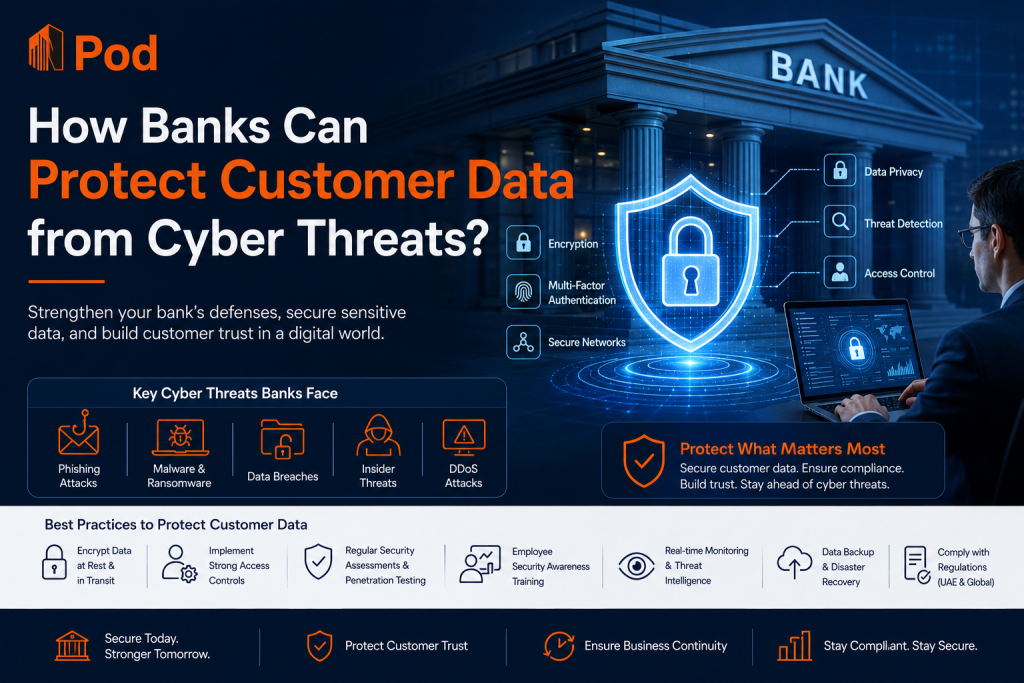
Financial institutions face many different types of banking cyber security challenges. It is important to understand what they are to create an adequate solution.
- Ransomware Attacks
One of the most harmful cyber threats experienced by financial organizations is ransomware attacks. Hackers take control of key business assets and demand payment for returning access. This type of attack can cause significant disruption to the bank’s work, leak sensitive information and lead to financial loss. To mitigate these threats, it is essential to install a ransomware protection tool specifically for banks.
- Phishing and Social Engineering
Cybercriminal often try to target bank staff and clients via phishing or social engineering schemes. The purpose of these activities is to obtain credentials, information about accounts, banking details or access to internal systems.
Special training programs and robust email security solutions will allow you to mitigate this threat effectively.
- Insider Threats
Cybersecurity threats do not always come from the outside. Some attacks are committed by bank employees or vendors who accidentally or purposely expose client data.
Proper access controls and constant monitoring reduce risks associated with insiders.
- Data Breaches
Data breaches could happen due to stolen credentials, vulnerabilities, unpatched systems, misconfigured infrastructure, and application weaknesses. With the gained access, intruders could get their hands on numerous amounts of customer data for monetary gain.
In order to prevent data breaches from causing any damage, it is crucial for banking companies to introduce advanced banking data security solutions.
Essential Strategies for Bank Data Protection
There are several security strategies a financial institution should implement to strengthen bank data protection and effectively protect all sensitive customer information from cyberattacks, unauthorized access, and data breaches.
Implement Strong Access Controls
Access to customer data should be limited to employees based on the business requirement. Only individuals with certain roles need access to sensitive customer data.
Main security measures to implement include:
- Role-based access control
- Multi-factor authentication
- Privileged access management
- Routine access review.
Encrypt Sensitive Data
Data encryption will help keep all customer data safe in case it gets stolen or intercepted, as encrypted data cannot be accessed without special decryption keys.
It is vital for banks to encrypt the following:
- Customer account information
- Financial transactions
- Bank internal communications
- Data stored in backup and archival
Strengthen Endpoint Security
Many bank employees have been accessing systems using several different devices in various places. Every single endpoint is a potential gateway into the network, and therefore there is a need to improve their security status.
The best approach would include the following measures:
- Advanced Antivirus Protection
- Endpoint Detection and Response (EDR)
- Policies Governing Device Management
- Up-to-date Software
Maintain Continuous Security Monitoring
Modern-day cyber threats can go on undetected for long. For this reason, real-time security monitoring is necessary for banks.
Some of the items that security operations teams should monitor continuously include the following:
- User Activities
- Network Traffic
- Log Files
- Authentication Events
- Behaviour of Applications
The Importance of Secure Data Storage for Banks
Data storage plays a crucial part in customer data protection, helping financial institutions keep customer information secure at all times.
The following items should be part of a secure data storage solution for banks:
- Data Encryption While Stored
- Redundant Storage Architecture
- Access Controls
- Backups and Recovery
- Continuous Monitoring and Auditing
Building Resilience with Ransomware Protection for Banks
As cyber threats continue to evolve, traditional security controls are becoming less effective, especially against ransomware. Implementing advanced banking cyber security strategies can help banks prevent attacks, detect threats early, and recover quickly from incidents.
Such ransomware protection for banks may include:
- Immutable Backups
Backups which cannot be tampered with and/or erased provide clean recovery points when all other parts of IT infrastructure are infected with ransomware.
- Network Segmentation
Limiting interactions between systems will decrease chances of spreading malware across multiple servers within the same network.
- Regular Backup Testing
It is necessary to regularly test backups’ availability and efficiency since having backup without restoration capability provides no benefit whatsoever.
- Incident Response Planning
Having a properly developed incident response plan will allow for a quick and efficient reaction to a security threat.
Why Micro Data Centers Are Becoming Important for Banks
As financial services become increasingly distributed, the necessity of having a robust IT infrastructure near user and branch locations grows.
Therefore, a micro data center for banks is needed in order to create a secure environment for processing, storing, and transferring the data of a financial institution.
Advantages of a micro data center for banks include:
- Lower latency for bank operations
- Higher business continuity
- Greater data protection and security
- More localized computing capabilities
- Easier infrastructural control and management
Strengthening Compliance and Governance
With time, regulatory frameworks will grow stricter in regard to securing sensitive customer information. Therefore, banks need to introduce governance structures in order to achieve compliance with these new frameworks.
Areas of focus include:
- Proper data classification policies
- Regular security audits
- Threat and risk assessment
- Vendor security management
- Proper compliance reporting
Creating a Security-First Culture
It is crucial to recognize that technology alone cannot address the problem of cyberattacks. In many ways, employees still make up the biggest component of cybersecurity programs.
The banking industry should consider investing in:
- Security awareness training
- Phishing drills
- Incident reporting procedures
- Continuous cybersecurity learning
Conclusion
Considering the constant development of new methods of cyber-attacks on the banking industry, the problem of ensuring data security in banks remains one of the most important. Ensuring data security in the banking industry requires multiple approaches, including using advanced technologies, secure data storage systems, and staff training.
Implementation of comprehensive banking data security solutions, improvement of secure data storage for banks, ransomware protection, and the application of cutting-edge technology like micro data centers for banks will help attain the best results
FAQs
1. Why is customer data protection important for banks?
Customer data protection is important because banks store highly sensitive financial, personal, and transactional information that cybercriminals actively target. Strong banking data security helps prevent data breaches, fraud, identity theft, and unauthorized access to customer accounts. It also supports regulatory compliance and maintains customer trust. By implementing advanced cybersecurity measures, banks can protect confidential information, reduce operational risks, and ensure uninterrupted banking services in an increasingly digital financial environment.
2. What are the most common cyber threats to customer data in banking?
The most common cyber threats to customer data in banking include ransomware attacks, phishing scams, insider threats, malware infections, credential theft, and data breaches. These attacks are designed to steal sensitive financial information, disrupt banking operations, or gain unauthorized access to systems. Banks can reduce these risks by deploying multi-factor authentication, continuous monitoring, endpoint security, and employee cybersecurity training programs. A proactive security strategy is essential for protecting customer information and maintaining operational resilience.
3. How can banks protect customer data from cyber threats?
Banks can protect customer data from cyber threats by implementing a multi-layered cybersecurity strategy that includes data encryption, access controls, multi-factor authentication, endpoint protection, and real-time monitoring. Regular security audits, employee awareness training, and ransomware protection solutions further strengthen defenses. Financial institutions should also maintain secure backups and incident response plans to ensure rapid recovery from cyber incidents. Combining technology, governance, and employee awareness significantly improves overall banking data protection.
4. How does a micro data center improve customer data security in banks?
A micro data center improves customer data security by providing a secure, self-contained infrastructure for storing and processing banking information closer to branch locations. It integrates physical security, environmental monitoring, backup power, cooling, and access control within a single solution. By reducing latency and supporting localized data processing, a micro data center helps banks improve business continuity, strengthen cybersecurity defenses, and maintain greater control over sensitive customer data and critical banking applications.
5. What cybersecurity measures should banks implement to prevent ransomware attacks?
Banks should implement ransomware protection measures such as immutable backups, network segmentation, endpoint detection and response solutions, regular patch management, and continuous threat monitoring. Employee training and phishing awareness programs are also critical because many ransomware attacks begin through malicious emails. A comprehensive incident response plan helps banks recover quickly if an attack occurs. These cybersecurity measures reduce downtime, protect customer data, and strengthen the overall resilience of banking infrastructure.
6. How can NVIDIA A100 GPUs help banks improve cybersecurity and fraud detection?
NVIDIA A100 GPU help banks improve cybersecurity by accelerating artificial intelligence and machine learning workloads used for fraud detection, threat analysis, and real-time security monitoring. These high-performance GPUs can process large volumes of transaction and security data quickly, enabling banks to identify suspicious activities faster and respond to threats more effectively. NVIDIA A100-powered infrastructure also supports advanced analytics, risk management, and compliance monitoring, helping financial institutions strengthen customer data protection and cybersecurity operations