In this article
With the rise in volume and availability of data produced by interconnected devices, applications, and digital services, speedier data processing becomes a growing necessity. Even though cloud computing remains an integral part of modern IT infrastructure, more businesses are considering edge computing for better performance and more real-time operations.
Far from being mutually exclusive technologies, edge and cloud computing are complimentary to each other. To understand how exactly they can benefit your organization, it’s crucial to explore the connection between them.
Understanding Cloud Computing
Cloud computing refers to on-demand services available in centralized data centers and provides computing resources, including storage, servers, networks, databases, software, etc., to businesses in a flexible and cost-efficient way.
Companies choose to implement cloud computing due to the flexibility it offers—it gives them access to IT assets without significant investments in infrastructure maintenance.
Cloud computing works great when it comes to storing, managing, analyzing, and processing massive volumes of data and applications. It also helps businesses scale their resources according to needs and manage them centrally.
What Is Edge Computing?
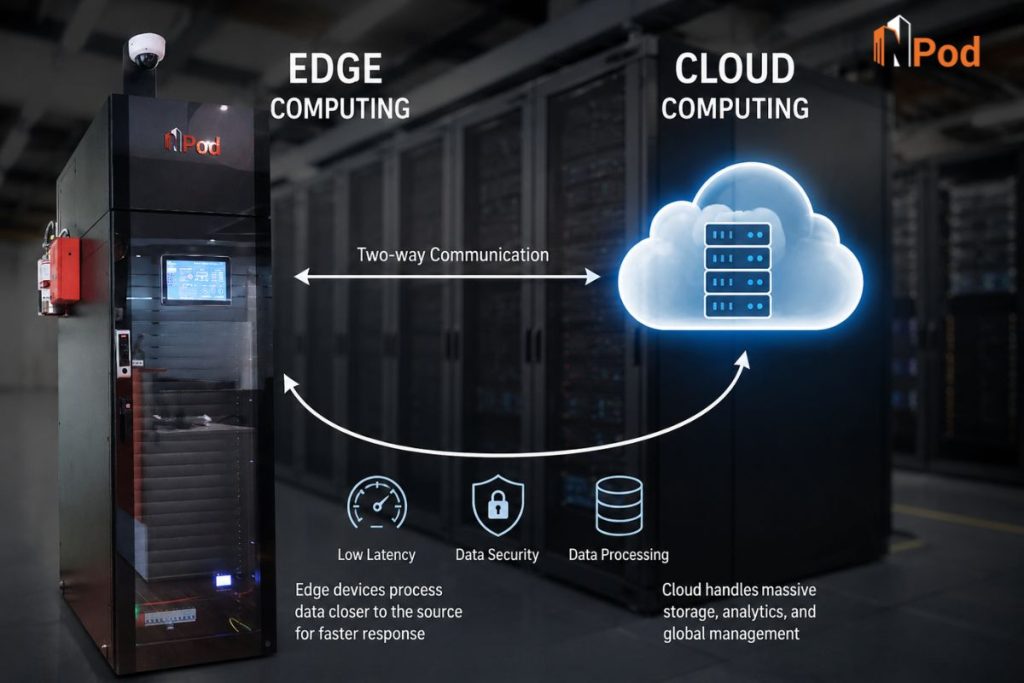
Edge computing refers to a type of distributed computing that involves processing data closer to its sources. Unlike regular cloud computing solutions, which involve transmitting all collected information to a cloud server, edge computing allows analyzing and processing data locally. The latter helps improve speed and reduce latency. Therefore, edge computing works perfectly with applications that require rapid actions and instant response. Among them are such areas as industrial production, smart cities, healthcare services, retail trade, etc.
How Do Edge and Cloud Computing Work Together?
It makes sense to say that edge computing and cloud computing are complementary technologies rather than substitutes. While edge systems deal with time-sensitive information, cloud platforms serve as centralized storage for data analysis and other business processes. In order to understand how these two concepts interact with each other, one needs to examine the roles of edge and cloud computing in one another.
Real-Time Processing at the Edge
Edge computing technology deals with data and provides for processing of this information immediately after it has been collected. For example, industrial sensors monitoring equipment performance can perform necessary analytics using edge systems.
Centralized Storage and Analytics in the Cloud
When all data processing occurs on-premises at the edge, cloud-based services become central for analysis and reporting purposes, as well as storage and long-term management. The information collected from various edge sites may be transferred to the cloud for further analytics and business intelligence purposes.
Cloud-based platforms can also provide the required computational power for advanced machine learning, business analytics, and enterprise software solutions.
The Importance of Micro Data Centers
This technology is defined as a mini-facility equipped with computer hardware, networks, storage devices, and other necessary components but occupying less space compared to conventional data centers. Micro data center can be used close to end users, devices, or other entities that require on-site computing capabilities. Micro data center contribute to edge computing infrastructure since they serve as local facilities where data processing takes place.
Advantages of Implementing Both Edge and Cloud Technologies
By utilizing edge computing along with cloud computing, enterprises may benefit from various advantages.
1. Lower Latency
Data processing occurs close to where data originates; hence, response times may decrease for certain processes that require quick response rates.
2. Reduced Bandwidth Usage
As mentioned earlier, edge systems may handle data processing locally, transmitting only useful information to the cloud to reduce traffic load and lower bandwidth costs.
3. Improved Reliability
During network outages, edge devices can still execute vital operations. The synchronization process will begin once the connection is restored.
4. Better Scalability
Cloud platforms offer scalable storage options and analytics tools, while edge infrastructure enables local processing of data. Therefore, the combined solution offers businesses flexibility to scale their operations effectively.
Common Business Applications
The combination of edge and cloud computing is used across many industries. The former is employed in manufacturing organizations to monitor equipment and store data in the cloud, whereas the latter is applied to process patient information in healthcare organizations while keeping patient data stored. Retail organizations utilize edge computing for inventory control and analysis and rely on the cloud to deliver business intelligence and reporting services.
Choosing the Right Edge Computing Solution
The selection of the right edge computing solution will depend on the business needs, application requirements, security measures, and other factors.
Businesses should opt for products that integrate easily with cloud infrastructure and offer robust local computing performance. With the right product, organizations are able to leverage the capabilities of edge computing and enjoy cloud services at the same time.
Conclusion
The association between edge and cloud computing is collaborative in nature instead of being competitive. Edge computing allows for rapid, localized computation of real-time applications, whereas cloud computing offers centralized storage, analysis, and management options.
By leveraging innovations like the micro data center, companies can design their systems to enhance efficiency and minimize latency in order to prepare for future scaling. In an age where digital transformation is occurring at an unprecedented rate, integrating cloud computing solutions with an appropriate edge computing framework will enable companies to function more effectively.
Faq’s
1: What is the difference between an edge data center and a traditional data center?
An edge data center is deployed closer to users and connected devices, enabling faster data processing and lower latency. A traditional data center is typically centralized and designed to handle large-scale computing, storage, and networking requirements.
2: Why are edge data centers important for modern businesses?
Edge data centers help businesses process data closer to where it is generated, improving application performance, reducing network congestion, and supporting real-time workloads such as IoT, AI, and smart infrastructure.
3: How do edge data centers support cloud computing?
Edge data centers handle local data processing and immediate workloads, while cloud platforms provide centralized storage, analytics, and management. Together, they create a flexible and efficient IT environment.
4: What industries benefit most from edge data centers?
Industries such as manufacturing, healthcare, retail, education, telecommunications, and smart cities benefit from edge data centers because they require fast, reliable, and localized data processing.
5: Can a micro data center be used as an edge data center?
Yes. A micro data center is often deployed as an edge data center because it provides computing, storage, cooling, power protection, and monitoring in a compact footprint, making it ideal for remote and space-constrained locations.
6. What is an edge data center and how does it work?
An edge data center is a compact IT facility located closer to users, devices, or applications. It processes and stores data locally, reducing latency and improving performance while connecting to the cloud for centralized management, analytics, and long-term storage.
7. What are cloud storage services, and why are they important?
Cloud storage services allow businesses to securely store, manage, and access data over the internet without relying on on-premises storage infrastructure. They provide scalability, data protection, remote accessibility, and cost efficiency, making it easier for organizations to safeguard critical information and support business continuity.