Introduction
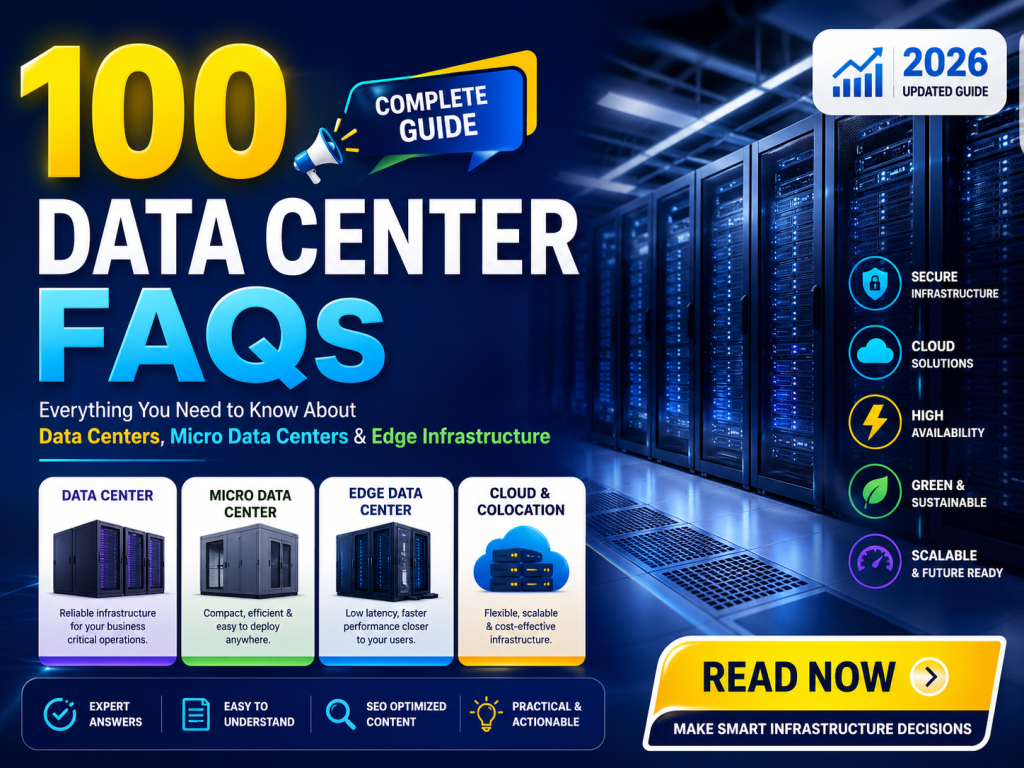
Digital transformation is accelerating across every industry, making reliable IT infrastructure more important than ever. From cloud hosting and AI workloads to business continuity and cybersecurity, choosing the right data center strategy can directly impact growth and performance.
This complete FAQ guide answers the most searched questions about micro data center, edge data center, colocation, cooling systems, security, and future trends. Whether you are a business owner, IT manager, startup founder, or investor, these practical answers will help you make smarter infrastructure decisions.
1. What is a data center and why is it important?
A data center is a secure facility that houses servers, storage devices, and networking systems used to run websites, cloud platforms, applications, and business operations. It is important because it ensures uptime, fast performance, cybersecurity, and safe data storage. Modern businesses rely on dependable infrastructure to avoid downtime and support digital growth.
2. Define data center in simple words.
To define data center simply, it is a place where computers and servers are kept to process, store, and manage digital information. Businesses use these facilities for emails, databases, websites, software, and backups. It acts like the engine room of the internet, supporting many services people use daily.
3. What is the data center meaning in business?
The data center meaning in business refers to a facility that supports critical IT systems and operations. It stores company data, powers applications, and enables communication tools. Whether physical or cloud-based, it helps businesses maintain productivity, security, and service availability in an increasingly digital environment.
4. What is a data center server room?
A data center server room is a dedicated room inside an office or facility where servers, switches, and storage systems are installed. It usually includes cooling, backup power, fire protection, and access control. Many small companies begin with a server room before moving to a larger professional hosting facility.
5. What is the difference between a server room and data center?
A server room is usually a smaller internal space with limited equipment, while a professional data center is purpose-built for scale, uptime, cooling, and security. Data centers offer stronger redundancy, better connectivity, and room for growth. Businesses often upgrade when internal rooms become costly or difficult to maintain.
6. What is a micro data center?
A micro data center is a compact, self-contained IT unit that includes servers, cooling, power backup, and monitoring in one enclosure. It is designed for branch offices, factories, retail stores, and remote sites. It offers enterprise-level computing where building a full facility is unnecessary or impractical.
7. What is an edge data center?
An edge data center is a smaller facility located close to users or connected devices to reduce latency and improve speed. It is commonly used for IoT, gaming, AI analytics, video streaming, and smart manufacturing. Businesses choose edge infrastructure when fast local processing is essential.
8. What is a data rack used for?
A data rack is a structured cabinet or frame used to organize servers, switches, and storage devices vertically. It helps improve airflow, cable management, security, and maintenance efficiency. Racks are essential in modern IT setups because they maximize space while keeping equipment neatly arranged.
9. What is a smart rack in a data center?
A smart rack is an advanced server rack with built-in sensors, remote monitoring, power tracking, and access controls. It helps businesses monitor temperature, energy use, and equipment status in real time. Smart racks improve efficiency, security, and uptime in both enterprise and edge environments.
10. What is a server tower?
A server tower is a standalone server designed in a vertical tower shape, similar to a desktop computer. It is commonly used by small businesses needing basic IT infrastructure. Tower servers are easy to deploy, cost-effective, and suitable for offices with limited technical requirements.
11. What are containerized data centers?
Containerized data centers are modular facilities built inside shipping-container-style units that include servers, cooling, racks, and power systems. They are ideal for remote locations, temporary projects, military operations, and rapid deployment needs. Businesses choose them when speed and portability are more important than permanent construction.
12. What is a portable data center?
A portable data center is a movable IT solution that can be deployed quickly where computing resources are needed. It is useful for field projects, events, emergency response, and temporary business expansion. Portable systems provide flexibility while maintaining core infrastructure capabilities such as power, cooling, and connectivity.
13. What is a data centre container?
A data centre container is a prefabricated modular unit converted into a compact IT facility. It includes racks, cooling systems, security, and backup power. Organizations use these solutions when they need faster deployment, lower construction time, or mobile infrastructure in changing environments.
14. What is a colocation data center?
A colocation data center allows businesses to place their own servers in a third-party facility. The provider supplies power, cooling, bandwidth, and physical security while the customer controls the hardware. It is popular because it reduces infrastructure costs while delivering enterprise-grade reliability and uptime.
15. What is a cloud data center?
A cloud data center is a physical facility that powers cloud computing services such as storage, virtual machines, databases, and SaaS platforms. Users access resources online instead of owning hardware. Cloud solutions help businesses scale faster, lower upfront investment, and support remote work environments.
16. What is data center architecture?
Data center architecture refers to the design of servers, storage, networking, cooling, security, and power systems within a facility. Good architecture ensures efficiency, uptime, and future growth. Businesses should prioritize scalable design so infrastructure can support increasing workloads without expensive redesign later.
17. What is data center network architecture?
Data center network architecture is the layout used to connect servers, switches, routers, firewalls, and storage systems. It determines traffic flow, speed, and redundancy. A strong network design helps prevent bottlenecks, improves security, and supports high-performance workloads such as cloud applications and AI systems.
18. What is data center scalability?
Data center scalability means the ability to increase computing power, storage, and network capacity as business demand grows. Scalable infrastructure helps organizations add users, applications, or locations without major disruptions. It is especially important for startups and fast-growing companies planning future expansion.
19. What is green data center technology?
A green data center uses energy-efficient cooling, renewable power, smart monitoring, and optimized hardware to reduce environmental impact. These facilities lower electricity costs and support sustainability goals. Many enterprises now prefer eco-friendly providers as part of long-term ESG and operational efficiency strategies.
20. What are data center energy reduction solutions?
Data center energy reduction solutions include server consolidation, virtualization, airflow management, efficient cooling systems, LED lighting, and AI monitoring tools. These strategies help reduce power consumption and operating costs. Energy efficiency is increasingly important as businesses expand digital infrastructure and sustainability commitments.
21. What is data center liquid cooling?
Data center liquid cooling uses liquids instead of air to remove heat from high-density servers and processors. It is highly effective for AI workloads, GPU clusters, and advanced computing environments. Liquid cooling improves efficiency, lowers energy use, and supports higher rack performance safely.
22. What is a hyperscale data center?
A hyperscale data center is a massive facility designed for cloud platforms, streaming services, AI systems, and global digital demand. It contains thousands of servers with highly automated operations. Hyperscale centers are built for efficiency, scalability, and the ability to support millions of users.
23. How many data center in India are there?
When asking how many data center in India, the number continues to rise due to growing demand. India has dozens of major commercial facilities and many enterprise sites across Mumbai, Chennai, Noida, Hyderabad, Pune, and Bangalore. Capacity is expanding rapidly with cloud and AI investments.
24. Which is the biggest data center in India?
The biggest data center in India can change as new campuses launch, but Mumbai and Chennai currently host some of the largest hyperscale developments. These facilities serve cloud providers, banks, enterprises, and digital platforms requiring large power capacity, strong connectivity, and room for expansion.
25. Why is server relocation important for businesses?
Server relocation is important when businesses move offices, merge operations, or upgrade facilities. Proper planning protects equipment, minimizes downtime, and ensures business continuity. Professional relocation includes backups, transport security, cable mapping, testing, and recovery planning so systems resume operations quickly and safely.
26. What is the biggest data center in the world?
The biggest data center in the world is usually measured by total floor space, power capacity, or server volume. Rankings can change as new hyperscale campuses are built. These massive facilities support cloud computing, AI workloads, streaming platforms, and enterprise hosting for millions of users globally.
27. What is the largest data center in the world?
The largest data center in the world often refers to mega-scale campuses designed for nonstop digital operations. They include advanced cooling, redundant power systems, strong security, and thousands of servers. These facilities are built to handle growing demand from cloud services, storage, and high-performance computing.
28. What is an AI data center?
An ai data center is a facility optimized for machine learning, deep learning, and analytics workloads. It typically uses GPU servers, high-density racks, fast networking, and advanced cooling. AI data centers help organizations train models faster and process complex data more efficiently at scale.
29. What are data center images used for?
Data center images are used in marketing materials, blogs, training, architecture planning, and presentations. They help explain racks, cooling systems, cabling, and facility layouts visually. Businesses also use image data center searches to create trustworthy content and showcase infrastructure capabilities to customers.
30. What is a colo data center?
A colo data center is another name for a colocation facility where businesses rent rack space and install their own servers. The provider handles cooling, security, power, and internet connectivity. It is ideal for companies wanting hardware control without building a private data center.
31. What are data center companies in India?
Data center companies in India include colocation providers, telecom operators, cloud infrastructure firms, and managed service companies. They support enterprises, startups, government workloads, and hyperscale demand. Major hubs include Mumbai, Chennai, Noida, Hyderabad, Pune, and Bangalore with continued market expansion.
32. Why is data center in India growing fast?
The data center in India market is growing rapidly due to cloud adoption, digital payments, OTT streaming, AI applications, and government digitization. Businesses increasingly need secure local hosting and low-latency services. Rising internet users and enterprise transformation are also driving strong investment.
33. Why is data center in Mumbai important?
A data center in Mumbai is highly important because Mumbai is India’s financial hub and a key landing point for international subsea cables. It offers excellent connectivity, enterprise demand, and access to major banking and fintech customers requiring reliable digital infrastructure.
34. Why choose a data center in Chennai?
A data center in Chennai is attractive because the city offers strong cable landing connectivity, strategic coastal access, and growing enterprise demand. Chennai is becoming a major hosting destination for cloud providers and businesses seeking disaster recovery or South India infrastructure expansion.
35. Why is data center in Noida in demand?
A data center in Noida is in demand because it serves Delhi NCR businesses, startups, public sector organizations, and enterprises needing low-latency services in North India. The region offers strong connectivity, growing commercial demand, and proximity to key decision-making markets.
36. Why are data centers in Hyderabad expanding?
Data centers in Hyderabad are expanding due to the city’s strong IT ecosystem, startup growth, skilled workforce, and rising cloud demand. Hyderabad has become a strategic technology hub where enterprises seek scalable infrastructure with modern facilities and future expansion opportunities.
37. Why are data centers in Bangalore popular?
Data centers in Bangalore are popular because Bangalore is India’s leading technology city with high demand from SaaS firms, IT companies, startups, and R&D centers. Businesses prefer hosting close to operations for better performance, lower latency, and easier infrastructure access.
38. Why choose a data center in Pune?
A data center in Pune is often chosen for western India operations, disaster recovery setups, and cost-efficient expansion. Pune’s growing IT ecosystem and proximity to Mumbai make it attractive for businesses needing reliable infrastructure without some of the congestion challenges of larger metros.
39. How can I find data centers near me?
To search data centers near me, compare providers based on uptime guarantees, certifications, support quality, carrier connectivity, pricing, and scalability. Local proximity may reduce latency and make site visits easier. Businesses should also review disaster recovery readiness before selecting a provider.
40. What is data center infrastructure?
Data center infrastructure includes servers, storage arrays, racks, networking devices, cooling systems, UPS units, generators, and security controls. It forms the foundation of digital operations. Reliable infrastructure helps businesses run applications smoothly while minimizing downtime and operational risk.
41. What is data center infrastructure management?
Data center infrastructure management (DCIM) is software used to monitor power, cooling, rack capacity, assets, and environmental conditions. It helps operators improve efficiency, reduce downtime, and plan expansions intelligently. DCIM is increasingly important for modern facilities seeking automation and visibility.
42. What are data center types?
Common data center types include enterprise data centers, cloud data centers, colocation facilities, hyperscale campuses, micro data centers, and edge sites. Each serves different needs depending on ownership, scale, budget, and performance requirements. Businesses should choose based on workload strategy.
43. What is an old data center?
An old data center usually refers to a legacy facility with outdated cooling, limited power capacity, lower rack density, and less automation. These sites often cost more to operate. Many organizations modernize or migrate to improve efficiency, reliability, and future readiness.
44. What is data center cooling system?
A data center cooling system controls temperature and humidity to keep servers operating safely. It may include CRAC units, chilled water systems, in-row cooling, or liquid cooling technologies. Effective cooling reduces failure risk, improves performance, and supports dense modern workloads.
45. What is data center networking?
Data center networking is the system that connects servers, storage devices, firewalls, switches, and routers for secure communication. Strong networking ensures speed, redundancy, and uninterrupted access to applications. It is critical for cloud platforms, enterprise systems, and real-time digital services.
46. What is data center rack used for?
A data center rack is used to mount servers, storage units, and networking equipment in a vertical structured format. It improves airflow, cable organization, security, and maintenance access. Standard racks help maximize space and support scalable infrastructure growth efficiently.
47. What is data center building design?
Data center building design focuses on power redundancy, floor loading, airflow planning, fire protection, physical security, and future expansion capacity. A well-designed facility reduces downtime risk and improves operating efficiency. Smart design is essential for long-term infrastructure success.
48. What is data center outage and why is it serious?
A data center outage is an example of IT disruption that can impact websites, payment systems, cloud apps, and internal operations. Causes may include power failures, network issues, cooling problems, or cyberattacks. Strong redundancy planning helps reduce downtime impact significantly.
49. What is data recovery center?
A data recovery center specializes in recovering lost, damaged, or corrupted data from hard drives, SSDs, servers, and RAID systems. Businesses use these services after accidental deletion, hardware failure, ransomware incidents, or disasters. Fast recovery helps minimize operational disruption.
50. How do I find data recovery center near me?
To find a data recovery center near me, compare provider experience, cleanroom facilities, success rates, confidentiality standards, and emergency support options. Businesses should choose specialists familiar with enterprise servers, RAID systems, and critical storage devices for the best recovery outcomes.
51. What are data center stocks?
Data center stocks are shares of companies involved in digital infrastructure such as colocation providers, REITs, telecom firms, cooling manufacturers, and cloud operators. Investors watch this sector because data demand continues to grow. These businesses may benefit from AI expansion, enterprise cloud adoption, and rising internet usage worldwide.
52. Why are data center stocks in India gaining attention?
Data center stocks in India are gaining attention because India’s digital economy is expanding rapidly. Growth in fintech, cloud computing, OTT streaming, e-commerce, and AI creates demand for modern infrastructure. Investors often see this sector as a long-term opportunity linked to technology and enterprise transformation.
53. Which are top data center stocks in India?
Top data center stocks in India often include companies with exposure to telecom infrastructure, IT parks, colocation, engineering services, or cloud facilities. Rankings change based on market performance and business execution. Investors should review financial strength, expansion plans, and actual data center revenue contribution.
54. What are best data center stocks in India for long term?
The best data center stocks in India for long term are usually companies with strong balance sheets, recurring revenue, quality management, and infrastructure growth plans. Firms investing in hyperscale campuses or digital ecosystems may hold advantage. Always research valuation and business risk before investing.
55. What are data center stocks India trends in 2026?
Data center stocks India trends in 2026 may include rising investor interest around AI infrastructure, renewable-powered campuses, and large-scale cloud demand. Market sentiment can also depend on interest rates, regulations, and execution quality. Watching capacity expansion and occupancy levels is useful.
56. Are there data center penny stocks in India?
Some investors search for data center penny stocks in India, but lower-priced shares often involve higher volatility and risk. Many small companies may have only indirect exposure to infrastructure. It is wise to verify fundamentals, debt levels, and genuine business operations before investing.
57. What are top 20 listed data center companies in India?
Searches for top 20 listed data center companies in India usually include firms with direct or indirect exposure through telecom, REITs, IT infrastructure, and managed hosting. Lists change over time. Investors should verify whether data centers are core revenue drivers or secondary business lines.
58. What are top data center companies in India?
Top data center companies in India generally operate large facilities in Mumbai, Chennai, Noida, Hyderabad, Pune, and Bangalore. They serve enterprises, cloud platforms, banks, and government clients. Key strengths include uptime, network density, scalability, security certifications, and managed support services.
59. What is server relocation?
Server relocation is the process of moving servers, storage systems, and networking equipment from one site to another safely. It includes planning, shutdown, labeling, transport, reinstallation, and testing. Businesses relocate during office moves, mergers, upgrades, or migration to a colocation facility.
60. How do companies relocate server equipment safely?
To relocate server equipment safely, companies create detailed migration plans, backups, asset lists, and downtime schedules. Hardware is packed securely, transported carefully, reinstalled, and tested before going live. Many providers say your safety is our priority to highlight careful risk management.
61. What is server room in house setup?
A server room in house setup means a business keeps servers inside its own office or building rather than using external hosting. This offers direct control but requires cooling, power backup, physical security, and regular maintenance. Growing companies often outgrow internal rooms over time.
62. Why do businesses upgrade from sever room to data center?
Many businesses move from a sever room or small office IT room to a professional facility for better uptime, cooling, bandwidth, and security. Internal spaces often face power limits and maintenance issues. Data centers provide stronger reliability and easier future expansion.
63. What is the difference between server tower and rack server?
A server tower is a standalone vertical server often used in smaller offices, while rack servers mount inside cabinets or a data rack. Rack servers are ideal for scalable environments. Businesses choose based on space, workload needs, and growth plans.
64. What is Iron Mountain data center known for?
Iron Mountain data center facilities are widely recognized for secure infrastructure, compliance-focused hosting, and enterprise-grade colocation services. Many organizations value providers with strong reputation, physical security, and disaster recovery expertise when choosing mission-critical hosting environments.
65. What is Gujarat State Data Center?
The Gujarat State Data Center refers to government digital infrastructure supporting e-governance systems, citizen services, departmental applications, and secure public-sector workloads. State facilities help centralize IT resources, improve efficiency, and strengthen service delivery for government operations.
66. What is global data research center?
A global data research center generally refers to organizations or institutes studying data trends, digital infrastructure, analytics, or market growth worldwide. They may publish reports on cloud adoption, AI demand, networking changes, and future technology opportunities for businesses and investors.
67. What is data center in cloud computing?
A data center in cloud computing is the physical infrastructure where cloud providers run servers, storage, and networking systems. While users access services virtually, workloads still operate inside real facilities. These centers power SaaS platforms, databases, backups, and virtual machines.
68. Why is cloud data center demand increasing?
Demand for a cloud data center is increasing because businesses want flexible scaling, lower upfront costs, and faster deployment of IT resources. Cloud platforms also support remote work, startups, and global operations. AI workloads are adding even more demand for capacity.
69. What is data center icon used for?
A data center icon is commonly used in websites, dashboards, mobile apps, and presentations to visually represent servers, cloud systems, hosting, or IT infrastructure. Clear icons improve user experience by helping people quickly identify technical functions and infrastructure topics.
70. Why do people search image data center online?
People search image data center content for presentations, blogs, architecture references, training materials, and sales pages. Visual examples help explain server rooms, cooling systems, racks, and facility layouts. Strong imagery also helps businesses build trust in infrastructure marketing.
71. What is biggest data center in India used for?
The biggest data center in India is typically used for hyperscale cloud workloads, banking systems, enterprise hosting, AI processing, and disaster recovery. Large campuses offer strong connectivity, high power capacity, and expansion space for rapidly growing digital demand.
72. Why are hyperscale data center facilities important?
A hyperscale data center is important because it supports massive workloads for cloud computing, streaming, search engines, and AI systems. These facilities are built for automation, efficiency, and rapid scaling. They help global platforms serve millions of users reliably.
73. What are containerized data centers used for today?
Containerized data centers are used today for telecom expansion, mining sites, military operations, temporary projects, and disaster recovery. Their modular design enables quick deployment where permanent construction is difficult. They are valuable when flexibility and speed matter most.
74. Why choose portable data center solutions?
A portable data center is useful when organizations need computing resources in temporary, remote, or mobile environments. It can be deployed quickly and moved later if needed. Industries such as defense, energy, events, and construction often benefit from this flexibility.
75. What makes micro data center popular in 2026?
The micro data center is popular in 2026 because businesses need local computing, faster deployment, stronger security, and lower latency. It combines power, cooling, monitoring, and server capacity in a compact unit. Demand is growing across retail, healthcare, and manufacturing sectors.
76. Why is edge data center demand rising quickly?
An edge data center is growing rapidly because businesses need faster computing closer to users and connected devices. Applications like IoT, video analytics, gaming, autonomous systems, and smart factories require low latency. Edge facilities reduce delay, improve reliability, and lessen dependence on distant centralized infrastructure.
77. How does edge data center reduce latency?
An edge data center reduces latency by processing data near the source instead of sending everything to a faraway cloud region. Shorter travel distance means quicker response times and smoother performance. This is especially valuable for healthcare monitoring, industrial automation, and real-time customer applications.
78. Can edge data center replace traditional data center?
An edge data center usually complements rather than fully replaces a traditional data center. Core facilities still manage backups, large storage, analytics, and centralized workloads. Edge locations handle time-sensitive processing locally. Many businesses adopt hybrid models combining both approaches for efficiency and performance.
79. What industries benefit most from edge data center?
Industries benefiting most from an edge data center include telecom, healthcare, retail, logistics, gaming, manufacturing, and smart city projects. These sectors depend on real-time decisions, connected devices, or customer experiences where speed matters. Local processing can improve uptime, efficiency, and user satisfaction.
80. What is future of edge data center in India?
The future of edge data center growth in India looks strong due to 5G rollout, smart city initiatives, AI adoption, and increasing digital consumption. Businesses need faster local compute resources outside major metros. Tier-2 and Tier-3 cities may also see significant expansion.
81. How does micro data center help small businesses?
A micro data center helps small businesses by delivering enterprise-grade computing in a compact package. It includes power backup, cooling, monitoring, and secure server space without needing a large server room in house. This reduces setup complexity, cost, and space requirements.
82. Is micro data center secure?
Yes, a micro data center can be highly secure when equipped with access control, locked cabinets, environmental sensors, fire suppression, and remote monitoring. Many businesses use them in branch locations where secure local processing is needed without building a traditional facility.
83. Where can micro data center be installed?
A micro data center can be installed in offices, factories, hospitals, warehouses, retail stores, schools, telecom sites, and branch locations. Because it is compact and self-contained, it works well where space is limited but reliable local IT infrastructure is still required.
84. Is micro data center energy efficient?
A micro data center is often energy efficient because power and cooling systems are right-sized for smaller workloads. Instead of running an oversized room server setup, businesses use compact optimized infrastructure. This can lower energy waste and improve operating efficiency.
85. What is data center liquid cooling best for?
Data center liquid cooling is best for AI clusters, GPU servers, dense compute racks, and workloads that generate intense heat. Liquids can remove heat more effectively than traditional air systems in many cases. This helps improve efficiency and supports high-performance processing environments.
86. Why are green data center projects increasing?
Green data center projects are increasing because companies want lower electricity costs, reduced emissions, and stronger ESG performance. Operators are adopting renewable energy, efficient cooling, and smarter infrastructure management. Sustainability has become both a business advantage and environmental priority.
87. What are smart rack benefits in data center?
A smart rack offers benefits such as temperature monitoring, power tracking, remote locking, access logs, and automated alerts. These features help detect issues early and improve uptime. Smart racks are especially useful in distributed environments and modern data center infrastructure strategies.
88. Why is data center scalability important for startups?
Data center scalability is important for startups because growth can happen quickly and unpredictably. Scalable infrastructure allows them to add storage, users, servers, and bandwidth without rebuilding systems. This helps manage costs early while supporting expansion when demand increases.
89. What are data center energy reduction solutions for enterprises?
Data center energy reduction solutions for enterprises include virtualization, server consolidation, airflow optimization, liquid cooling, AI monitoring, and renewable energy sourcing. These strategies reduce operating expenses while maintaining performance. Energy efficiency improvements often deliver strong long-term returns for larger organizations.
90. Why do companies modernize old data center facilities?
An old data center may suffer from poor efficiency, outdated cooling, limited rack density, and higher downtime risk. Companies modernize to lower costs, improve reliability, strengthen security, and support cloud or AI workloads. Upgrades also help meet modern compliance expectations.
91. What is data center outage risk management?
Since a data center outage is an example of IT disruption, risk management focuses on backup power, redundant networking, monitoring tools, disaster recovery plans, and failover systems. Businesses reduce downtime by testing emergency procedures and using multiple locations when possible.
92. How does colocation data center save money?
A colocation data center saves money by sharing facility costs such as cooling, power systems, security, and bandwidth across many tenants. Businesses avoid the expense of building private infrastructure while keeping ownership of their hardware and maintaining operational control.
93. Why choose cloud data center over in-house servers?
A cloud data center offers faster deployment, flexible scaling, lower upfront investment, and remote accessibility compared with in-house servers. Businesses can launch workloads quickly without managing physical hardware. This is especially valuable for growing companies and distributed teams.
94. What is data center network architecture best practice?
Best practice for data center network architecture includes redundancy, segmentation, secure firewalls, high-speed switching, and scalable design. Strong architecture prevents bottlenecks, improves resilience, and supports critical applications. Businesses should plan networks for both current demand and future expansion.
95. What is data center building security?
Data center building security includes perimeter fencing, CCTV, guards, biometric access, visitor controls, and mantrap entry systems. Physical protection is essential because facilities contain critical infrastructure. Security layers usually work alongside cybersecurity tools for complete risk management.
96. Why are data centers near me useful for businesses?
Searching data centers near me can help businesses find lower-latency hosting, easier site visits, and faster hands-on technical support. Local proximity may also simplify compliance, audits, and disaster recovery planning. Nearby facilities are especially useful for hybrid IT strategies.
97. What is biggest advantage of hyperscale data center?
The biggest advantage of a hyperscale data center is efficiency at massive scale. These facilities optimize cooling, automation, procurement, and power usage across thousands of servers. This lowers unit costs and supports large workloads for cloud platforms, streaming, and AI systems.
98. Why is data center in Mumbai still dominant?
A data center in Mumbai remains dominant because of strong connectivity, financial sector demand, enterprise concentration, and access to submarine cable networks. These advantages make Mumbai a strategic gateway for national and international digital traffic within India.
99. How do data center companies choose new locations?
Data center companies choose new locations based on power availability, land cost, connectivity, climate, regulations, tax incentives, and customer demand. Proximity to enterprise hubs also matters. Reliable utilities and room for future expansion are major decision factors.
100. What is future of data center industry globally?
The future of the data center industry looks strong due to AI growth, cloud expansion, edge computing, and rising digital consumption. Expect more automation, liquid cooling, sustainable design, and distributed infrastructure combining hyperscale, edge, and micro data center models.
Conclusion
The right infrastructure can improve uptime, reduce costs, strengthen security, and prepare your business for future growth. Whether you need a traditional data center, a flexible cloud data center, a compact micro data center, or a fast edge data center, informed planning creates long-term value.
Use this guide as a trusted resource when comparing providers, planning upgrades, or understanding where digital infrastructure is heading in 2026 and beyond.