By Manish Sharma, Cloud Computing & Data Center Specialist | Published: April 21, 2026 | Last Updated: May 14, 2026 | 12 min read
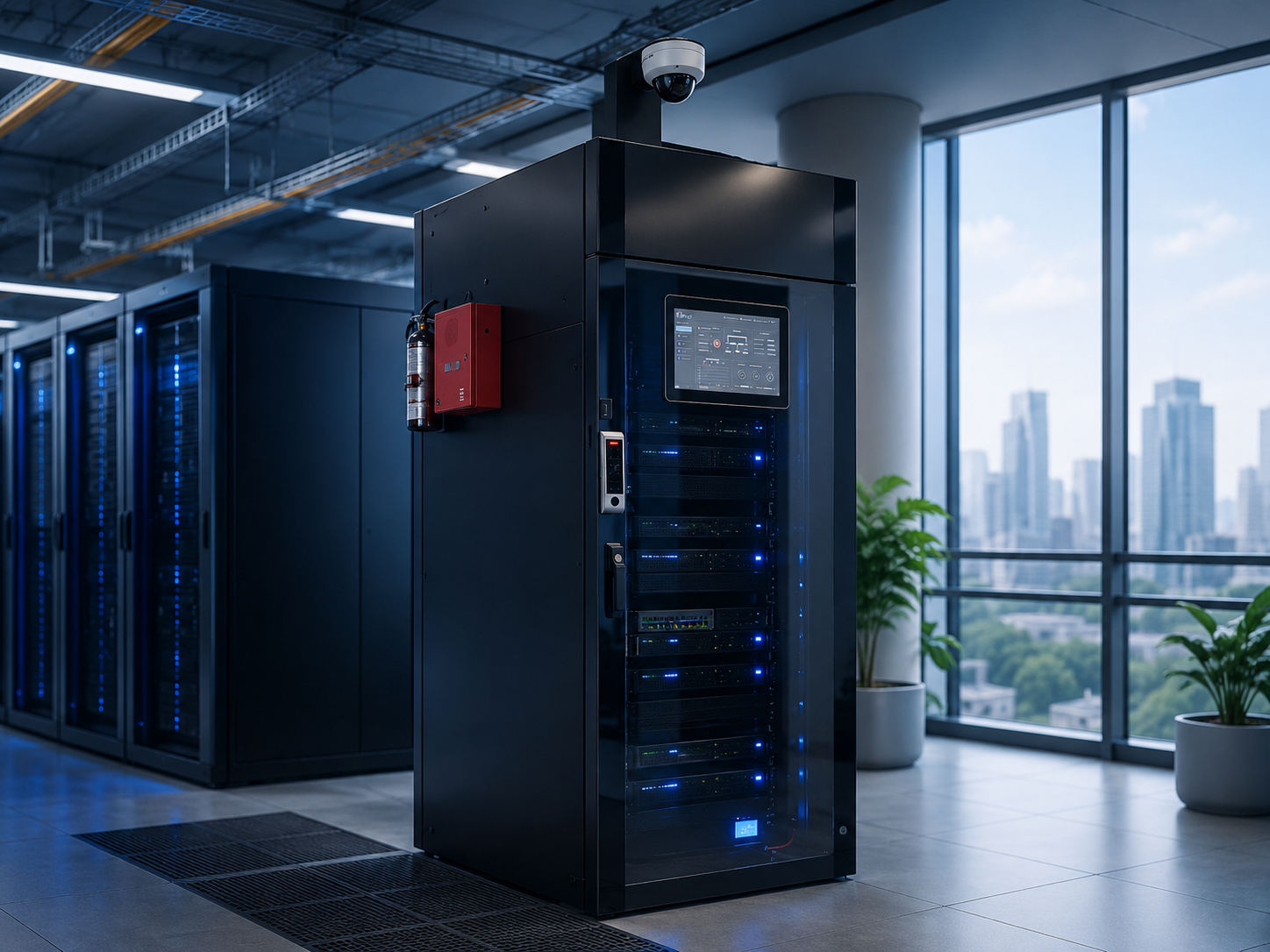
A micro data center solves three problems at once: it brings low-latency computing to the edge, enables rapid deployment in remote or branch locations, and delivers enterprise-grade IT infrastructure without building a full facility from scratch. It integrates GPU servers, storage, networking, precision cooling, UPS power backup, and fire suppression into a single pre-engineered enclosure.
As GPU-powered AI and machine learning workloads grow across Indian enterprises, deploying them in centralized cloud environments is no longer always practical. Micro data centers bring GPU compute closer to where the data is generated, reducing latency, cutting cloud costs, and enabling real-time inference at the edge. GPUs need power, cooling, and proximity to data. Micro data centers deliver all three in a compact, deployable unit, making them the natural home for edge AI and GPU-accelerated workloads in India.
Why Micro Data Center Are Gaining Popularity in India
India is one of the world’s fastest-growing digital economies, with over 900 million internet users and massive government investment in digital infrastructure. Traditional large-scale data center while powerful, cannot always serve the needs of enterprises that require
low-latency computing at the edge, rapid deployment in remote locations, or cost-effective IT infrastructure without building a full facility from scratch.
Industries driving demand include:
- Telecom: 5G rollout requires edge compute near network hubs
- BFSI: branch offices need compliant, low-latency processing
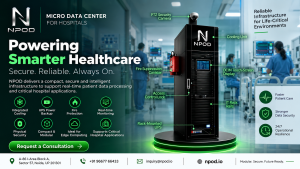
- Healthcare: edge diagnostics and real-time patient data processing
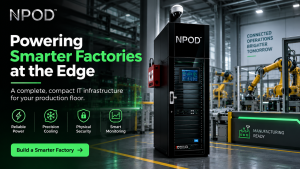
- Manufacturing: Industry 4.0 and IoT workloads on factory floors
- Government: smart cities, e-governance, and MEITY-compliant deployments
- AI/ML: GPU inference at the edge without cloud dependency
The India micro data center market is projected to grow from USD 153 million in 2023 to USD 748 million by 2032, at a CAGR of 18.55%. This growth is driven by 5G rollout, IoT adoption, data localization mandates under India’s DPDP Act, and rapidly rising demand for edge AI infrastructure.
A micro data center solves all three problems. It integrates GPU servers, storage, networking, precision cooling, power backup (UPS), and fire protection suppression into a single, pre-engineered enclosure. Industries driving demand include telecom (5G rollout), BFSI (branch offices), healthcare (edge diagnostics), manufacturing (Industry 4.0), and government (smart cities, e-governance).
GPU servers need power, cooling, and proximity to data. Micro data centers deliver all three in a compact, deployable unit — making them the natural home for edge AI and GPU-accelerated workloads in India.
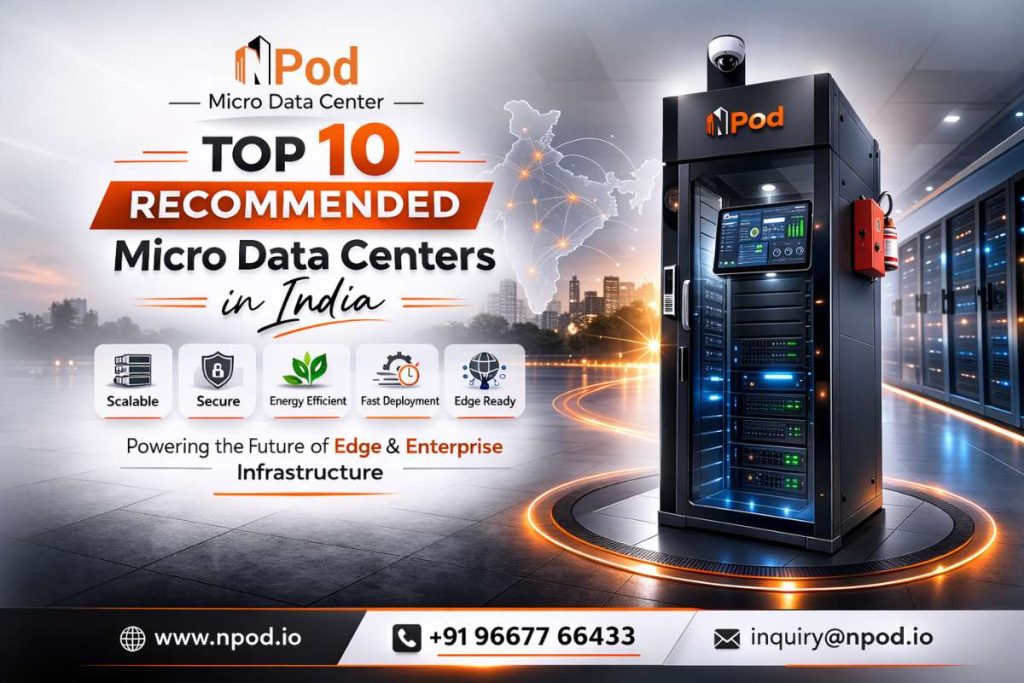
Top 10 Micro Data Center Providers in India (2026)
NPOD – Micro Data Center by NetforChoice
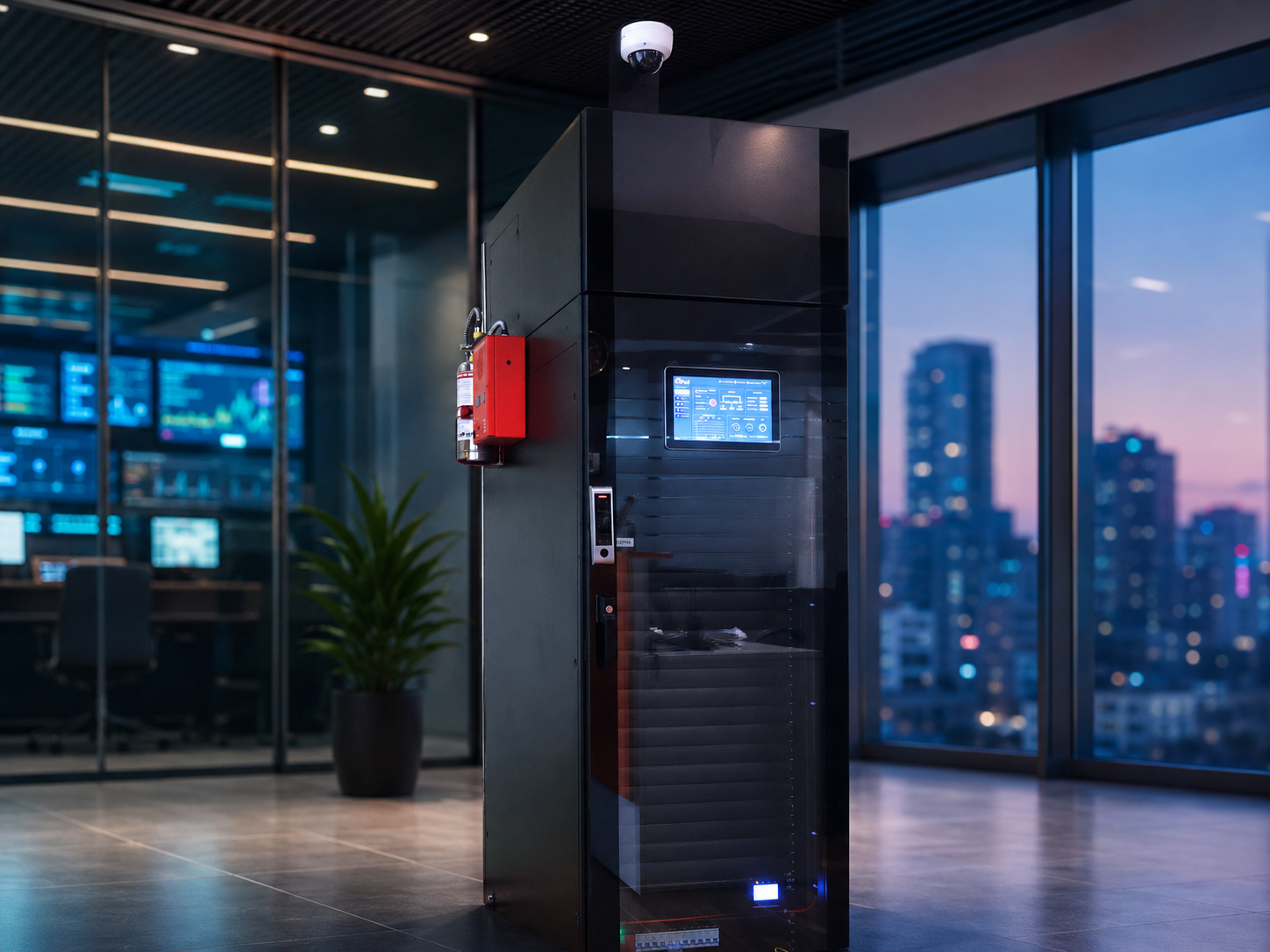
Best for: Enterprises, BFSI, Telecom, Healthcare, Government, Edge AI deployments.
✔ MEITY Empaneled ✔ ISO Certified ✔ Deployed in 4–6 Weeks ✔ 24/7 Support
Netweb Technologies
GPU Ready
Private Cloud
Netweb Technologies is a Mumbai-based IT infrastructure manufacturer focused on high-performance computing. Their container data center solutions bundle compute, storage, private cloud, and GPU-ready servers into integrated systems. Their solutions are widely used by research institutions, animation studios, and enterprises running AI workloads at the edge, with strong integration and post-deployment support. Deployment timelines are longer than prefabricated providers, making them better suited for planned rollouts where customization is prioritized over speed.
Best for: AI/ML workloads, research labs, enterprises needing GPU compute.
Schneider Electric
EcoStruxure™
Tier III / IV
Schneider Electric is a globally recognized leader in data center infrastructure. Their EcoStruxure™ Micro Data Center range offers fully integrated solutions with UPS, cooling, and intelligent DCIM. With strong distribution and support across India, Schneider is trusted by enterprises, telecom, and smart city projects. Pricing is typically higher than local alternatives, but the brand’s reliability, global warranty support, and certified infrastructure make it a strong choice for regulated industries. EcoStruxure’s DCIM platform also enables remote monitoring and management at scale.
Best for: Healthcare networks, telecom operators, smart city deployments.
Vertiv
Modular
Power Integration
Vertiv specializes in modular and portable data center solutions with deep expertise in power and cooling integration. Their SmartCabinet and SmartRow solutions are designed for IT rooms, branch offices, and edge deployments. Vertiv has a large service presence in India and is widely used in manufacturing plants and telecom sites where power stability and thermal management are critical. Their solutions are particularly strong in high-density environments where standard air cooling falls short and liquid or precision cooling is required.
Best for: Power-intensive workloads, manufacturing plants, edge deployments.
Nxtra by Airtel
Renewable Energy
Latency-Sensitive
Nxtra, Airtel’s data center arm, operates one of India’s largest networks of edge data center sites — 120+ locations across 65+ cities — making it the most geographically distributed provider in the country. Nxtra stands out with renewable energy adoption and strong connectivity via Airtel’s telecom backbone, ideal for fintech, gaming, and streaming workloads. Their sub-200kW edge units are optimized for latency-sensitive applications including OTT platforms, AI/ML inference, and financial transaction processing where network proximity matters.
Best for: Fintech, gaming, streaming, and latency-sensitive applications.
Yotta Infrastructure
Prefabricated
Rapid Deploy
Yotta is widely known for its hyperscale data center campuses and is expanding into modular and prefabricated micro data center solutions for enterprises needing rapid edge deployments. Their prefab modules allow quick installation and scalability, making them ideal for organizations extending workloads from central hyperscale infrastructure to edge environments. Yotta’s strong compliance posture and enterprise relationships make them a natural extension for organizations already in the Yotta ecosystem.
Best for: Enterprises expanding to edge with consistent infrastructure.
CtrlS Datacenters Ltd.
Disaster Recovery
Prefabricated
CtrlS is India’s first Tier IV certified data center operator and provides compact prefabricated micro data center solutions with high uptime guarantees. Their solutions are widely deployed in BFSI and government sectors where uptime, disaster recovery, and compliance are non-negotiable. With a 99.999% uptime SLA and a strong track record in mission-critical deployments, CtrlS is the right choice when the cost of downtime far exceeds the cost of infrastructure.
Best for: BFSI, disaster recovery, and mission-critical workloads.
Cyfuture Cloud
ISO Certified
Government Ready
Cyfuture is a MEITY-empaneled, ISO-certified provider offering customizable portable micro data center solutions for enterprises and government organizations. Their hybrid cloud approach combines on-prem micro data centers with managed cloud services, including DCIM monitoring and remote infrastructure management. Cyfuture’s government and PSU relationships, combined with their compliance credentials, make them a strong choice for public sector deployments where vendor empanelment is a mandatory procurement requirement.
Best for: Government departments, PSUs, and hybrid infrastructure deployments.
Pressmach Infrastructure
Scalable Enclosures
Modular Specialist
Pressmach specializes in modular data center enclosures and prefabricated IT infrastructure with fast deployment timelines. Their solutions are widely used by SMEs, co-working spaces, and educational institutions needing reliable and scalable IT infrastructure at a lower cost point. While they lack the enterprise-grade certifications of larger players, Pressmach’s competitive pricing and modular design make them a practical choice for organizations with straightforward workloads and budget constraints.
Best for: SMEs, educational institutions, and mid-market deployments.
Huawei India
Telecom Grade
AI Integrated
Huawei’s FusionModule micro data center solutions are compact, containerized, and designed for telecom operators and enterprises requiring rugged IT infrastructure for outdoor and industrial environments. These solutions include integrated power, cooling, and monitoring, making them ideal for 5G deployments, smart cities, and industrial IoT use cases. Huawei’s deep integration with telecom infrastructure and proven global deployments make them a strong option for operators building edge compute into their 5G rollout plans.
Best for: Telecom operators, 5G deployments, enterprises, and industrial IoT use cases.
Quick Comparison Table – Top 10 Micro Data Center India (2026)
Use this table to quickly compare providers across the most important decision criteria before shortlisting.
The Largest Data Center in India
While micro facilities are growing rapidly, India also hosts some of the world’s largest hyperscale data center.
NetforChoice (NPOD) in Noida offers over 820,000 sq. ft. of floor space and
50 MW capacity, with further expansion planned. Other major facilities include Yotta’s NAVANA campus and CtrlS Hyderabad campus.
Hyperscale and micro data center complement each other enterprises use central hubs for compute while deploying micro data center at edge locations to reduce latency.
Advantages of Micro & Modular Data Center
Here is why enterprises across India are choosing micro and modular data centers over traditional builds or cloud-only strategies:
Deploy in 4–8 weeks, much faster than traditional data center builds. Unlike conventional facilities that require months of civil work, vendor coordination, and compliance checks, micro data centers arrive pre-configured and ready to power on. This makes them ideal for businesses that need infrastructure running before a project deadline, not after it.
Start small and scale to racks or containers as demand grows. A single-rack micro data center can expand to a multi-rack or containerized setup without rebuilding your infrastructure from scratch. This modular approach means your capital investment grows with your actual workload, not your projected one.
Lower upfront costs compared to building full facilities. There’s no civil construction, no lengthy vendor contracts, and no wasted capacity from Day 1. Organizations in India have reported significantly lower CapEx and more predictable OpEx compared to colocation or traditional on-premise builds.
Precision cooling and efficient UPS reduce power usage. Micro data centers are engineered with hot/cold aisle containment and inverter-based cooling that actively responds to load, unlike traditional server rooms that run cooling at full capacity 24/7. A lower PUE (Power Usage Effectiveness) directly translates to lower electricity bills every month.
Portable units can be relocated as business needs change. Whether you’re expanding to a new city, setting up a temporary project site, or shifting from one facility to another, a micro data center moves with you. No infrastructure gets left behind, and no new build is required at the new location.
Designed for low-latency applications like AI and 5G. When data has to travel hundreds of kilometers to a central cloud before a decision is made, real-time applications suffer. Micro data centers sit at the edge of your network, processing data locally so AI inference, video analytics, and 5G workloads respond in milliseconds, not seconds.
Key Trends Shaping the Market in 2026
Edge-First Strategy
Companies are deploying edge data centers to support real-time AI inference, autonomous systems, and ultra-low latency applications. The shift is being driven by the limitations of centralized cloud, since when milliseconds matter, sending data to a distant server and waiting for a response is simply not an option. In 2026, enterprises across manufacturing, retail, and telecom in India are moving compute closer to the source, making edge-first architecture a boardroom priority, not just an IT preference.
AI-Optimized Micro DCs
Modern designs include liquid cooling and high-density power rails to support GPUs/TPUs for edge AI workloads. Traditional micro data centers were built for standard server loads, but AI inference requires sustained high-density power delivery and aggressive thermal management that older designs can’t handle. Today’s AI-optimized micro data centers are purpose-built with GPU-grade cooling, higher power per rack capacity, and dedicated network throughput so that models can run at the edge without throttling or downtime.
Green Data Center
Renewable energy-powered prefabricated data centers are rising due to ESG mandates and increasing power costs. Indian enterprises facing rising electricity tariffs and sustainability reporting requirements are actively seeking infrastructure that lowers their carbon footprint without compromising uptime. Micro data centers built with inverter-based precision cooling, energy-efficient UPS systems, and solar-ready power inputs are helping organizations meet RE100 goals and comply with India’s evolving green building and data center norms.
5G Expansion
5G rollout is driving demand for micro data centers near network hubs to enable ultra-low latency applications. As Jio, Airtel, and Vi extend 5G coverage across Tier 1 and Tier 2 cities in India, the applications riding on those networks — smart surveillance, connected vehicles, industrial IoT — need compute infrastructure that lives at the network edge, not in a distant cloud. Micro data centers deployed at or near 5G tower sites are becoming the backbone of this new low-latency architecture, processing data locally before it ever touches the core network.
How to Choose the Right Micro Data Center Provider
When evaluating providers, consider these six factors based on your deployment needs. Getting this decision right upfront saves months of rework and significant cost down the line.
Frequently Asked Questions (FAQ)
1. What is a micro data center?
A micro data center is a compact, self-contained IT infrastructure unit that integrates power, cooling, security, and connectivity in a single enclosure. It is designed for edge deployments, branch offices, and remote locations where a full-scale data center is impractical. Micro data centers can typically be deployed in 4–8 weeks and scaled modularly as business needs grow.
2. What is the cost of a micro data center in India?
The cost of a micro data center in India varies based on rack capacity, cooling type, and certifications. Entry-level single-rack solutions from Indian providers like NPOD start at a fraction of the cost of traditional builds, with significantly lower CapEx and predictable OpEx. Total cost of ownership should factor in installation, maintenance contracts, remote monitoring, and future scaling costs.
3. What is the difference between a micro data center and an edge data center?
A micro data center is a physical, self-contained enclosure that houses IT equipment servers, storage, networking, cooling, and power in a compact unit. An edge data center is a broader concept describing any compute infrastructure deployed close to end users or data sources to reduce latency. A micro data center is typically the hardware form factor used to build an edge data center.
4. Which micro data center is best for small businesses in India?
For small businesses in India, NPOD by NetforChoice is a strong choice due to its fast deployment (4–6 weeks), flexible rack options (6U to 42U), MEITY empanelment, and 24/7 support. Pressmach is also worth considering for budget-sensitive SME deployments. The right choice depends on workload type, budget, and whether government certifications are required.
5. Can a micro data center support GPU workloads?
Yes. Modern micro data centers designed for AI and edge workloads include high-density power rails, liquid cooling or precision air cooling, and dedicated network throughput to support GPU-intensive applications. NPOD’s AI-ready configurations and Netweb’s GPU-focused systems are both capable of running edge AI inference, video analytics, and machine learning workloads on-premise.
6. How quickly can a micro data center be deployed in India?
Prefabricated micro data centers like NPOD can be deployed in 4–6 weeks from order to live operation. This includes site survey, delivery, installation, and commissioning. Traditional data center builds by comparison typically take 6–18 months. Faster deployment is one of the primary reasons enterprises in India are choosing micro data centers over conventional builds.
7. What industries use micro data centers in India?
Micro data centers are deployed across telecom (5G rollout), BFSI (branch office compliance), healthcare (edge diagnostics), manufacturing (Industry 4.0 and IoT), retail (POS and inventory systems), government (smart cities, e-governance), and education (campus IT infrastructure). Any industry that needs local, low-latency compute at branch or edge locations is a strong candidate.
8. Are micro data centers secure?
Yes. Enterprise-grade micro data centers include multi-layered physical and digital security: biometric access control, CCTV surveillance, fire suppression systems, environmental sensors, and 24/7 remote monitoring via DCIM software. NPOD’s units, for example, are equipped with firewalls, biometric access, and advanced monitoring capabilities, meeting the security requirements of BFSI and government deployments.
Conclusion
Micro data centers are transforming IT infrastructure across India from SMEs to telecom giants. The demand for scalable, fast-deploy, and energy-efficient solutions continues to grow as 5G, AI, IoT, and data localization requirements accelerate.
Among the top providers reviewed, NPOD stands out for customization, deployment speed, GPU readiness, and strong support backed by NetforChoice’s hyperscale infrastructure. Other key players include Schneider Electric (global reliability), Vertiv (cooling expertise), CtrlS (Tier IV uptime), and Nxtra (geographic distribution).
Choosing the right provider early gives your organization a competitive advantage in performance, cost efficiency, and compliance readiness. Evaluate based on your specific workload, location, timeline, and certification requirements not just brand name or price.
Ready to Deploy Your Micro Data Center?
Talk to experts and get a customized deployment plan for your business needs.