Modern businesses cannot rely on slow apps or delayed systems anymore. Whether it is a website, mobile app, IoT device, or business platform, users expect everything to respond quickly. Cloud and edge computing work together to deliver faster, smarter, and more reliable infrastructure in real-world environments.
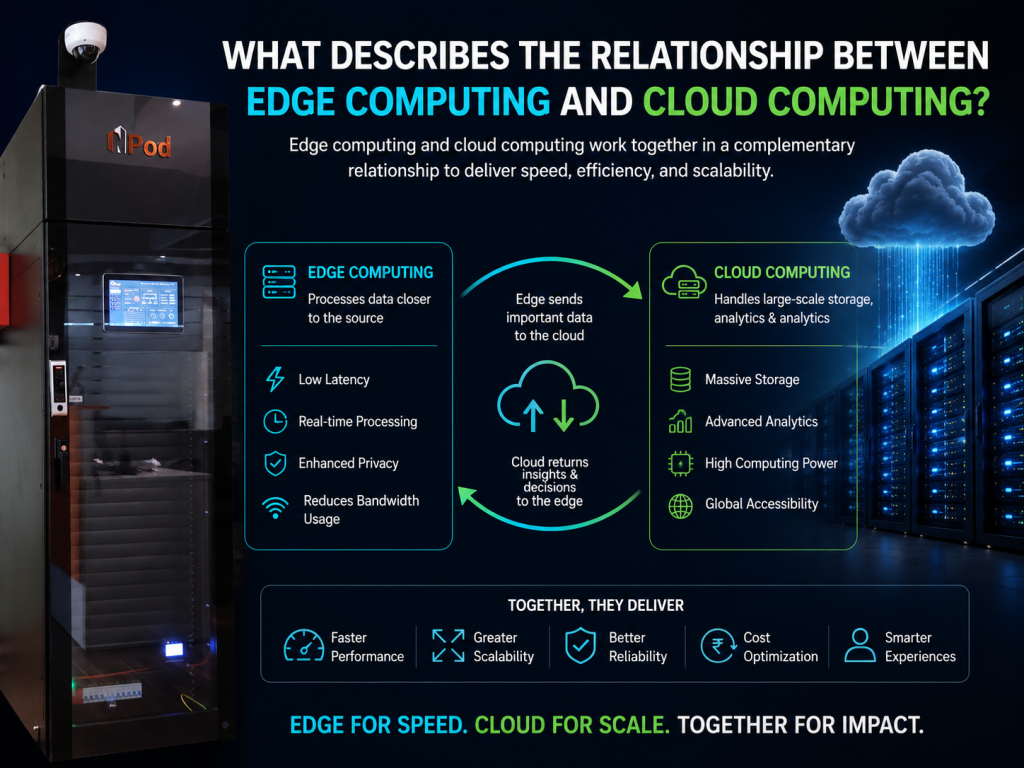
Many people compare them as two separate technologies, but in real business use, they work better together. Cloud computing provides large storage, backup, and centralized control, while edge computing brings processing closer to users and devices.
What is Cloud Computing?
Businesses can access servers, storage, databases, and software over the internet without maintaining physical infrastructure. Instead of building everything on-site, companies can access IT resources from cloud data centers.
It is widely used for storing business data, running applications, and managing backups efficiently. However, most cloud environments still rely on centralized data centers. When data travels from a user device to a distant cloud server and comes back, it can create delays. For real-time applications, even a small delay can affect performance.
What Is Edge Computing?
In simple terms, edge computing focuses on processing data closer to where it is generated. Instead of sending every request to faraway cloud data centers, important tasks are processed closer to users, devices, and operational locations instead of being sent to distant data centers.
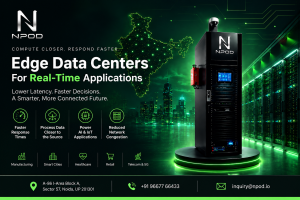
This is exactly where solutions like NPOD play a critical role in real deployments. NPOD provides modular and micro data center solutions designed for edge-ready infrastructure. Its systems combine compute, storage, cooling, UPS power systems, fire protection, security, and monitoring into one compact setup. This helps businesses deploy infrastructure closer to their operation and improve real-time performance.
The Real Relationship Between Edge and Cloud Computing
Instead of competing, both technologies complement each other to handle different parts of modern workloads. The cloud works well for large-scale storage and centralized control, where the edge handles real-time processing and faster decision-making.
Difference Between Cloud Computing and Edge Computing
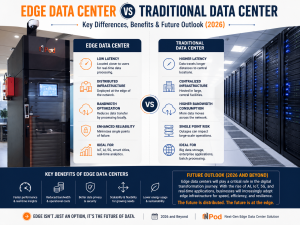
The main difference between cloud computing and edge computing is where data processing happens. In cloud computing, data is usually processed in large centralized data centers. In edge computing, data is processed closer to the source.
Cloud computing supports businesses that need scalability and storage, while edge computing fits scenarios where speed and real-time response are critical. Another point of difference is latency. Cloud computing may involve longer data travel distances, while edge computing reduces this by placing infrastructure closer to users and devices.
Cloud Computing Vs. Edge Computing
When discussing cloud computing vs. edge computing, think of the cloud as a powerful central office and the edge as a local branch that acts immediately. The cloud can manage large workloads and store massive data, while the edge handles quick responses and time-sensitive tasks efficiently.
For example, in a hospital, edge computing can help process patient monitoring data in real time, while cloud computing can store records and support backup. Businesses can process urgent data locally and send only useful data to the cloud.
Edge Computing Vs. Cloud Computing for Business performance
When companies compare edge computing vs cloud computing, performance becomes one of the most important factors. Cloud computing is powerful, but performance can depend on network quality, distance, and internet availability. Performance improves significantly when dependency on distant servers is reduced, especially for time-sensitive tasks.
For businesses using AI, IoT, automation, surveillance, telecom, or real-time analytics, local processing can make a major difference. This is why edge-ready systems like NPOD systems are gaining attention because they allow businesses to deploy closer to data sources without building a full traditional data center from scratch. NPOD also highlights faster deployment compared with traditional data center construction.
How Does Edge Computing Reduce Latency for End Users?
Many businesses often ask how edge technology improves response time in real scenarios. It reduces latency by shortening the distance data needs to travel.
In a cloud-only model, user data may travel to central cloud data centers located far away. The request is processed there and then sent back to the user. This round trip takes time. With edge computing, data can be processed at a nearby micro data center, branch location, or local edge site.
So, how does edge computing reduce latency for end users in daily use? Computing power is placed closer to where data is generated, reducing delays and improving response speed. As a result, applications load faster, machines respond quicker, and real-time systems become more reliable.
Why Businesses Need Both Edge and Cloud Computing?
Modern businesses should not choose only one. The future is a combined approach. Cloud computing is still important for scalability, backup, software platforms, and centralized visibility. Edge computing plays a key role in improving speed, reliability, and real-time decision-making.
A retail chain can use edge systems in store for faster billing, inventory tracking, and video analytics, while the cloud manages reports and company-wide data. This is why the edge computing and cloud computing discussion should focus on workload needs, not replacement.
Role of NPOD in Edge and Cloud Infrastructure.
NPOD supports businesses that need faster and more flexible infrastructure. Its modular data center approach helps companies deploy compute power closer to users and devices. With integrated cooling, UPS power management, fire protection, physical security, and real-time monitoring, NPOD makes edge deployment easier and more practical.
NPOD solutions are widely used in AI workloads, telecom infrastructure, and smart city deployments where low latency and high performance are critical. This makes NPOD useful for remote locations, campuses, telecom sites, factories, smart city projects, and AI-ready environments where businesses need local processing without building a full-scale traditional data center.
Conclusion
Edge and cloud computing are not competing technologies; they are designed to work together. Cloud computing gives businesses the power to store data, manage backups, run applications, and scale resources efficiently. Edge computing brings processing closer to users, devices, and business locations, helping reduce delay and improve real-time performance.
The best approach is a hybrid model. Businesses can use the cloud for large-scale management and the edge for fast local processing. With solutions like NPOD, companies can bring computing closer to where data is created while still connected to the wider power of the cloud.