AI-powered applications are transforming how businesses process and analyze data. From smart manufacturing and IoT devices to predictive analytics and real-time surveillance, organizations now generate massive volumes of data every second. The challenge is no longer only about storing information. Businesses now need infrastructure capable of processing data instantly to support faster decisions and uninterrupted operations.
Traditional centralized infrastructure is increasingly struggling to meet modern performance expectations. When data travels long distances to centralized cloud environments or large data centers, latency increases and application performance can suffer. For businesses that rely on real-time insights, even minor delays can impact operations, customer experience, and productivity.
This is where AI micro data centers are becoming essential.
Organizations are now moving toward distributed and edge-ready infrastructure models that bring computing resources closer to users, devices, and operational environments. Instead of depending entirely on centralized facilities, businesses are deploying compact and scalable systems designed to support faster processing, lower latency, and greater operational control.
Solutions like NPOD by NetForChoice help enterprises deploy secure and scalable AI-ready infrastructure with integrated cooling, UPS, monitoring, and rapid deployment capabilities.
Why Real-Time Data Processing Is Becoming Essential
Modern businesses depend heavily on continuous data processing. AI-powered applications, industrial automation systems, IoT devices, surveillance platforms, and customer analytics tools generate information continuously, requiring immediate analysis and response.
For many enterprises, relying entirely on centralized infrastructure creates noticeable delays in operations. In industries such as healthcare, manufacturing, telecom, and banking, waiting even a few seconds for data processing can affect efficiency and decision-making.
This growing demand for real-time data processing is pushing organizations toward distributed infrastructure environments.
An advanced micro data center allows organizations to process workloads closer to where the data is generated. By reducing the distance between applications and computing resources, businesses can improve response times, reduce latency, and support uninterrupted digital operations.
The impact is already visible across multiple industries:
- Manufacturers can detect equipment failures before downtime occurs.
- Retail businesses can analyze customer behavior in real time.
- Healthcare providers can access critical patient data faster during time-sensitive situations.
- Smart city environments can process surveillance and traffic analytics instantly.
- Telecom providers can support low-latency edge computing services more efficiently.
The ability to process data locally is quickly becoming a major competitive advantage.
The Growing Need for Edge AI Infrastructure
AI applications require continuous access to computing power, storage, and networking resources. These workloads also generate enormous amounts of data that often need immediate analysis. Because of this, edge AI infrastructure is becoming a critical priority for modern enterprises.
Instead of routing every workload through centralized environments, edge deployments move computing resources closer to operational locations. This allows AI-powered applications to respond faster while reducing network congestion and bandwidth dependency.
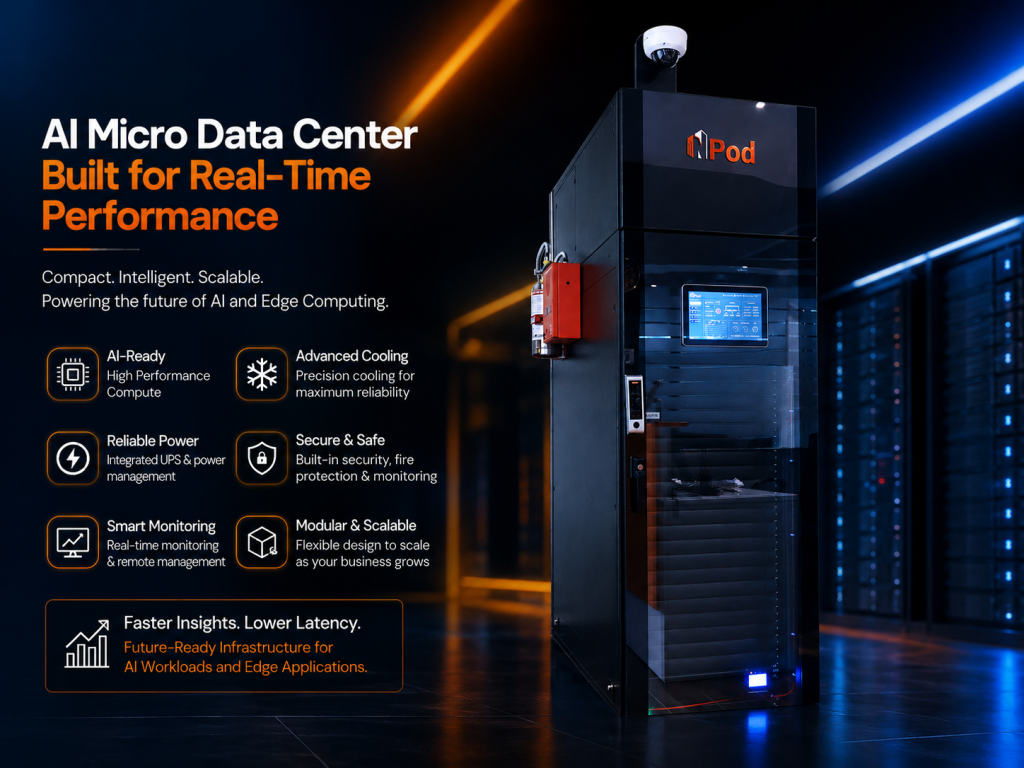
A modern AI micro data center combines:
- Intelligent cooling systems
- UPS power backup
- Network connectivity
- Physical security
- Fire protection
- Remote monitoring
- Compute and storage resources
within a compact and pre-integrated environment.
These systems are especially useful in locations where traditional data center deployments may not be practical, including:
- Remote offices
- Industrial facilities
- Telecom sites
- Smart city deployments
- Retail branches
- Healthcare environments
- Edge computing locations
Solutions like NPOD by NetForChoice simplify deployment by offering modular AI infrastructure designed for faster installation and easier management. Businesses can deploy infrastructure rapidly without facing the long timelines and operational complexity associated with conventional data center projects.
NVIDIA A100 GPUs and AI Infrastructure Costs
The growing adoption of AI workloads is also increasing demand for high-performance GPUs such as the NVIDIA A100. Many businesses researching AI infrastructure often compare factors like NVIDIA A100 price, deployment cost, and long-term scalability before building AI environments.
While the NVIDIA A100 GPU delivers exceptional performance for AI training, machine learning, deep learning, and real-time analytics, the overall infrastructure investment can become significant when combined with cooling, power, networking, and deployment requirements.
This is why organizations are increasingly adopting modular AI infrastructure and AI micro data centers that simplify deployment while supporting high-density GPU workloads efficiently. Businesses can scale GPU-powered infrastructure more effectively while maintaining operational reliability and lower deployment complexity.
Benefits of AI Micro Data Centers
Lower Latency for AI Applications
AI-powered systems require immediate access to data for faster decision-making. By processing workloads closer to users and devices, AI micro data centers significantly reduce latency and improve application performance.
This is especially important for:
- Predictive analytics
- Autonomous systems
- Smart surveillance
- Industrial automation
- AI-driven customer experiences
Faster Deployment
Traditional data center projects can take months to build and configure. In contrast, modular AI infrastructure solutions support rapid deployment with integrated power, cooling, monitoring, and security systems.
This allows businesses to scale operations faster and respond quickly to changing infrastructure demands.
Improved Scalability
Infrastructure requirements can change rapidly as AI workloads continue growing. A scalable micro data center enables organizations to expand computing resources gradually based on operational needs rather than investing heavily in oversized infrastructure upfront.
This improves:
- Cost efficiency
- Resource utilization
- Operational flexibility
- Long-term scalability
Better Reliability and Business Continuity
Localized infrastructure helps organizations maintain operations even during connectivity disruptions. Critical workloads can continue functioning independently without relying entirely on centralized cloud environments.
For industries where downtime directly impacts productivity and customer experience, this level of resilience is becoming increasingly important.
Industries Benefiting from AI Micro Data Centers
Healthcare
Healthcare organizations use AI micro data centers for:
- Real-time patient monitoring
- Medical imaging analysis
- Faster data access
- Emergency response systems
Low-latency infrastructure helps healthcare providers improve operational efficiency and patient care.
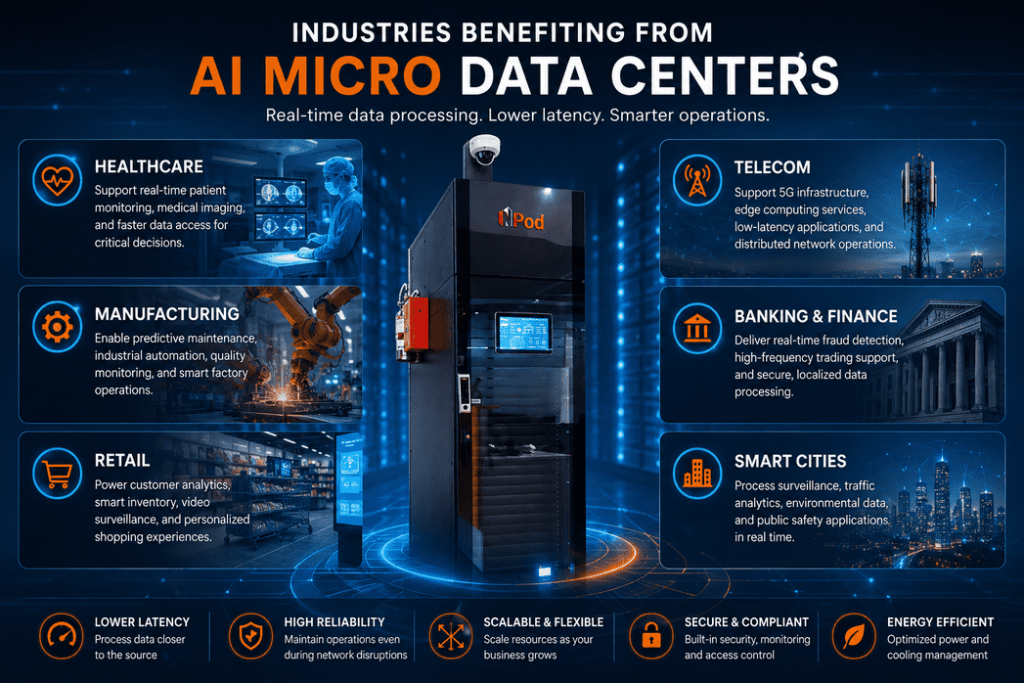
Manufacturing
Manufacturers deploy edge AI infrastructure to support:
- Predictive maintenance
- Industrial automation
- Quality monitoring
- Smart factory operations
Real-time processing helps reduce downtime and improve production efficiency.
Retail
Retail businesses use AI-powered infrastructure for:
- Customer behavior analytics
- Smart inventory management
- Video surveillance
- Personalized shopping experiences
Localized processing enables faster insights and improved customer engagement.
Telecom
Telecom providers rely on AI micro data centers to support:
- Edge computing services
- 5G infrastructure
- Low-latency applications
- Distributed network operations
Compact and scalable deployments help telecom operators expand services efficiently.
Supporting the Future of AI Edge Computing
Businesses are no longer relying solely on centralized computing models. They are building distributed infrastructure environments designed for faster decisions, lower latency, and uninterrupted digital performance.
To support these changing demands, organizations are increasingly adopting modular AI infrastructure solutions that provide greater scalability, flexibility, and operational efficiency.
An intelligent AI micro data center helps enterprises build this foundation through:
- Compact deployment
- Integrated infrastructure
- Scalable architecture
- Simplified management
- Secure operations
- Faster deployment capabilities
Solutions like NPOD by NetForChoice are helping businesses modernize infrastructure for AI-driven workloads, real-time processing, and edge computing environments.
As AI adoption continues to expand, businesses will require infrastructure capable of processing data where it is generated. Organizations investing in distributed AI infrastructure today are building a stronger foundation for future growth, innovation, and operational resilience.
Conclusion
AI-powered applications are driving the need for faster, smarter, and more efficient infrastructure environments. Traditional centralized systems alone are no longer enough to support the growing demand for real-time data processing and low-latency AI operations.
AI micro data centers provide a scalable and edge-ready solution for businesses looking to modernize infrastructure while improving performance, reliability, and operational flexibility.
With integrated cooling, UPS, monitoring, security, and rapid deployment capabilities, solutions like NPOD by NetForChoice help organizations build future-ready infrastructure for AI edge computing and real-time digital operations.
Businesses investing in scalable AI infrastructure today will be better prepared for the next generation of intelligent applications and connected technologies.
Frequently Asked Questions (FAQs)
1. What is an AI micro data center?
An AI micro data center is a compact and modular infrastructure solution designed to support AI workloads, real-time data processing, edge computing, and low-latency applications. It typically includes integrated cooling, UPS power backup, monitoring, networking, and security within a single deployment-ready unit.
2. Why are AI micro data centers important for real-time data processing?
AI applications generate massive amounts of data that require instant analysis and response. AI micro data centers process data closer to users and devices, reducing latency and improving application performance. This helps businesses support real-time analytics, predictive maintenance, surveillance, and AI-driven automation more efficiently.
3. How does edge AI infrastructure reduce latency?
Edge AI infrastructure places computing resources closer to where data is generated instead of sending workloads to distant centralized facilities. This reduces network delays, improves response time, and supports faster decision-making for AI-powered applications.
4. Which industries benefit most from AI micro data centers?
Industries using AI micro data centers include:
- Healthcare
- Manufacturing
- Retail
- Banking and finance
- Telecom
- Smart cities
- Logistics
- Oil and gas
These industries rely heavily on real-time processing, low latency, and continuous operations.
5. What is the difference between a traditional data center and a micro data center?
Traditional data centers are large centralized facilities designed for massive-scale infrastructure deployment. Micro data centers are smaller, modular, and edge-ready environments designed for faster deployment, localized processing, and easier scalability closer to operational sites.
6. Can AI micro data centers support NVIDIA A100 GPUs?
Yes, modern AI micro data centers can support high-performance GPUs like the NVIDIA A100 for AI training, machine learning, deep learning, and real-time analytics workloads. Proper cooling, power management, and infrastructure planning are essential for high-density GPU deployments.
7. What factors affect NVIDIA A100 price for AI infrastructure deployment?
The NVIDIA A100 price depends on:
- GPU memory configuration
- Server hardware
- Cooling requirements
- Power infrastructure
- Networking setup
- Deployment scale
Businesses should also consider operational and infrastructure costs beyond GPU hardware when planning AI deployments.
8. Are AI micro data centers scalable?
Yes, scalable micro data center solutions allow businesses to expand infrastructure gradually based on workload requirements. Organizations can add compute, storage, cooling, and networking resources without redesigning the entire infrastructure environment.
9. How quickly can a modular AI micro data center be deployed?
Unlike traditional infrastructure projects that may take months, modular AI micro data centers can often be deployed much faster because they come with pre-integrated cooling, UPS, monitoring, and security systems.
Solutions like NPOD by NetForChoice help organizations accelerate deployment timelines while simplifying infrastructure management.
10. What are the benefits of deploying AI workloads at the edge?
Edge AI deployments provide several advantages:
- Lower latency
- Faster processing
- Reduced bandwidth usage
- Improved reliability
- Better business continuity
- Real-time decision-making
- Localized data processing
These benefits are especially important for AI-driven operations and distributed environments.
11. How do AI micro data centers support business continuity?
Localized infrastructure allows critical workloads to continue operating even during network or cloud connectivity disruptions. Integrated monitoring, cooling, UPS backup, and security systems help maintain stable and uninterrupted operations.
12. What should businesses look for in an AI micro data center solution?
Businesses should evaluate:
- Scalability
- Cooling efficiency
- UPS integration
- GPU support
- Remote monitoring
- Security features
- Deployment speed
- Edge computing capabilities
- Power efficiency
- Infrastructure management simplicity
A well-designed AI micro data center should support long-term AI growth while maintaining operational reliability.
13. Why are businesses investing in distributed AI infrastructure?
Businesses are adopting distributed AI infrastructure to support:
- Real-time AI processing
- Edge computing
- IoT environments
- Low-latency applications
- Continuous digital operations
Distributed environments help organizations improve performance while reducing dependence on centralized infrastructure.
14. How can NPOD help businesses deploy AI-ready infrastructure?
NPOD by NetForChoice provides modular AI-ready micro data center solutions with integrated cooling, UPS systems, monitoring, security, and rapid deployment capabilities. These solutions help businesses build scalable and edge-ready infrastructure for AI workloads and real-time operations.