Businesses today are generating and processing more data than ever. Connected machines, IoT sensors, security cameras, AI applications, mobile devices, and smart systems continuously create information that needs to be analyzed and acted upon. For many applications, waiting several seconds for a response is no longer acceptable.
This is where edge data center become important.
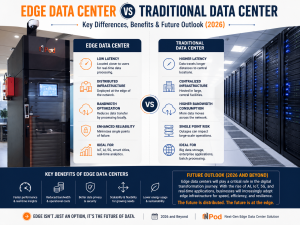
Instead of sending every piece of data to a centralized data center that may be hundreds or thousands of kilometers away, edge infrastructure brings computing resources closer to the location where data is created. By processing information locally, businesses can reduce unnecessary data travel, improve application responsiveness, and support real-time operations.
What Is an Edge Data Center?
An edge data center is a localized computing facility positioned closer to users, devices, machines, or business operations. It provides computing, storage, networking, power, cooling, and other infrastructure required to run IT workloads outside a traditional centralized data center.
The concept is simple: process data closer to where it is needed.
For example, consider a manufacturing plant with hundreds of connected machines and sensors. These devices may generate information about temperature, vibration, production speed, and equipment performance every second. Instead of sending all this information to a distant data center, an edge data center located at or near the facility can process important information locally.
This allows the business to respond to certain events without depending entirely on a remote computing facility.
Why Latency Matters
Latency is the delay between sending data and receiving a response. For everyday applications such as browsing a website or checking email, a small amount of latency may not cause a major problem.
However, real-time applications are different.
An automated production line may need to stop a machine immediately when a fault is detected. A security system may need to identify a suspicious event as it happens. An autonomous vehicle needs to process information quickly to make decisions. An AI-powered camera may need to identify an object or activity without waiting for data to travel to a distant server.
In these situations, reducing latency can directly affect performance and operational efficiency.
How Edge Data Centers Reduce Latency
The main advantage of edge infrastructure is proximity. When computing resources are located closer to the source of data, information does not have to travel as far before it can be processed.
Imagine a business operating a smart factory. Cameras, sensors, and machines continuously generate data. If every request has to travel to a centralized data center, the network introduces additional communication time.
With an edge data center, processing can happen closer to the factory floor. The system can analyze important information locally and respond much faster.
This does not eliminate network latency completely, but it can significantly reduce the amount of time associated with sending data to a remote location and waiting for a response.
Reducing Unnecessary Data Transfers
Modern businesses often generate enormous amounts of data. Video surveillance is a good example.
A company with hundreds of cameras could produce terabytes of video data over time. Sending all of this raw footage to a centralized cloud environment can consume substantial bandwidth.
Edge computing provides another approach.
An edge system can analyze video locally and identify events that actually require attention. For example, instead of continuously sending every camera frame to a remote location, the system could identify a specific event and transmit only the relevant information.
This reduces unnecessary data movement and allows important information to reach decision-making systems faster.
Edge Data Centers and Artificial Intelligence
Artificial intelligence is one of the major technologies driving interest in edge computing.
AI applications often need to analyze data quickly. In many cases, the value of an AI system depends on how quickly it can produce a result.
Consider an AI-powered quality inspection system in a manufacturing facility. Cameras capture images of products moving along a production line. An AI model analyzes each image and determines whether the product meets the required standards.
If the processing happens at a remote location, images need to be transferred before the AI model can make a decision. With Edge AI infrastructure, the processing can happen closer to the cameras and production equipment.
The result can be faster identification of defects and quicker action on the production floor.
Edge Computing for IoT
The Internet of Things has created another major requirement for localized computing.
Organizations are connecting sensors and devices across factories, warehouses, hospitals, offices, retail stores, vehicles, and infrastructure. These devices continuously generate information.
Sending every data point to a centralized data center is not always necessary.
An edge data center can collect and process information locally. It can determine which data requires immediate action and which information can be sent to centralized systems for storage or analysis.
For example, sensors monitoring industrial equipment can detect unusual vibration or temperature levels. A local edge system can analyze the information and generate an alert immediately.
This allows businesses to respond to problems before they become larger operational issues.
Edge Data Centers and 5G
The growth of 5G is also increasing the potential of edge computing.
5G networks provide high-speed connectivity and support applications that require fast communication. However, a fast network alone does not solve the problem of distance between users and centralized computing resources.
Combining 5G with edge computing can bring processing capabilities closer to connected devices and users.
This can support applications such as connected vehicles, smart factories, augmented reality, industrial automation, remote monitoring, and real-time video analytics.
For these applications, the combination of high-speed connectivity and nearby computing infrastructure can create a more responsive environment.
Reducing Network Congestion
Another advantage of edge infrastructure is reduced network pressure.
As businesses add more connected devices, the amount of data moving through their networks continues to increase. Sending everything to a centralized facility can consume significant bandwidth.
Edge computing allows businesses to process and filter information locally.
Only important data needs to be forwarded to the central cloud or data center. This can reduce network traffic and help organizations make better use of their available bandwidth.
For companies operating large numbers of IoT devices or cameras, this can become particularly valuable.
Edge and Cloud Can Work Together
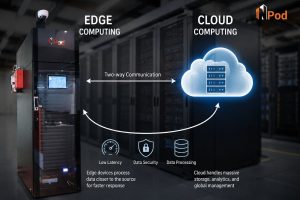
Edge computing does not mean that cloud computing is no longer needed.
In fact, edge and cloud environments can complement each other.
Businesses can use edge infrastructure for workloads that require immediate processing, while centralized cloud or data center infrastructure can handle long-term storage, backups, large-scale analytics, reporting, and AI model training.
For example, a retail company could use edge infrastructure to analyze video feeds inside individual stores. The system could identify relevant events locally and send selected information to centralized storage.
This creates a hybrid architecture where workloads are processed in the environment best suited to their requirements.
Edge Data Centers for Remote Locations
Edge data centers are also useful for businesses operating in remote or distributed locations.
Factories, warehouses, telecom sites, branch offices, healthcare facilities, mines, and other locations may need local computing capabilities but may not have the space or infrastructure required to build a traditional data center.
A modular edge data center can provide a compact infrastructure environment that includes essential components such as power, cooling, monitoring, physical security, and fire protection.
This makes it possible to deploy computing infrastructure closer to remote operations while maintaining appropriate environmental and operational controls.
Why Cooling and Power Matter at the Edge
Deploying servers at a remote location is not enough. The infrastructure must provide the right operating environment.
Power availability is essential because servers and networking equipment need stable electricity to operate reliably. Backup power can provide additional protection against interruptions.
Cooling is equally important, particularly when organizations deploy high-performance servers or GPUs. Computing equipment generates heat, and insufficient cooling can affect performance and hardware reliability.
Monitoring, physical security, fire protection, and environmental controls are also important considerations.
A properly designed edge data center brings these requirements together rather than treating computing equipment as an isolated component.
Industries Benefiting From Edge Data Centers
Edge computing can support a wide range of industries.
Manufacturing companies can use it for predictive maintenance, robotics, automation, and quality inspection. Healthcare organizations can use localized infrastructure for connected medical systems and data-intensive applications.
Retail businesses can process video analytics, inventory information, and connected-device data closer to individual stores.
Telecommunications companies can deploy edge infrastructure to support distributed network services and low-latency applications.
Smart city projects can use edge computing for traffic systems, surveillance, sensors, and other connected infrastructure.
Transportation organizations can also benefit from localized processing for connected vehicles and intelligent transport systems.
NPOD and Edge Data Center Infrastructure
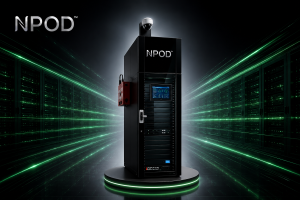
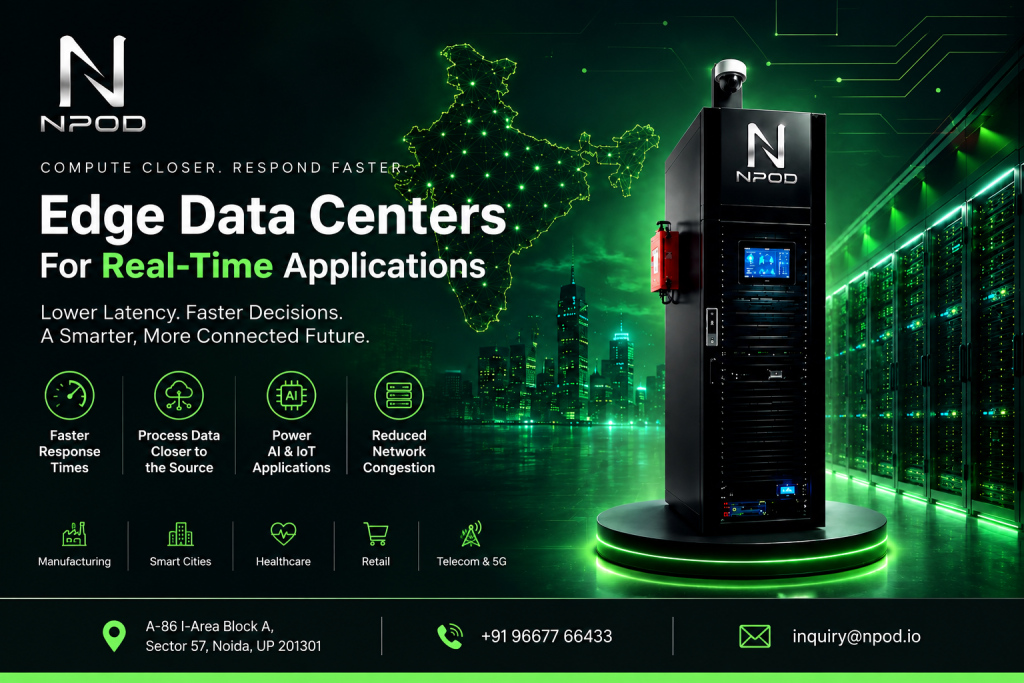
For organizations looking to deploy computing closer to their operations, NPOD provides modular data center infrastructure designed for distributed environments.
NPOD combines critical infrastructure components such as power, cooling, monitoring, security, and protection into a modular solution. This approach can simplify deployment for organizations that need reliable IT infrastructure outside a traditional centralized data center.
Whether the requirement involves Edge AI, IoT, industrial automation, smart infrastructure, or distributed enterprise computing, a purpose-built edge environment can provide the foundation needed to support these workloads.
Conclusion
The growing use of AI, IoT, 5G, automation, and connected devices is changing the way businesses think about computing infrastructure.
Applications that require fast responses cannot always depend on a distant centralized data center. By moving computing resources closer to where data is generated, edge data centers can reduce latency, minimize unnecessary data transfers, improve network efficiency, and support faster decision-making.
Edge computing is not a replacement for cloud or traditional data centers. Instead, it adds a local processing layer that handles workloads where proximity and speed matter most.
As real-time applications continue to grow, businesses that combine centralized infrastructure with strategically placed edge data centers can create a more responsive, flexible, and efficient IT environment.