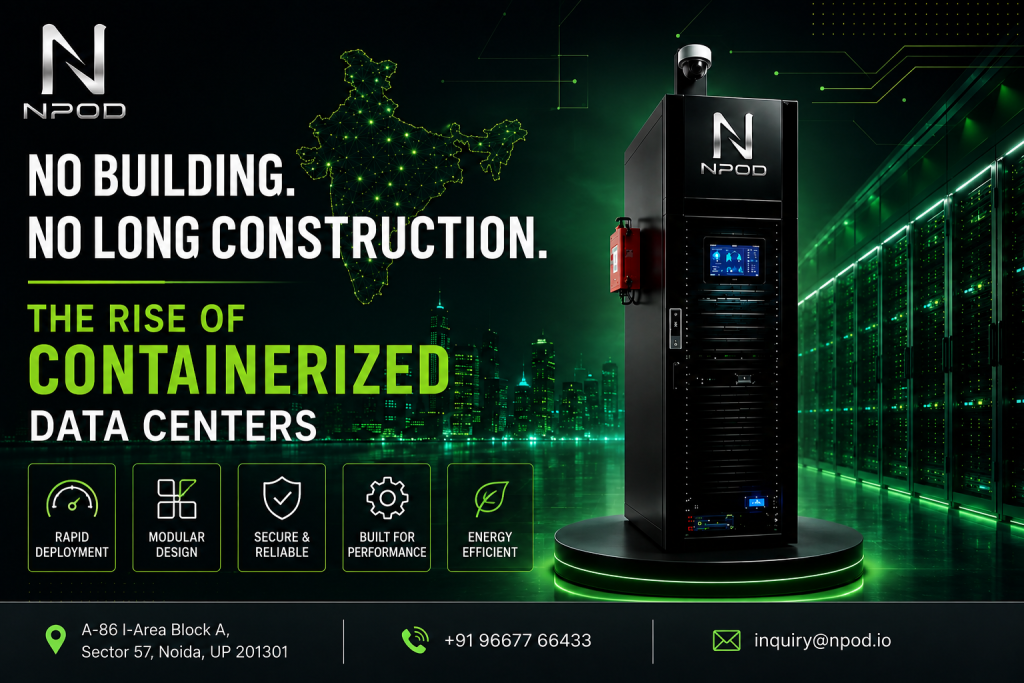
Building a traditional data center is often a long and complex process. Businesses may need to find suitable space, prepare the site, construct a facility, install power and cooling systems, deploy IT racks, implement security, and test everything before the infrastructure becomes operational.
But what happens when a business needs IT infrastructure quickly?
What if the infrastructure is required at a remote location where building a complete data center is difficult or impractical?
This is where a Containerized Data Center offers a different approach.
Instead of constructing an entire building and installing every component separately on-site, critical infrastructure can be integrated into a self-contained solution before deployment. The system can then be transported to the required location and prepared for operation.
This approach is changing how businesses think about data center deployment, especially when speed, flexibility, and scalability are important.
Why Are Businesses Looking Beyond Traditional Data Center Construction?
The demand for computing infrastructure is growing rapidly. AI applications, edge computing, IoT devices, automation, video surveillance, cloud services, and data-intensive workloads are increasing the need for reliable IT infrastructure.
However, traditional construction does not always move at the speed of business.
Building a conventional data center may involve multiple contractors, vendors, approvals, construction activities, and installation stages. Power systems, cooling infrastructure, racks, monitoring tools, and security systems may all need to be deployed and integrated at the final location.
A Containerized Data Center offers a more streamlined alternative.
Much of the infrastructure can be designed, assembled, and tested before reaching the deployment site. This reduces the amount of complex work required at the final location and can help businesses simplify the deployment process.
No Building Required: A Different Approach to IT Infrastructure
The biggest difference between a traditional facility and a Container Data Center is how the infrastructure is delivered.
With a conventional data center, the building is usually the starting point. Once the facility is ready, different systems are installed and integrated over time.
A Containerized Data Center, however, brings multiple infrastructure components together in a single, integrated environment.
Depending on the configuration, it may include:
- IT racks and server space
- Power distribution infrastructure
- UPS and backup power systems
- Cooling solutions
- Fire detection and protection
- Environmental monitoring
- Physical security controls
- Network connectivity
Instead of coordinating every component separately at the site, businesses can deploy an integrated infrastructure solution designed around their requirements.
This can be particularly useful when deployment timelines are tight or when the location is not suitable for large-scale construction.
Faster Deployment Without Long Construction Cycles
One of the main advantages of a Rapid Deployment Data Center is the potential to reduce the time and complexity associated with traditional infrastructure construction.
In a conventional project, multiple systems need to be installed, connected, tested, and optimized on-site.
With a factory-built approach, much of this work can be completed before delivery.
However, faster deployment does not mean that the solution can simply arrive at a location and become operational instantly. The site still requires proper planning. Businesses need to consider power availability, network connectivity, physical placement, environmental conditions, and other infrastructure requirements.
The difference is that a Prefabricated Data Center can reduce the amount of integration and construction required at the final location.
This can make deployment more manageable for organizations that need additional IT capacity without waiting through an extended building project.
What Is Inside a Containerized Data Center?
A Containerized Data Center is not simply a container filled with servers. It is designed to provide a controlled environment where critical IT infrastructure can operate reliably.
The exact configuration depends on the organization’s capacity requirements, workloads, location, and operational needs.
Power Infrastructure
Reliable power is essential for any IT environment.
A containerized solution may include UPS systems, power distribution units, backup power arrangements, and monitoring capabilities. The configuration can be designed according to the required capacity and level of redundancy.
Cooling Systems
Servers and networking equipment generate significant heat. Without effective cooling, equipment performance and reliability can be affected.
A Container Data Center can include integrated cooling systems designed around the expected IT load and environmental conditions.
IT Racks and Equipment Space
The infrastructure can include server racks for computing, storage, networking, and other IT equipment.
Businesses can select configurations based on current requirements while also considering future capacity needs.
Security and Access Control
Physical security becomes particularly important when IT infrastructure is deployed outside a traditional data center building.
Depending on the solution, security features may include controlled access, surveillance, monitoring, and other protection mechanisms.
Monitoring and Management
Infrastructure monitoring can help IT teams track important conditions such as temperature, power status, cooling performance, and equipment health.
This can be especially valuable for remote or unmanned locations where IT teams may not always be physically present.
Why Modular Infrastructure Is Becoming More Important
Business infrastructure requirements rarely remain the same forever.
A company may need a certain amount of IT capacity today but require significantly more resources in the future. Building a large facility from the beginning can sometimes result in unused capacity and unnecessary investment.
A Modular Data Center provides a more flexible approach.
Instead of planning for every possible future requirement on day one, businesses can deploy infrastructure based on their current needs and expand as requirements grow.
This approach can support better capacity planning and help organizations align infrastructure investments with actual business demand.
For example, a company may initially deploy infrastructure at a manufacturing facility, remote branch, or edge location. As applications, users, and workloads increase, additional capacity can be planned accordingly.
Taking Data Center Infrastructure to Remote Locations
Not every business operates from a major city or has access to a large data center facility.
Industrial sites, manufacturing plants, remote offices, mining operations, rural locations, and temporary project sites may require local computing infrastructure without the ability to construct a traditional facility.
This is where a Portable Data Center can become valuable.
The infrastructure can be delivered closer to where computing and storage resources are needed. This may reduce the dependence on a distant central facility and support applications that require faster local processing.
For organizations operating in challenging environments, a portable and self-contained infrastructure solution can offer greater flexibility than constructing a permanent building.
Supporting Edge Computing and Modern Workloads
The growth of edge computing is one of the major reasons businesses are exploring alternative data center models.
Many applications now generate data outside traditional centralized data centers. IoT devices, smart factories, video surveillance systems, connected equipment, and other technologies can generate large amounts of information at multiple locations.
Sending all this data to a central facility may not always be practical or efficient.
A Containerized Data Center can support localized processing by bringing computing infrastructure closer to where data is generated.
This can be useful when applications require lower latency, faster processing, or local data handling.
AI and high-performance computing workloads can also increase infrastructure requirements. These workloads may require high-density computing, reliable power, and effective cooling.
The final infrastructure design should always be based on the specific workload, equipment density, cooling requirements, and operational goals.
Containerized Data Center vs Traditional Construction
Traditional data centers can be suitable for organizations with large-scale and permanent infrastructure requirements. However, constructing a new facility often requires significant planning and on-site development.
A Containerized Data Center follows a different model.
Much of the infrastructure can be integrated and tested before delivery, reducing the amount of construction and technical integration required at the deployment location.
Traditional facilities are generally fixed to one location. Expanding capacity may require additional construction, planning, and installation work. A Modular Data Center, on the other hand, can provide a more flexible approach to expansion based on changing infrastructure requirements.
A Prefabricated Data Center can also be particularly useful when deployment speed is important. By integrating major components before delivery, businesses can reduce on-site complexity and focus on preparing the location for deployment.
The right option depends on several factors, including capacity requirements, location, budget, deployment timeline, power availability, and long-term IT strategy.
Common Use Cases for Containerized Data Centers
A Container Data Center can support a variety of business and technology requirements.
Edge Computing
Organizations can deploy computing resources closer to devices, users, and applications where data is generated.
Remote and Industrial Sites
Businesses can deploy local IT infrastructure in locations where constructing a traditional facility may not be practical.
Disaster Recovery
A separate infrastructure environment can support business continuity and disaster recovery planning.
Manufacturing Facilities
Local computing infrastructure can support automation, monitoring, connected devices, and operational technologies.
Temporary or Project-Based Deployments
Some organizations need IT infrastructure for a specific project or location. A Portable Data Center can provide greater flexibility than constructing a permanent facility.
Capacity Expansion
Businesses with growing infrastructure requirements can consider a modular approach instead of immediately investing in a large traditional facility.
What Should Businesses Consider Before Deployment?
Although a Rapid Deployment Data Center can simplify infrastructure deployment, proper planning is still essential.
Before selecting a solution, businesses should evaluate:
- Current and future IT capacity requirements
- Available power infrastructure
- Cooling and environmental requirements
- Network connectivity
- Physical location and site conditions
- Security requirements
- Monitoring and remote management capabilities
- Scalability requirements
- Compliance and data protection needs
- Disaster recovery and business continuity plans
The best solution is not simply the one that can be deployed fastest. It should also support the organization’s long-term operational and technology requirements.
The Future of Data Center Deployment Is More Flexible
Businesses no longer have only one option when they need new IT infrastructure.
The traditional approach of acquiring land, constructing a building, and installing every system on-site can still be the right choice for certain large and permanent facilities. However, many organizations now need infrastructure that can be deployed faster and in more locations.
A Containerized Data Center provides an alternative focused on flexibility, integration, portability, and modular growth.
It can help organizations rethink where and how computing infrastructure is deployed.
For businesses supporting edge applications, expanding into remote locations, planning disaster recovery infrastructure, or responding to growing IT requirements, this approach can provide a practical alternative to long construction cycles.
Conclusion
The way businesses deploy IT infrastructure is changing.
A Containerized Data Center reduces the dependence on building a complete facility before deploying critical infrastructure. By integrating essential systems such as power, cooling, IT racks, security, and monitoring into a factory-built solution, businesses can simplify the deployment process.
Whether the requirement involves edge computing, remote operations, disaster recovery, capacity expansion, or modern data-intensive workloads, a Modular Data Center can offer greater flexibility than traditional infrastructure construction.
The future of data center deployment is not only about building larger facilities. It is also about deploying the right infrastructure in the right location at the right time.
For organizations looking to reduce long construction cycles and deploy infrastructure more efficiently, a Containerized Data Center can provide a practical and adaptable path forward.