Constructing a conventional data center may take quite some time to be completed. Site preparation, building, installation of hardware, testing, and commissioning may take months or even years to complete. In the age where organizations are heavily dependent on information technology, such delays are likely to cause a setback.
This is one of the reasons why many companies are seeking means through which they can reduce data center deployment time while ensuring optimum performance from their IT facilities. Modular data center are one such viable alternative that allows them to construct infrastructure rapidly.
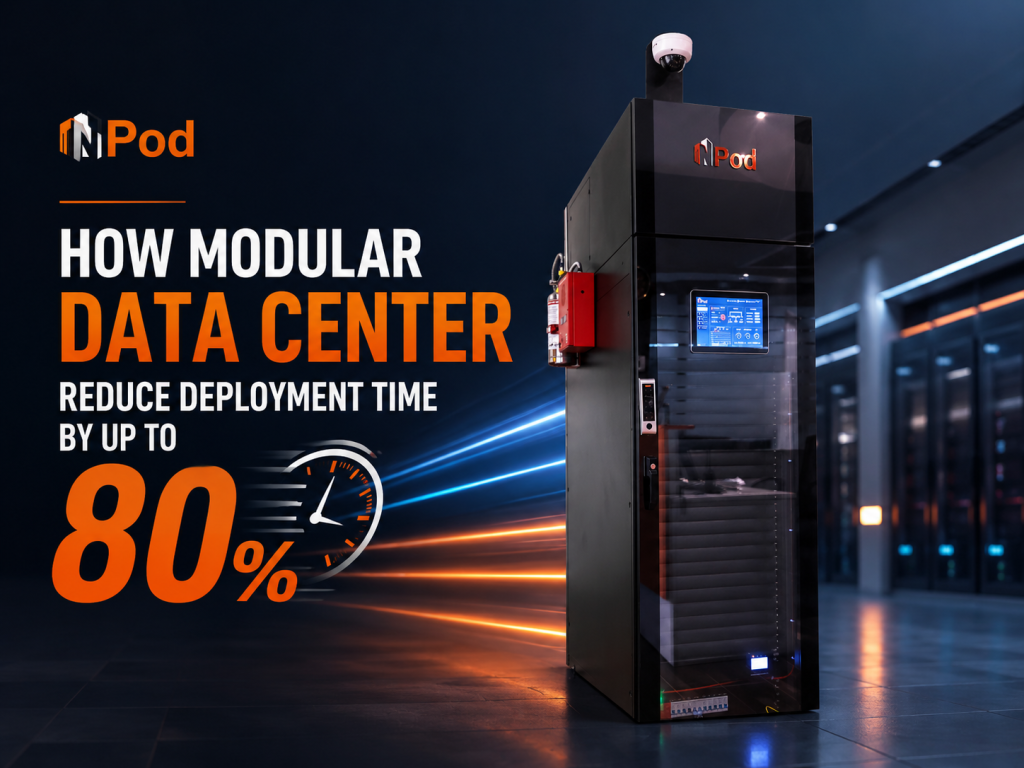
With the use of this approach, many organizations have been able to cut down data center deployment time by up to 80%.
The Reasons Why Data Center Projects Get Delayed
Traditional data centers come with several stages of work that have to be carried out sequentially by construction crews, electricians, HVAC specialists, networking specialists, and IT professionals before the facility begins operation.
Often, these complications result in data center implementation challenges that may cause more delays and costs than originally planned.
One of the most common reasons why data center projects get delayed when constructing a data center is that various elements in the data center infrastructure are assembled and tested on-site.
When companies wonder about how to reduce data center deployment time for a new data center, they usually come to realize that traditional deployment models pose a challenge.
What Makes Modular Data Centers Unique?
Unlike traditional data centers, modular data centers are prefabricated, assembled, and tested in the factory before being installed in the final location.
The process makes it easier for data center infrastructure deployment since all critical components, such as power supplies, cooling systems, monitoring features, security systems, and racks, are assembled in advance. Installation of a module involves much less construction compared to regular data centers.
In line with the idea of modular infrastructure, NPOD’s solutions incorporate pre-engineered systems that are already tested prior to installation. According to NPOD, each module contains everything required for operation: pre-installed cooling systems, power management, security systems, and monitoring options. As a result, organizations can achieve faster data center deployment while maintaining enterprise-grade reliability.
Modular Data Centers and How They Save Deployment Time
1. Prefabricated Infrastructure
Conventional projects involve assembling the infrastructure on-site. Using modular data centers will mean that most of the processes occur before deployment.
Prefabricated data center solutions have their power generation systems, cooling facilities, fire safety equipment, and monitoring systems combined in advance and tested. This ensures efficient installations without any problems that might come up unexpectedly. Testing is also enhanced in prefabricated data center solutions since they are done in controlled factory environments.
2. Minimal Civil Construction
Civil constructions often consume a lot of time in conventional projects. The processes of excavation, building structures, installing utilities, and so forth could take several months.
Using modular data center deployment. Often, very little work needs to be done on the ground before the actual data center can be installed. This will enable organizations to reduce their deployment times significantly, especially when expanding rapidly.
3. Parallel Project Execution
The traditional delivery method always adheres to a series of steps. Building construction needs to be completed before equipping.
Since the implementation of a modular data center, the construction and site preparation phases happen at the same time. During the assembly and testing of the module at the factory, preparation work can be done at the deployment location. This parallel workflow is one of the key reasons organizations achieve faster data center deployment compared to conventional methods.
4. Efficient Testing and Commissioning Process
The testing phase usually consumes additional time. Testing needs to be completed before the traditional facility becomes fully operational.
However, since NPOD modules undergo testing within the factory setting prior to shipment, the post-installation test phase takes less time.
Benefits of Modular Data Center Deployment
While analyzing the infrastructure options, many companies tend to consider the modular data center deployment benefits in the long term rather than the fast deployment itself.
The main benefits can be listed as follows:
- More rapid project implementation
- Easier construction process
- Greater flexibility
- Uniform performance
- Less disruption during implementation
- Favourable deployment results
This type of infrastructure becomes especially beneficial for enterprises, telecommunication providers, smart cities, edge computing scenarios, and governmental projects.

Solving Common Infrastructure Deployment Challenges
Many organizations face recurring data center implementation challenges when expanding capacity. These may include budget overruns, contractor coordination issues, equipment delays, and lengthy testing cycles.
Modular infrastructure addresses these concerns by standardizing deployment processes and reducing dependency on extensive on-site construction.
For businesses focused on reducing infrastructure deployment delays, modular solutions provide a practical path forward. Since systems arrive pre-integrated and pre-tested, there are fewer variables that can disrupt project timelines.
Similarly, organizations exploring fast data center deployment solutions often find that modular architecture provides the speed and flexibility needed for modern digital operations.
Why Speed is More Important Than Ever Before
The modern world cannot allow its business organizations to spend years developing their infrastructure. Modern AI workloads, edge computing needs, and increased data need quick computing resource deployment.
Businesses interested in learning how to reduce data center deployment time often tend to choose the modular way of infrastructure development due to several reasons.
Firstly, it helps them grow faster and provide services quickly. Secondly, fast data center deployment solutions are helpful in responding quickly to changing needs and conditions.
When it comes to the distributed infrastructure, telecom companies, and remote deployments, fast data center deployment is critical in gaining a competitive advantage.
Conclusion
Classical data center projects frequently face issues with lengthy project times, the need for coordination, and construction delays. This may lead to slower company expansion and higher costs.
A better option would be to use modular infrastructure. With factory-installed systems, already integrated hardware, and simplified installation procedures, companies can cut deployment time for data centers and speed up digital transformation programs.
With the ever-growing desire by companies to minimize the delays in deploying their infrastructure, modular technologies such as NPOD present a viable means of fast, secure, and high-performance infrastructure installation.