The way businesses manage IT infrastructure is changing rapidly. In 2026, organizations are handling larger volumes of data, supporting AI-driven applications, and operating across multiple distributed environments. Traditional server rooms and centralized facilities often struggle to meet the growing demand for speed, flexibility, and real-time processing.
Modern enterprises now require infrastructure that can be deployed quickly, operate efficiently, and process workloads closer to users and connected devices. This shift has increased the adoption of compact and modular infrastructure solutions across industries such as healthcare, banking, manufacturing, retail, telecom, and smart city development.
A micro data center is designed to address these evolving requirements by delivering localized computing, integrated security, efficient cooling, and scalable infrastructure within a compact footprint. Instead of depending entirely on large centralized environments, businesses can deploy computing resources exactly where they are needed.
In today’s digital landscape, the purpose of a micro data center extends far beyond basic server hosting. It has become a strategic solution for improving operational efficiency, reducing latency, supporting edge computing, and enabling faster digital transformation.
Understanding the Role of Modern Compact Infrastructure
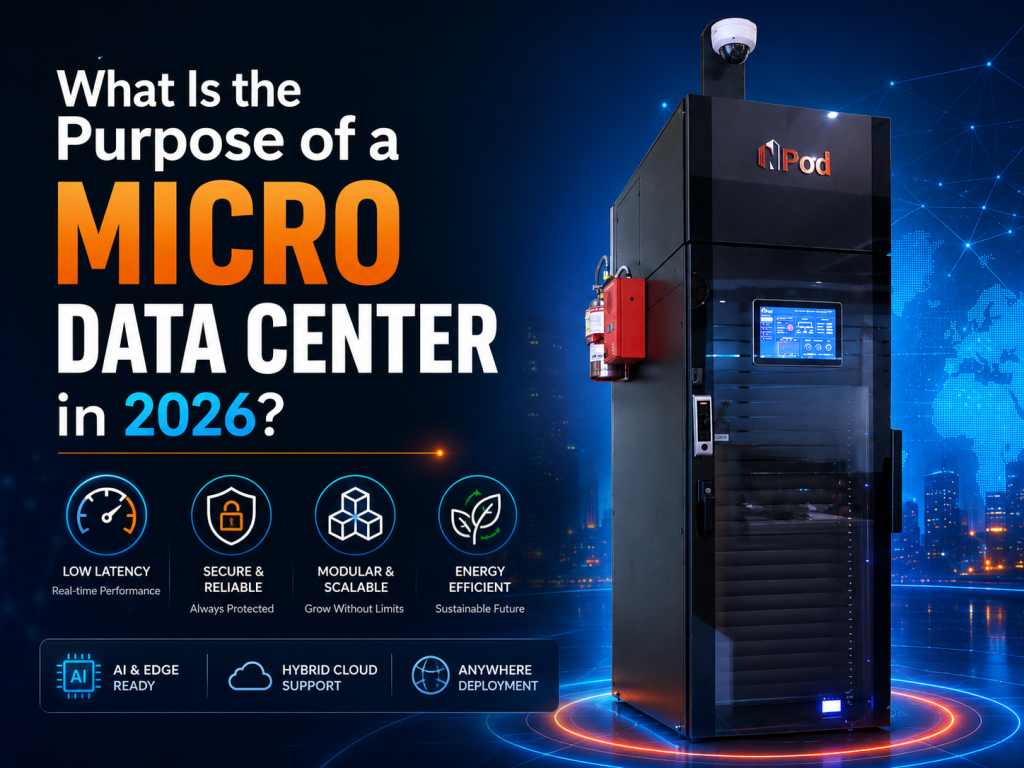
A micro data center is a self-contained infrastructure unit that combines servers, power backup, cooling systems, networking, monitoring, and physical security into a single enclosure. These systems are designed for environments where traditional infrastructure may be too expensive, difficult to manage, or inefficient for modern workloads.
The primary objective is to provide reliable computing capabilities closer to users, devices, and applications. By processing workloads locally, businesses can improve application responsiveness while reducing dependency on distant centralized facilities.
Unlike conventional setups that require extensive construction and deployment planning, a modular data center can be installed quickly and scaled based on operational needs. This flexibility makes it suitable for organizations that require agile and distributed infrastructure strategies.
Why Businesses Are Moving Beyond Traditional Data Centers
Conventional infrastructure models were built for centralized operations. However, digital transformation has created a highly distributed environment where businesses operate across multiple locations and require real-time data processing.
Organizations today commonly face challenges such as the following:
- Delayed application response times
- Increasing energy consumption
- Infrastructure expansion limitations
- Complex maintenance requirements
- Downtime risks
- High operational costs
These challenges become even more significant when businesses adopt AI applications, IoT platforms, and edge-based services.
A micro data center addresses these concerns by bringing computing power closer to the source of data generation. This localized approach improves performance while simplifying infrastructure deployment and management.
Supporting Edge Computing and Real-Time Processing
One of the biggest reasons behind the growth of modular infrastructure is the rise of edge computing. Modern applications often require immediate processing and low-latency communication to function effectively.
Industries now rely heavily on:
- AI-powered analytics
- Smart surveillance systems
- Industrial automation
- Predictive maintenance
- Connected healthcare devices
- Real-time retail analytics
Sending all data to distant cloud environments can create delays that affect operational efficiency and user experience.
A modular data center enables businesses to process information locally, improving speed and reliability. This capability is especially important for AI inferencing workloads and time-sensitive applications where even small delays can impact performance.
As edge computing adoption continues to grow, localized infrastructure is becoming an essential part of modern enterprise operations.
AI Workloads and High-Performance GPU Infrastructure
The rapid growth of artificial intelligence applications is also increasing the demand for high-performance GPU computing environments. Modern AI workloads such as machine learning, large language models, video analytics, and deep learning require powerful infrastructure capable of handling intensive computational tasks efficiently.
Many organizations searching for enterprise AI infrastructure also explore topics related to NVIDIA GPU deployments, including the latest trends around NVIDIA A100 GPU pricing and availability. Businesses evaluating advanced AI environments often compare deployment costs, cooling requirements, scalability, and infrastructure readiness before investing in GPU-based computing platforms.
A modern micro data center provides an ideal environment for supporting GPU-powered workloads because it offers the following:
- Precision cooling for high-density computing
- Integrated power backup systems
- Intelligent environmental monitoring
- Enhanced physical security
- Scalable edge deployment capabilities
This makes a modular data center highly suitable for AI inferencing, edge AI applications, and GPU-intensive enterprise environments.
Organizations planning AI deployments frequently research topics such as NVIDIA A100 price, GPU cloud infrastructure, and scalable AI-ready environments to optimize performance and operational efficiency. Businesses looking for enterprise GPU infrastructure insights can also explore resources related to AI-ready deployment strategies and GPU computing environments through platforms like Inhosted AI.
By combining scalable AI infrastructure with localized computing capabilities, a micro data center helps organizations support modern GPU workloads while maintaining operational flexibility, lower latency, and improved infrastructure efficiency.
Faster Deployment and Scalable Growth
Building a traditional facility often requires significant investment, long deployment timelines, and complex infrastructure planning. Many organizations cannot afford delays when expanding operations or supporting new digital initiatives.
A major advantage of a micro data center is rapid deployment. These prefabricated systems are designed for quick installation and operational readiness, allowing businesses to expand infrastructure without extensive construction.
Scalability is another key benefit. A modular data center allows organizations to increase capacity gradually based on operational demand. Instead of overinvesting in oversized infrastructure, businesses can adopt a more flexible and cost-efficient approach.
This makes modular infrastructure highly valuable for remote offices, industrial facilities, retail locations, and fast-growing enterprises.
Improving Security and Operational Continuity
Security and uptime are critical for organizations managing sensitive applications and business data. Infrastructure failures, overheating, power disruptions, and cyber threats can result in major operational losses.
Modern compact infrastructure solutions are built with integrated protection systems that improve reliability and operational continuity. These features may include:
- Intelligent environmental monitoring
- Precision cooling
- Power backup systems
- Fire suppression technology
- Remote infrastructure management
- Controlled physical access
A distributed infrastructure strategy also reduces dependency on a single location, improving disaster recovery capabilities and minimizing the impact of localized failures.
For businesses operating in mission-critical environments, maintaining continuous availability has become a top priority.
Energy Efficiency and Sustainability
Energy efficiency has become one of the most important infrastructure considerations in 2026. Traditional facilities often consume large amounts of electricity for cooling and operational management, increasing both costs and environmental impact.
Compact infrastructure solutions are designed with optimized airflow, intelligent cooling systems, and efficient power utilization to reduce unnecessary energy consumption.
A micro data center can help businesses improve sustainability goals while maintaining high-performance operations. Reduced cooling requirements and efficient space utilization contribute to lower operational expenses and improved environmental responsibility.
As sustainability regulations continue evolving globally, organizations are increasingly adopting energy-efficient infrastructure strategies.
Supporting Remote and Distributed Operations
Many industries require computing infrastructure in environments where traditional deployment models are impractical. Manufacturing plants, telecom sites, mining operations, transportation networks, and remote branch locations often need localized infrastructure with reliable performance.
A ruggedized modular data center can operate effectively in challenging conditions while maintaining operational stability and security.
Its compact design also reduces space requirements, making deployment easier in locations with limited infrastructure availability.
This flexibility allows organizations to support distributed operations without compromising reliability or scalability.
The Future of Digital Infrastructure
The future of enterprise IT is becoming increasingly decentralized. Businesses are adopting hybrid cloud environments, AI-driven systems, and edge-based architectures that require localized computing capabilities.
A micro data center supports this transformation by delivering flexible, scalable, and efficient infrastructure closer to end users and connected devices.
As organizations continue investing in digital innovation, modular infrastructure will play a larger role in improving operational agility, reducing latency, and supporting business growth.
In 2026, compact infrastructure is no longer viewed as an alternative deployment model. It is becoming a critical component of modern IT strategy.
Conclusion
The purpose of a micro data center is to provide efficient, scalable, and secure infrastructure for modern digital operations. Businesses today require faster processing, localized computing, improved operational continuity, and flexible deployment models that traditional environments often struggle to deliver.
A modular data center helps organizations support edge computing, AI applications, remote operations, and sustainability goals while reducing deployment complexity and operational costs.
As digital transformation continues accelerating across industries, compact and intelligent infrastructure solutions will remain essential for building future-ready enterprise environments.
Frequently Asked Questions
1. What is the main purpose of a micro data center?
The main purpose is to provide localized computing infrastructure that improves performance, reduces latency, and supports modern digital workloads.
2. Why are modular infrastructure solutions becoming popular?
Businesses are adopting modular infrastructure because it offers faster deployment, scalability, energy efficiency, and simplified management.
3. Can compact infrastructure support AI applications?
Yes, modern systems are designed to handle AI analytics, edge processing, IoT workloads, and real-time applications efficiently.
4. How does localized computing improve business operations?
Localized computing reduces latency, improves application response times, and minimizes dependency on distant centralized facilities.
5. Which industries benefit the most from distributed infrastructure?
Industries such as healthcare, manufacturing, telecom, retail, banking, and smart city development benefit significantly from distributed infrastructure deployments.