India’s digital economy is expanding rapidly. Businesses across sectors are adopting cloud platforms, AI applications, analytics tools, and connected technologies to improve operations and customer experience. As digital adoption increases, infrastructure requirements are also changing at a much faster pace.
Many organizations are now realizing that traditional infrastructure models are becoming difficult to scale efficiently. Rising operational costs, deployment delays, power limitations, and increasing AI workload demands are creating serious pressure on existing environments.
This is why conversations around data center challenges in India are becoming more relevant for enterprises planning long-term digital growth.
At the same time, businesses are increasingly exploring micro data center solutions as a more flexible and scalable alternative to conventional infrastructure.
Why Infrastructure Demands Are Changing
Modern businesses rely heavily on real-time applications and uninterrupted access to data. Industries such as banking, manufacturing, healthcare, retail, and telecom require infrastructure that can support continuous operations without performance bottlenecks.
Today’s enterprise environments are expected to handle:
- AI-driven applications
- remote operations
- edge computing
- large-scale analytics
- high-density workloads
- growing storage requirements
However, many traditional environments were not designed for this level of scalability and performance.
As workloads continue to increase, businesses are facing multiple operational and infrastructure-related challenges.
Rising Infrastructure Costs
One of the biggest concerns for enterprises is the increasing cost of maintaining traditional facilities.
Building and operating a conventional setup involves major investment in:
- cooling systems
- power backup
- physical security
- networking equipment
- maintenance
- real estate
As infrastructure expands, operational expenses rise significantly. For growing businesses, this can directly affect scalability and long-term planning.
Organizations now want infrastructure that delivers efficiency without requiring massive upfront investment. This is one reason why modern deployment models are gaining attention across the industry.
Power and Cooling Challenges
Power availability and thermal management continue to be critical infrastructure concerns.
High-performance computing and AI workloads generate substantial heat, making efficient cooling systems essential for stable operations. Poor thermal management can lead to:
- equipment failures
- downtime
- reduced hardware lifespan
- higher energy consumption
In several regions, inconsistent power supply further increases operational risks.
These operational limitations remain among the most important data center challenges in India, especially for businesses handling high-density workloads.
Slow Deployment Timelines
Traditional infrastructure expansion often takes several months because of
- construction work
- electrical setup
- cooling implementation
- hardware integration
- compliance approvals
For fast-growing organizations, long deployment cycles can delay business expansion and affect operational agility.
Modern enterprises need infrastructure that can be deployed quickly and scaled efficiently without major delays.
AI Infrastructure Challenges
Artificial intelligence is significantly changing infrastructure requirements.
Businesses working with AI applications require:
- GPU-ready environments
- scalable compute capacity
- efficient cooling systems
- reliable power management
- low-latency processing
Many older environments struggle to support these demands effectively.
As AI adoption increases, organizations are facing growing AI infrastructure challenges related to scalability, performance, and operational efficiency.
Businesses now need infrastructure that can support AI-driven workloads without creating additional complexity.
Latency and Distributed Operations
Businesses no longer operate only from centralized locations. Many organizations now manage branch offices, remote facilities, edge environments, and distributed operations across multiple regions.
Applications that depend on real-time processing cannot afford high latency or delayed data access.
Industries such as:
- manufacturing
- healthcare
- BFSI
- telecom
- logistics
often require local processing capabilities to improve operational efficiency and application performance.
This increasing demand for low-latency environments is driving interest in on-premise data center solutions and edge-ready deployments.
Why Businesses Are Moving Toward Modern Infrastructure Models
Traditional infrastructure models were designed for centralized operations, but modern business environments require greater flexibility and scalability.
Organizations now prefer infrastructure that can:
- scale faster
- support distributed operations
- simplify deployment
- reduce operational overhead
- support AI and edge workloads efficiently
This shift is increasing demand for modular and prefabricated data center environments that are easier to deploy and manage.
How Micro Data Center Solutions Help
To address these growing infrastructure challenges, many enterprises are adopting compact and integrated deployment models.
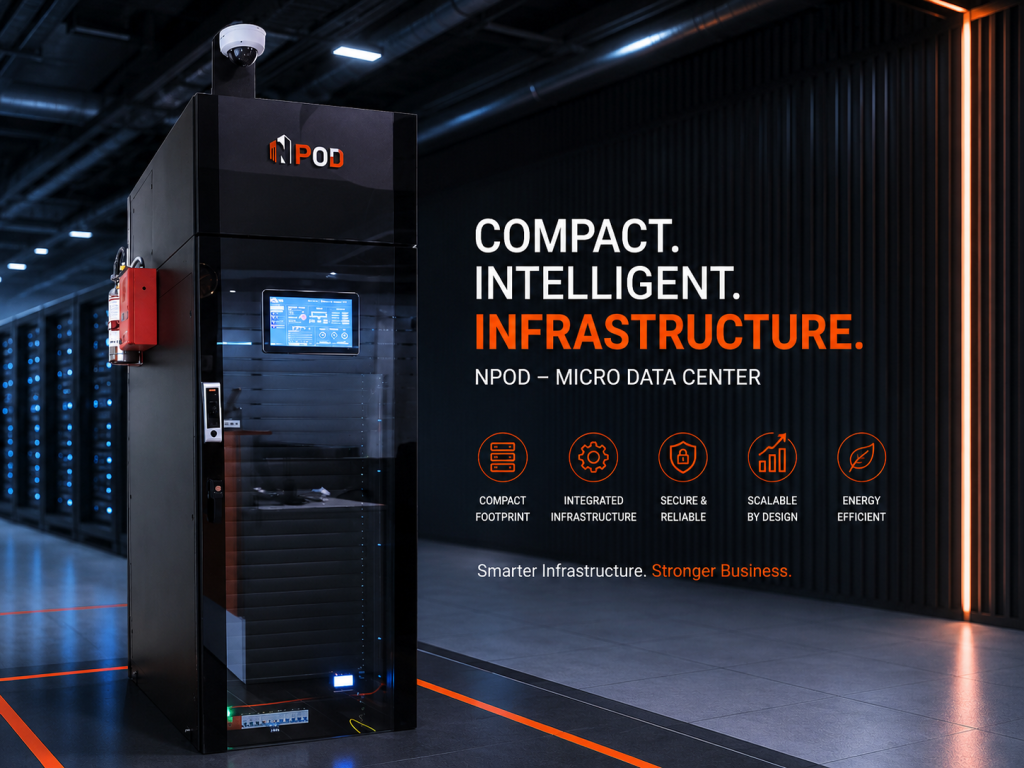
Modern micro data center solutions combine critical infrastructure components such as:
- cooling
- UPS systems
- fire protection
- monitoring
- physical security
within a single integrated environment.
Compared to traditional facilities, these solutions offer:
- faster deployment
- simplified management
- better energy efficiency
- easier scalability
- lower operational complexity
This makes them highly suitable for modern enterprise environments and edge deployments.
NPOD – A Smarter Approach to Enterprise Infrastructure
As businesses continue searching for practical ways to modernize infrastructure, NPOD provides a scalable and deployment-ready solution designed for modern enterprise needs.
NPOD is built to support organizations that require:
- compact infrastructure deployment
- integrated cooling and power systems
- scalable expansion
- secure on-premise environments
- edge-ready architecture
- AI-ready infrastructure
Its modular architecture allows businesses to deploy infrastructure more efficiently compared to conventional environments.
For enterprises managing remote operations, branch locations, manufacturing facilities, or AI workloads, NPOD helps simplify deployment while reducing operational complexity.
Instead of investing months in traditional infrastructure setup, businesses can deploy scalable environments faster and adapt more easily to changing operational demands.
The Future of Enterprise Infrastructure in India
Infrastructure requirements will continue evolving as businesses increase investments in digital transformation and AI technologies.
Organizations now need environments that are:
- scalable
- energy-efficient
- easier to manage
- deployment-ready
- capable of supporting modern workloads
Traditional infrastructure alone may not be enough to meet these growing expectations.
This is why businesses are steadily moving toward more flexible and scalable infrastructure strategies.
Conclusion
Businesses across India are facing increasing pressure to modernize infrastructure while managing costs and supporting growing digital operations.
Challenges related to scalability, cooling, deployment speed, AI readiness, and operational efficiency are becoming more common in traditional environments.
As enterprise workloads continue evolving, organizations need infrastructure that can adapt quickly without creating unnecessary operational complexity.
Solutions like NPOD help businesses address many of the critical infrastructure concerns by offering scalable and modern environments built for today’s operational requirements.
For enterprises planning long-term digital growth, investing in efficient and future-ready infrastructure is becoming a strategic necessity rather than just an IT upgrade.
FAQs
1. What are the major data center challenges businesses face in India?
Businesses commonly face challenges related to rising operational costs, cooling limitations, deployment delays, power management, and increasing AI workload requirements.
2. What are micro data center solutions?
Micro data center solutions are compact infrastructure environments that integrate cooling, power backup, monitoring, and security systems within a single unit.
3. Why are AI workloads creating infrastructure challenges?
AI applications require high-performance computing, scalable power systems, low-latency processing, and efficient cooling, which many traditional environments are not optimized to handle.
4. Why are businesses adopting prefabricated infrastructure models?
Prefabricated infrastructure helps reduce deployment time, simplify management, improve scalability, and lower operational complexity.
5. Why are on-premise data center solutions important for businesses?
On-premise environments help organizations improve control, reduce latency, support edge deployments, and manage critical workloads more efficiently.